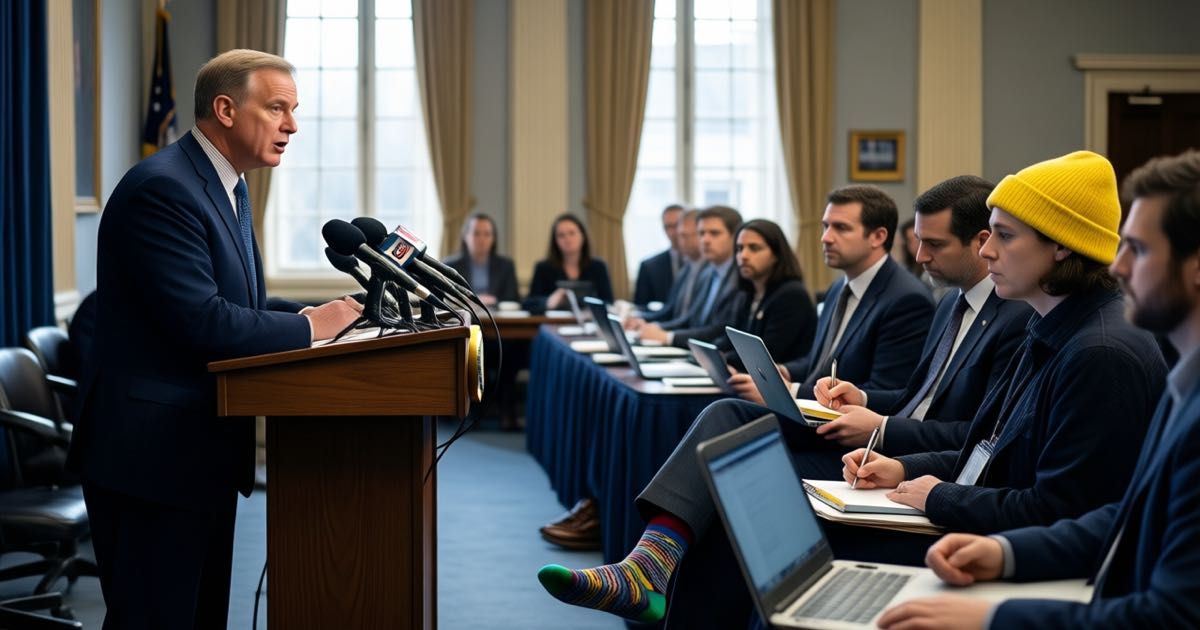
The Trump administration suspended Microsoft, Adobe and six major IT outsourcing firms from the PERM programme — the main pathway that lets US employers sponsor foreign workers for permanent residency — in what officials framed as a crackdown on visa fraud, announced at a White House news conference on Thursday 8 October (US time), 9 October NZ time.
“Our message to Microsoft is, you’re a great American company, but you’ve got to hire great American workers,” Vice President JD Vance said, accusing the company of laying off American staff while filing for foreign visas. Labor Secretary Keith Sonderling said the Department of Labor would not accept any new or pending permanent labour certification applications involving the named companies, citing active federal investigations.
🔍 THE BOTTOM LINE
For tech workers, this is a structural shift in who companies can hire, not a layoff event — and analysts read it in opposite directions. One reading says reduced visa sponsorship raises bargaining power and wages for domestic workers. The other says skilled immigration has historically coincident with job creation, not displacement, and cutting it while AI reshapes hiring could push roles offshore rather than to local candidates. Both agree on the mechanism: it changes employer behaviour at the hiring stage.
What the administration says
Vance cited figures attributing to Microsoft: the company “laid off 6,000 American workers last year” while benefiting from “6,300 H-1B visas and nearly 3,000 green cards.” His arithmetic: “For every worker that Microsoft laid off, they replaced that worker with one and a half foreign indentured servants.”
Labor Secretary Sonderling gave cumulative figures for the named outsourcing firms — Cognizant, Infosys, Tata, Wipro, HCL and Capgemini: since 2009, he said, “just these companies alone have requested almost 3 million foreign workers,” receiving over 230,000 H-1B approvals and over 100,000 permanent labour certifications.
Vance also said the administration would investigate nine universities, including Harvard, Yale and Stanford, over allegations of abuse of a related international-student programme — and flagged the OPT fee proposal the Department of Homeland Security published the day before.
What the companies say
Microsoft disputed the characterisation in a statement: “The vast majority of our workforce is American, and 80% of the H-1B applications we filed in the last year were for extensions or status changes for people who already worked for the company. Microsoft only files H-1B petitions for those who meet the rigorous standards of this visa category.”
On pay, Microsoft said: “We pay our H-1B employees the same as any other employees doing comparable work.” That directly contests Vance’s claim that H-1B workers earn on average $20,000 less than US workers in the same positions — a figure his office sourced from programme-wide averages, not Microsoft-specific filings.
Adobe and the six outsourcing firms had not responded to requests for comment at the time of reporting, according to TechCrunch and Fox Business.
Context matters here: Microsoft was the fifth-largest H-1B petitioner with roughly 3,700 applications in 2026, per the Guardian — but Amazon topped the list with more than 9,300, and was not among those named. The suspension also covers only the PERM green-card process; it does not (yet) touch new H-1B filings or extensions.
Two readings for tech careers
Reading one — tighter supply raises domestic leverage. If large employers can no longer sponsor green cards, the pool of workers who can be retained on the promise of permanent residency shrinks. Employers who compete for the same talent must bid with pay and conditions instead. Workers in visa-reliant occupations — software engineering, data, IT services — could see stronger bargaining positions. This is the implicit logic of the administration’s policy.
Reading two — work moves, not workers. The counter-argument, which echoes what New Zealand data on AI job ads shows about local hiring markets, is that skill shortages don’t disappear when visas tighten. For occupations with genuinely scarce expertise, employers shift to offshore contracting, remote international hires, or relocation of whole functions — leaving local workers competing with overseas capacity rather than visa holders at the next desk. Economists have long cited mixed evidence on which effect dominates, and it can differ by occupation and year.
Both readings agree on one thing: hiring decisions for skilled roles now carry a new compliance dimension, and that changes how both employers and candidates plan careers across borders.
What it means for NZ workers
New Zealand isn’t a party to US visa policy, but the flow-on is familiar to anyone who has watched NZ’s tech job market respond to migration settings. Three practical channels:
- Accredited employer visas and salary thresholds: when the US tightens skilled-worker routes, NZ’s Accredited Employer Work Visa competition from the same talent pool intensifies — overseas candidates who once targeted US firms look at Australia and NZ. Whether that raises or lowers NZ salary competition depends on whether those candidates compete for the same roles or fill gaps.
- Global capability centres: IT services firms named in the crackdown run delivery centres worldwide. If US sponsorship tightens for firms like Infosys, Wipro or Cognizant, expansion of offshore delivery — including in NZ — is one of the adjustments analysts expect to watch.
- NZ skilled-migrant policy settings: the same “prioritise local workers” framing appears in NZ’s own immigration reviews. What happens to US interpretation of those rules is being watched here as a signal of direction.
FAQ
What is the PERM programme? Program Electronic Review Management (PERM) is the US Department of Labor process through which employers certify that no willing US workers are available for a role, allowing them to sponsor a foreign worker for an employment-based green card.
Which companies were suspended? Microsoft and Adobe, plus IT outsourcing firms including Cognizant, Infosys, Tata, Wipro, HCL and Capgemini, according to Labor Secretary Keith Sonderling.
Does this affect H-1B visas themselves? No — the suspension applies to the PERM permanent-residency pathway. New and pending labour certification applications involving the named companies won’t be processed, but existing H-1B employment continues.
Does New Zealand have a PERM equivalent? NZ’s employer-assisted work and residence pathways — like the Accredited Employer Work Visa — serve a similar function of tying sponsorship to employer demand, without the same permanent labour certification step.
— CJ Murden, editor of Singularity.Kiwi. Former digital technologies teacher, author of AI-focused books. Writing with a New Zealand focus.