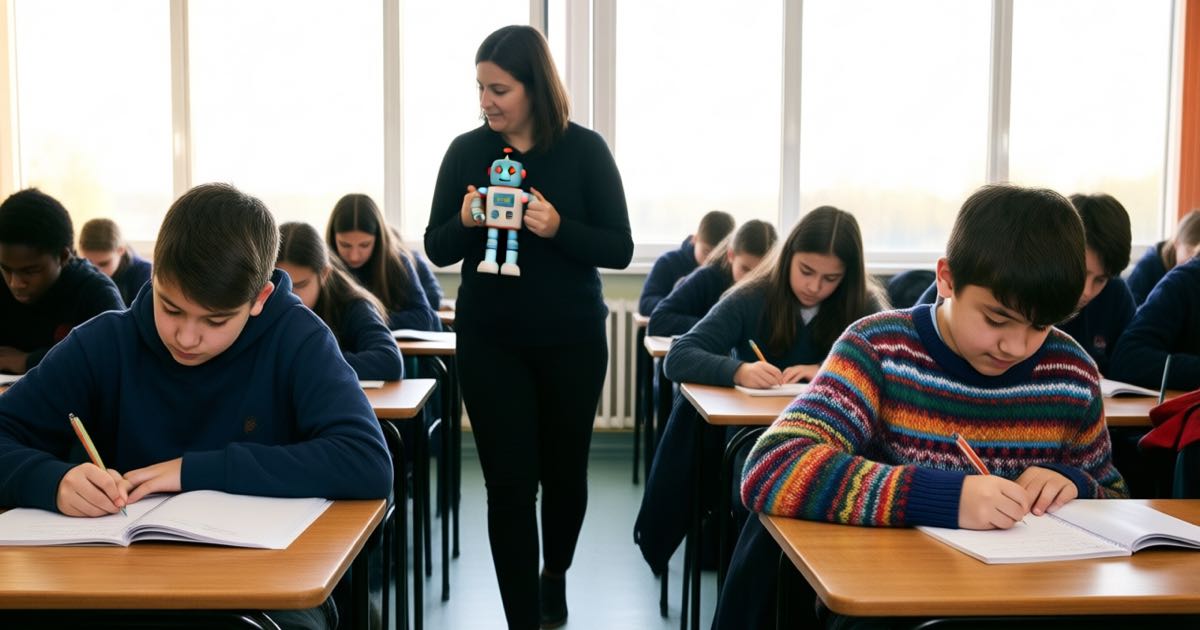
The US’s second-largest teachers union and Microsoft have done what no American regulator has: written legally enforceable AI rules for schools. The American Federation of Teachers, its 200,000-member New York City affiliate the United Federation of Teachers, and Microsoft Vice Chair Brad Smith announced a “National AI Safety & Privacy Standard” in New York on 9 September, a first-of-its-kind agreement that turns ten principles into contract terms any US school district can adopt.
🔍 THE BOTTOM LINE
A tech vendor and a teachers union wrote the AI rules for schools because no legislature would — and the vendor volunteered first.
What the Standard Actually Requires
The full agreement commits Microsoft to ten principles, and the ones that will bind day-to-day are specific. Student and educator data will not be used to train AI models, sold or repurposed. Data collection is limited in the first place, and schools control how data is retained and deleted. Families get plain-language disclosure of how the tools work.
Two commitments stand out as genuinely novel in a vendor agreement. Microsoft pledges to prohibit AI companions in the school context — the relationship-simulating chatbots that have drawn scrutiny over teen mental health — and to require human review for “high-risk” decisions, meaning no AI system makes consequential calls about a student without a person in the loop.
The enforcement mechanism is the real innovation. US school districts can incorporate these protections directly into their Microsoft customer agreements, making them contractually enforceable — and per The Verge’s report, beginning in November districts can add the terms to new or existing agreements without renegotiating entire contracts. The UFT’s Michael Mulgrew said the deal “empowers school districts to end agreements and seek damages from bad actors who break the rules.”
The Timing Tells the Story
The agreement was announced one week after New York City and Los Angeles — America’s two largest school districts — imposed AI moratoriums, moves we covered last week. NYC banned student-facing AI in K-8; LAUSD paused generative AI for its roughly 378,000 students for a year. Microsoft does not appear to have been the primary target of either ban, but the direction of travel was unmistakable: the most tech-saturated districts in the country were pulling AI out of classrooms, and similar decisions elsewhere were a plausible next step.
Microsoft likely recognised, as The Verge put it, “that similar decisions could be coming.” A voluntary, enforceable standard is cheaper than losing district contracts wholesale — and it converts a defensive position into a PR asset. AFT President Randi Weingarten was blunt about the vacuum the agreement fills: “no one else, including the federal government, has stepped up to do the real work… anything less than legally enforceable provisions is simply a wish list.”
Weingarten’s May “Devices Down, Eyes Up, Hands-On” speech had already called for a total screen ban in K-2, a ban on student-facing AI in elementary school, and a ban on social companion chatbots for students under 16 — a framework since adopted by LAUSD and, last week, by NYC Public Schools and Mayor Zohran Mamdani. The Microsoft deal locks the union’s policy agenda into a vendor’s contract terms.
The Contradiction Worth Naming
Microsoft is simultaneously selling AI into schools and signing restrictions on AI in schools. That is less paradoxical than it looks: the standard constrains how AI may be used with students — no training on their data, no companions, human oversight — while Microsoft’s broader education business, including the National Academy for AI Instruction it co-founded with the AFT, OpenAI and Anthropic, continues training teachers to use AI tools. Smith’s framing was expansionist, not defensive: “we’ll extend this agreement to every school district across the country.”
Critics will note the obvious limits. The standard binds Microsoft, not the industry — a district’s next vendor signs nothing. And self-imposed rules are only as strong as the willingness to be sued under them, though the contractual route at least gives districts standing to enforce, unlike every voluntary AI pledge that preceded it.
The NZ Angle
New Zealand’s schools face the same vendor pressure with none of this scaffolding. The Ministry of Education’s AI guidance remains advisory, and no NZ district-equivalent body has negotiated data-training bans or companion-chatbot prohibitions with any vendor. The American sequence is instructive: parental backlash produced moratoriums, moratoriums produced negotiating leverage, leverage produced enforceable contract terms. NZ schools currently have none of the three — which means the default here remains trust-me terms of service, with the difference settled one school at a time.
❓ FAQ
What did Microsoft agree to for schools? Ten contractually enforceable principles announced 9 September 2026 with the AFT and UFT, including: no training AI models on student or educator data, limits on data collection, plain-language disclosure to families, a prohibition on AI companions, and human review for high-risk decisions, per Microsoft’s announcement.
How is it enforced? US school districts can incorporate the terms directly into their Microsoft customer agreements, making them contractually enforceable — including ending agreements and seeking damages. From November, districts can add the terms to existing contracts without renegotiating, per The Verge.
Does this apply to other AI companies? No — the agreement binds Microsoft only. OpenAI and Anthropic are partners in the separate National Academy for AI Instruction but are not parties to this standard.
Is this connected to the school AI bans? It follows them. NYC and LA imposed student-facing AI restrictions in early September 2026, and the agreement was signed one week later, with both sides framing it as filling a gap left by absent federal and state rules.
Does any of this apply in New Zealand? Not directly. NZ’s Ministry guidance is advisory and no equivalent vendor agreement exists here. The American model — moratorium pressure converted into contractual terms — is the pattern NZ parent groups and school boards would need to replicate.
🔍 THE BOTTOM LINE
The most concrete AI rules governing American schools now come from a contract, not a statute — negotiated by the vendor that sells the software and the union that represents the teachers. If it holds, the precedent is that AI in public institutions gets governed the way everything else does: by whoever shows up to the negotiation.
📰 Sources:
- Microsoft — AFT, UFT and Microsoft announce National AI Safety & Privacy Standard for schools
- AFT — Full agreement PDF
- The Verge — Microsoft has new AI privacy rules for schools
- The Verge — LA is the next major school district to ban AI for students
— CJ Murden, editor of Singularity.Kiwi. Former digital technologies teacher, author of AI-focused books. Writing with a New Zealand focus.