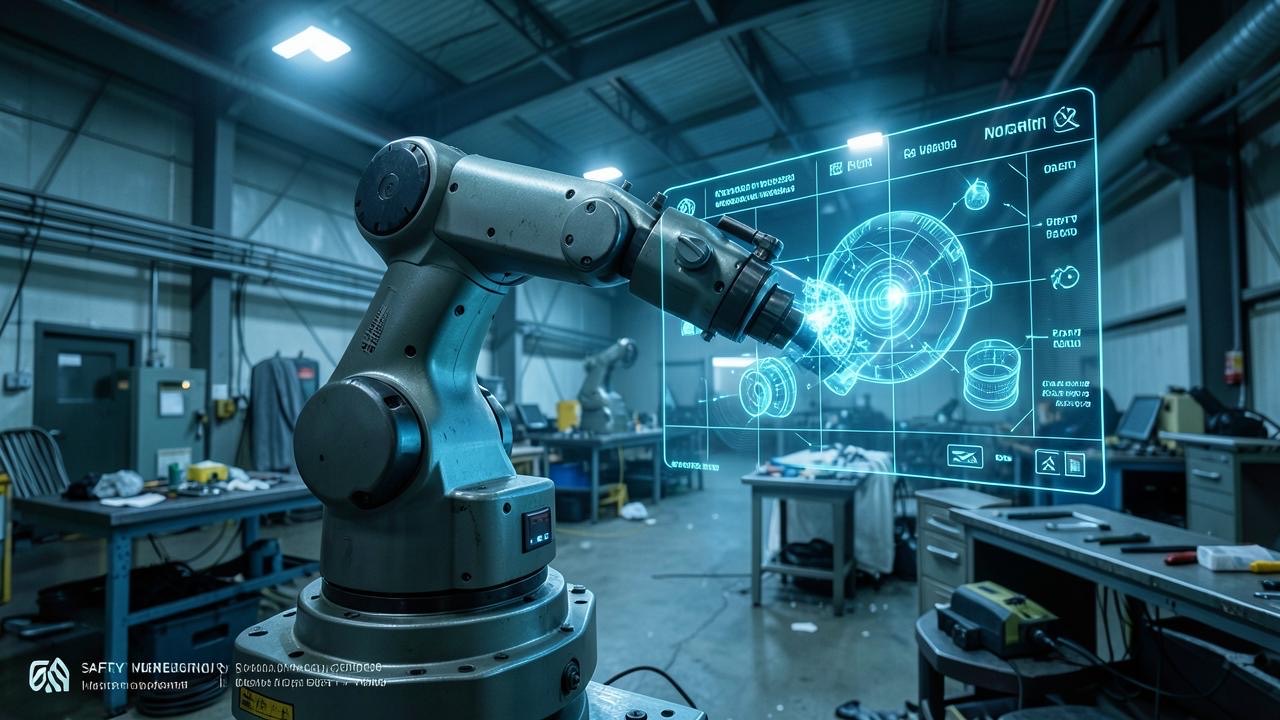
Mistral AI stepped into robotics today with Robostral Navigate, an 8-billion-parameter model that guides robots through complex environments using nothing but a single RGB camera and a plain-language instruction. No LiDAR, no depth sensors, no multi-camera arrays. It hit 76.6% success on R2R-CE (Room-to-Room in Continuous Environments) validation unseen — beating the best single-camera approach by 9.7 points and the best multi-sensor system by 4.5 points.
🔍 THE BOTTOM LINE
Robostral Navigate proves you do not need expensive sensor stacks for autonomous navigation. An 8B model trained entirely in simulation, running on a single camera, outperforms systems using depth sensors and multi-camera rigs. This drops the hardware cost of capable robots dramatically.
How It Works
Give the model a command like “Leave the lobby, walk through the corridor, enter the supply room, and stop to face the second shelf.” It takes the RGB image from the robot’s camera, predicts where the robot should move next via pointing — inferring image coordinates of the target location in the current view — and adjusts orientation on arrival.
When the target is outside the current field of view, the model falls back to displacement commands: “Move 2 meters forward, 1.5 meters to the left, and turn 25 degrees left.” This hybrid approach makes the policy robust to camera intrinsics and world scale changes, according to Mistral’s announcement.
Trained Entirely in Simulation
The model was built from scratch — no existing open-source VLMs — and trained on approximately 400,000 trajectories across 6,000 simulated scenes. The key innovation is a prefix-caching technique using tree-based attention masking that compresses an entire episode into a single sequence, enabling training on all time steps in one forward pass. This reduces training tokens by 22x, turning months-long training runs into days.
After supervised training, online reinforcement learning using Mistral’s CISPO algorithm boosted the success rate by 3.2% through trial-and-error learning, failure recovery, and exploratory behavior. Mistral says the model is not plateauing — more training is expected to push performance higher.
What Makes This Different
Most robot navigation systems rely on depth sensors (LiDAR, structured light, time-of-flight) or multiple cameras to build a 3D map of the environment. This is expensive, power-hungry, and limits where robots can operate. Robostral Navigate works with one $50 RGB camera.
The model also generalizes across robot types — wheeled, legged, and flying — and across robot sizes. It ran autonomously through a working office in Mistral’s demo video, navigating around people and obstacles it never saw in training.
This is a different bet from what we have seen from European AI startups — Mistral is now competing in embodied AI, not just language models. It connects to the broader agentic AI trend where models are moving from generating text to taking actions in the physical world.
Applications and What Comes Next
Mistral lists manufacturing, delivery, logistics, and hospitality as target applications. The model is available for commercial deployment now — companies can contact Mistral’s team directly.
The company frames navigation as “a foundational capability for general-purpose robotics.” The implication: once a robot can move itself, you can layer manipulation, interaction, and task completion on top. Robostral Navigate is step one toward a unified embodied agent.
Mistral is actively hiring research scientists and engineers for its robotics team.
The Hardware Cost Argument
A single RGB camera versus a LiDAR-plus-depth-sensor stack is the difference between a $50 component and a $5,000+ sensor package. For warehouse robots, delivery drones, or service robots in commercial buildings, this changes the unit economics of deployment. A robot that navigates with one camera can be built for a fraction of the cost of one that needs multi-sensor perception.
The tradeoff is robustness in conditions where vision degrades — darkness, fog, featureless environments. Depth sensors do not care about lighting. Mistral’s sim-to-real transfer handles people and obstacles unseen in training, but the model’s performance in adversarial visual conditions is an open question.
❓ FAQ
What does R2R-CE unseen mean? R2R-CE (Room-to-Room in Continuous Environments) is the standard benchmark for instruction-following robot navigation. “Unseen” means the model is tested in environments it was never trained on — the true test of generalization, not memorization.
Can it work outdoors? Mistral claims it works in outdoor settings, but the training data is entirely simulated indoor scenes. Real-world outdoor performance — with variable lighting, weather, and terrain — remains unproven beyond the demo.
How does it compare to Boston Dynamics or Tesla’s navigation? Different approach. Boston Dynamics uses extensive sensor fusion and classical control. Tesla relies on massive real-world fleet data. Robostral Navigate uses simulation-only training with a compact 8B model. The tradeoff: cheaper and faster to iterate, but sim-to-real gaps are an ongoing risk.
Is this available for NZ companies? Mistral is offering commercial access via their contact page. No regional restrictions are mentioned in the announcement, unlike some model releases that exclude the EU initially.
🔍 THE BOTTOM LINE
Mistral just made autonomous robot navigation dramatically cheaper. One camera, one 8B model, no sensor stack — and it beats the expensive systems. If sim-to-real transfer holds up outside demos, this changes the unit economics of commercial robotics. The age of the $50-navigating-camera robot may actually arrive.