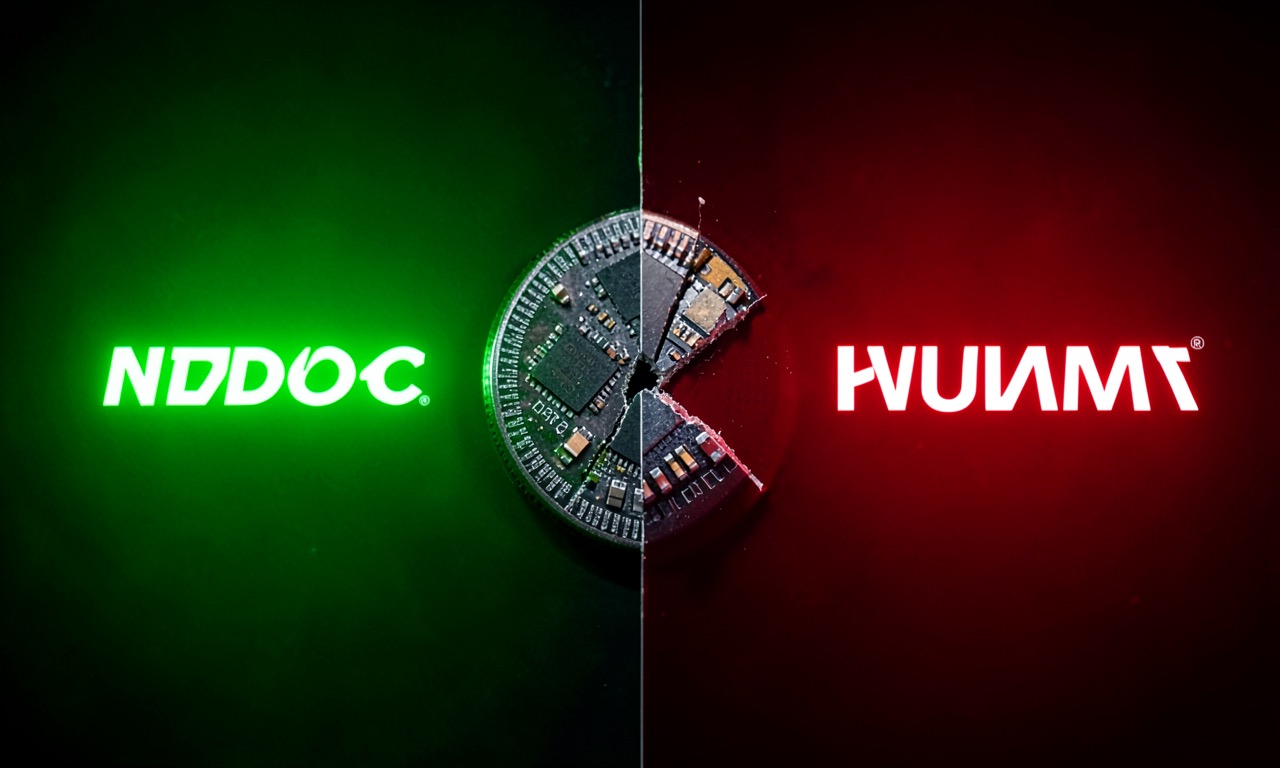
Zero Percent. That’s Nvidia’s Share of China’s Advanced AI Chip Market.
Nvidia CEO Jensen Huang delivered a line that’ll be quoted in geopolitical textbooks for years: “We’ve really largely conceded that market to them.”
Speaking to CNBC’s Sara Eisen after Nvidia’s blockbuster Q1 2027 earnings — revenue up 85% to $81.62 billion — Huang was blunt about China. Huawei, he said, is “very, very strong.” They had a record year. They’ll “very likely have an extraordinary year coming up.” And their local ecosystem of chip companies is “doing quite well, because we’ve evacuated that market.”
“Evacuated.” Not “lost.” Not “withdrew from.” Evacuated — like fleeing a disaster zone.
The Numbers Behind the Concession
Nvidia’s China position has collapsed under the weight of US export controls:
- China once accounted for at least one-fifth of Nvidia’s data center revenue
- In April, the Trump administration told Nvidia it would need a license to export chips to China and a handful of other countries
- Nvidia’s advanced AI chip market share in China: zero percent — Huang’s own words
- Huawei now holds approximately 41% of China’s AI accelerator market, with that figure rising
Some Chinese companies — Alibaba, Tencent, ByteDance, JD.com — have received Commerce Department approval to purchase H200 chips. But a US trade representative said chip export controls were “not part of discussions” during last week’s Trump-Xi summit, suggesting significant easing remains distant.
Huang told investors to “expect nothing” regarding approvals to sell advanced chips into China.
The Paradox: Record Revenue, Zero China
Here’s what makes this story so strange: Nvidia is printing money despite losing China. Revenue surged 85%. The company announced an $80 billion share buyback program and raised its dividend. Huang described the AI industry as a “five-layer cake” — energy, chips, infrastructure, models, applications — and said Nvidia is investing across all of it.
“The idea of a many times larger company is not out of the question,” Huang said.
So why does China matter if Nvidia is thriving without it? Two reasons:
- The vacuum creates a competitor. Every chip Huawei sells is revenue funding R&D for the next generation. China’s domestic ecosystem isn’t just replacing Nvidia — it’s getting better at it.
- The precedent is irreversible. Huawei’s Ascend chips are improving. Once Chinese customers build around Huawei’s ecosystem, they won’t switch back to Nvidia even if restrictions lift. The market is permanently lost.
Huawei’s Rise: From Telecom Vendor to AI Chipmaker
Huawei’s pivot from telecom equipment to AI semiconductors has been remarkably successful under pressure. The Ascend line of AI accelerators, once considered inferior to Nvidia’s offerings, has matured rapidly. Chinese cloud providers are building around Huawei’s ecosystem because they have no other choice — and finding it works well enough.
This is the core failure of the export control strategy: it was designed to keep China’s AI capabilities behind. Instead, it incentivised China to build its own parallel stack — and that stack is now good enough to compete.
Huang himself acknowledged this dynamic: US export policy has “largely backfired.” You don’t often hear a CEO say his own government’s policy has backfired on live television.
What This Means
For the AI industry, this is a bifurcation moment. The world is splitting into two AI infrastructure stacks:
- The Western stack: Nvidia, AMD, Intel, running CUDA and its descendants
- The Chinese stack: Huawei Ascend, Cambricon, running homegrown frameworks
Each stack feeds the other’s improvement. Western restrictions push Chinese innovation. Chinese competition pushes Western pricing. Neither side wins cleanly.
For New Zealand — which runs primarily on Western cloud infrastructure — the practical impact is limited in the short term. But the long-term question is real: if you’re a small country buying AI compute, do you bet on a single stack? The NZ Reserve Bank has already warned about concentrated AI provider risk.
❓ Frequently Asked Questions
Q: Can Nvidia still sell any chips to China? Yes, but only lower-performance chips that don’t violate export controls. The H200 — Nvidia’s current flagship AI chip — requires a license, and most applications are being denied or indefinitely delayed.
Q: Is Huawei’s Ascend chip as good as Nvidia’s? Not yet, but the gap is closing fast. Huawei has had record revenue years and is pouring resources into next-generation designs. The constraint isn’t capability — it’s ecosystem maturity.
Q: What does “zero percent” actually mean? It refers to Nvidia’s market share for advanced AI chips in China. Nvidia can still sell older, restricted chips. But for the cutting-edge compute that drives frontier AI training, Huawei and domestic Chinese chipmakers now dominate.
Q: Does this affect NZ? Directly, no — NZ runs on Western cloud infrastructure. Indirectly, yes — a bifurcated chip market means higher costs globally as R&D is duplicated, and it raises questions about supply chain resilience for AI compute.
🔍 THE BOTTOM LINE
Jensen Huang just confirmed what the chip industry suspected: US export controls haven’t contained China’s AI capability — they’ve handed Huawei the world’s second-largest AI market on a plate. The question isn’t whether Huawei will catch up. It’s whether Nvidia will ever get China back.
SOURCES
- CNBC — Nvidia says it has ‘largely conceded’ China’s AI chip market to Huawei
- Times of India — Nvidia share in China has fallen to zero
- PC Gamer — Jensen Huang bemoans Nvidia’s market share
- Nikkei Asia — Nvidia’s Jensen Huang says China should not have its most advanced chips
- Reuters — US clears H200 chip sales to some Chinese firms