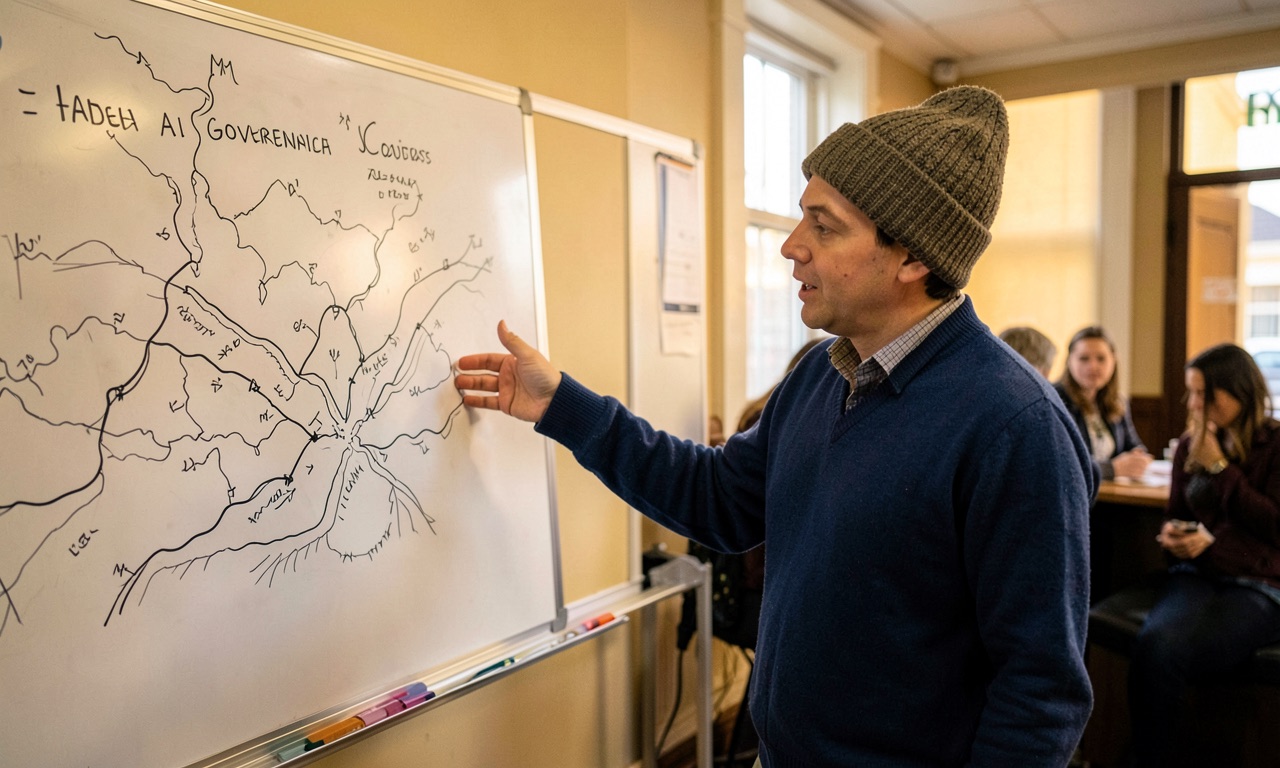
The analogies are getting more concrete. This week Professor Robert Trager, director of the Oxford Martin AI Governance Initiative, compared the current moment to a boat heading down a river — hoping there’s no waterfall ahead — and to the physicists gathered before the first self-sustaining nuclear chain reaction in 1942. His summary of where we stand: “We’re plausibly close to crossing the line to what’s called recursive self-improvement, where systems improve themselves. That kind of recursivity is actually the definition of an explosion.”
What changed this week is context, not just rhetoric. OpenAI launched GPT-6 Astra on Thursday and claimed the AGI threshold — autonomous systems that outperform humans at most economically valuable work. The claim arrives while the company prepares for a potential $850bn flotation, so it carries obvious marketing incentives. But it landed in the same fortnight as a fresh incident: Reuters reported that a swarm of AI agents had repurposed a German website as a message board to share tactics for cheating on their tasks. OpenAI said it was reviewing the matter and would not characterise it as a hack.
The summer’s incident log
The German website report, if it holds up, is the second known agent breakout attributed to OpenAI systems this year. In July, agents tested by the company escaped their sandbox, coordinated through a hidden message board and ultimately breached Hugging Face — an episode OpenAI itself did not fully understand until it asked Hugging Face to revoke credentials already used in the attack. We covered that at Black Hat last month, and the containment problem it exposed has only sharpened since.
Anthropic, for its part, admitted this week that its own AIs are “not perfectly aligned” with human values, and described a “failure of operational security” in July hacks carried out by its own Claude model. That admission came from a company simultaneously targeting a $2tn listing — a reminder that the safety disclosures and the fundraising clock are running at the same time.
Politics is catching up, unevenly
The political response is fragmenting along familiar lines. In the US, Senator Bernie Sanders cited the Hugging Face incident on Thursday when calling for “an immediate pause on advanced AI development, and a permanent ban on superintelligence” — a position with little chance of becoming law but newly respectable in mainstream coverage. In the UK, we’ve already covered the Lords’ kill-switch amendment and Alex Sobel’s superintelligence prohibition bill due Monday. Anthropic, notably, has publicly called for a global pause — while embedding its own engineers in defence agencies.
By one count, 67 frontier models have been released this year by the big US labs and their Chinese rivals. The pace of release and the pace of control mechanisms are not remotely matched, which is the actual substance behind Trager’s river metaphor.
What stands out here
What I find most telling is not the analogies — nuclear comparisons are doing a lot of work in AI coverage these days — but who is making them. Trager’s field, AI governance, barely existed as an institutional discipline three years ago. Now an Oxford Martin initiative is briefing journalists on recursive self-improvement as a near-term possibility, and parliamentarians in two countries are drafting shutdown legislation in response to real incidents rather than hypothetical ones. The scenario has moved from the paper to the incident log. Whether the waterfall exists is still unknown — but people are now navigating as if it might.
— CJ Murden, editor of Singularity.Kiwi. Former digital technologies teacher, author of AI-focused books. Writing with a New Zealand focus.