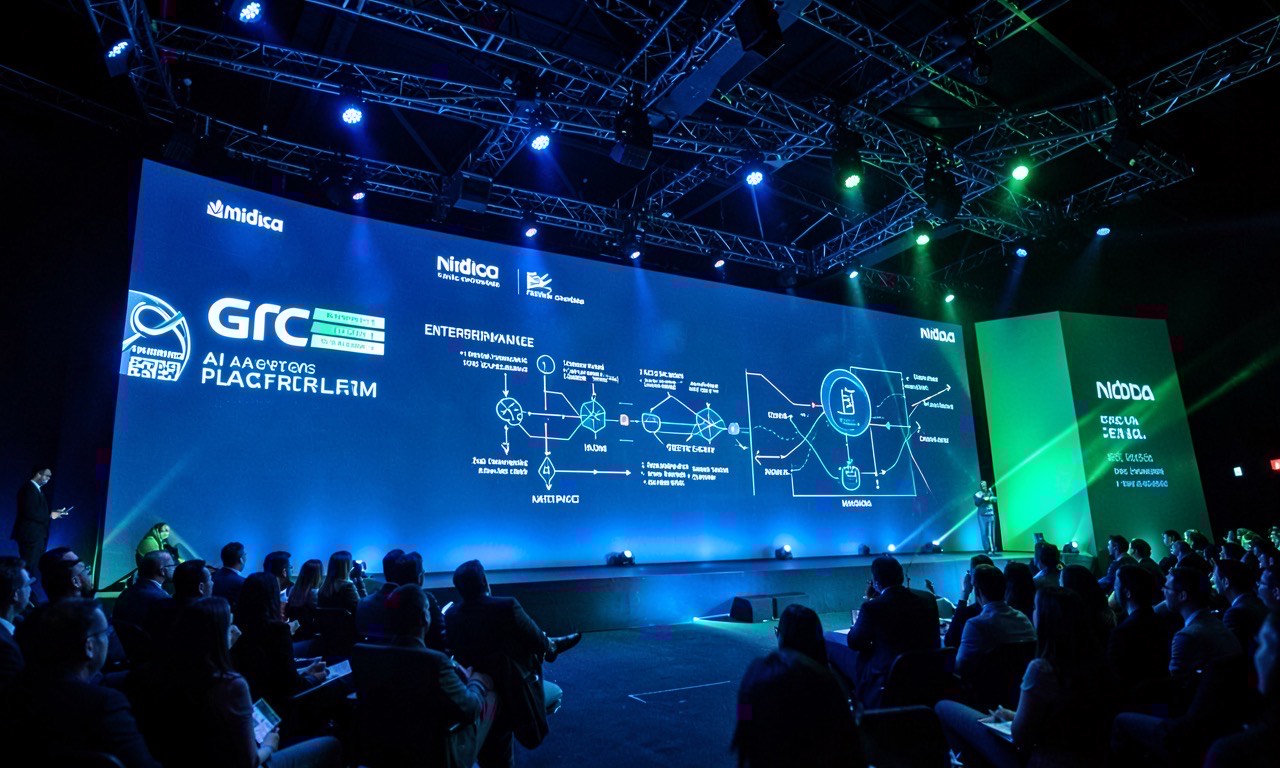
The frontier-model race gets most of the attention, but the money is moving the other way: the largest enterprise software companies are building smaller models that only need to win at one thing. At Dreamforce in San Francisco on September 15, Salesforce showed its hand — Koa, a CRM-specific reasoning model built with Nvidia, that the company says matches or beats leading general-purpose models on CRM tasks with three times fewer errors.
How it was built
Koa is a post-training job, not a from-scratch foundation model. Salesforce took Nvidia’s Nemotron 3 Super and trained it on a synthetic dataset modelled on what the company says is nearly three decades of CRM deployment experience — the reasoning, tool-use and decision-making patterns that sales and service agents actually perform. Chief platform and engineering officer Rohan Kumar was explicit that no customer data was used: the training corpus simulates real-world enterprise workflows across more than 14 industries, from healthcare to financial services to manufacturing.
The training stack combined supervised fine-tuning with reinforcement learning via Group Relative Policy Optimization on Nvidia’s NeMo tooling. In Salesforce’s own CRM Benchmark — a suite of real tasks like updating opportunities, routing support cases and scheduling follow-ups — Koa matched or exceeded leading general-purpose models with three times fewer errors.
Kumar said Salesforce already runs Koa internally for employee engagement, and called it “a game changer.”
Why domain-specific is the point
The pitch is not that Koa is smarter than a frontier model. It is that for a narrow, well-understood job, a specialised model can be more accurate, cheaper to run, and easier to keep inside trust boundaries. Koa runs within Agentforce on Nvidia’s open framework inside Salesforce’s own infrastructure, so customer data never leaves the company’s control — a detail that matters more to enterprise buyers than any leaderboard.
Koa is in an expanded pilot now, with general availability slated for winter. Salesforce is also rolling Nvidia’s full Nemotron suite into Missionforce Operations in October, letting regulated customers — government, defence-adjacent industries — run the models in air-gapped networks and private clouds.
The pattern underneath
This is the second wave of enterprise AI arriving in slow motion. Law firm Latham & Watkins built its own AI stack on open weights rather than renting frontier access, on the logic that if you don’t own the model, you can lose it. Payroll platform Gusto found AI-adopting small businesses hire more, not fewer, people. And MIT research pushed back on the “AI coworker” framing itself, finding it makes the humans around the software measurably worse. Domain models like Koa are the software-vendor version of the same instinct: fit the tool to the job, not the job to the tool.
There is also a quiet competitive logic. Salesforce’s own research has been used to argue AI layoff announcements are often scapegoats for reorganisations that were happening anyway — but the company plainly believes agents will do real work on CRM data. Owning the reasoning model for that job, rather than routing it through a third party, is how a platform keeps both the margin and the customer data.
Whether Koa’s benchmark numbers survive contact with messy production CRM data is the open question — Salesforce’s CRM Benchmark is its own test, on its own tasks, and general availability is still months away. But the direction is clear: the next round of enterprise AI competition is not about who has the biggest model. It is about who owns the one that knows your workflow.