At its Innovation Day 2026 event in Shanghai on October 29, AGIBOT introduced Worken, a proposed framework for measuring how much productive work robots actually deliver once deployed. The name glues “Work” to “Token”, and the company is careful, in the official release, to call it a proposal rather than a standard. But the direction of travel is unmistakable: an industry that has spent two years bragging about serial numbers is now inventing the accounting for output.
The formula itself is disarmingly simple:
Worken = Number of Active Robots × Autonomous Working Hours × Output Efficiency Ratio
According to The Robot Report, the first factor counts robots actively performing tasks in real environments — not units manufactured or sitting in inventory. The second counts hours spent working autonomously, not total powered-on time. The third scores output against a benchmark for a defined task, such as the amount of acceptable work a human worker completes under established operating standards. AGIBOT calls the resulting unit “effective intelligent work hours.”
Peng Zhihui, AGIBOT’s co-founder, president and CTO, framed it as a practical question. “But as robots begin working in factories, warehouses, and service environments, we need to answer a more practical question: How much productive work are they actually delivering?” he said in the release. “We want to move beyond measuring how many robots are built or delivered and begin measuring how effectively they can perform useful work, autonomously and consistently, in the real world.”
Why Bother With a Metric at All
The honest answer is that shipment counts have run their course as a competition metric. AGIBOT led IDC’s count of global humanoid shipments in the first half of 2026 — we covered that milestone earlier this month — and rolled its 20,000th robot off the line in September. Unit counts no longer separate anyone. When two deployments each have “similar numbers of robots”, as the release itself concedes, they can deliver very different levels of productivity depending on how independently the machines operate and how often humans step in.
That is a real observation, and it cuts the way metrics usually do. As we noted in our piece on AGIBOT’s retail deployments, a fleet spread across 100 cookware stores is only worth what it actually sells, guides or inspects — the livestream was the proof, not the headcount. Worken is an attempt to make that gap legible.
The economics angle is where the metric gets interesting. AGIBOT’s own framing, echoed in Unite.AI’s coverage: hardware depreciates over time, but software and model updates may let the same machine deliver more useful work across its operating life — so buyers could weigh output against total lifecycle cost instead of sticker price. That is the software-business logic of the data centre applied to the factory floor.
The Catch: Who Grades the Homework
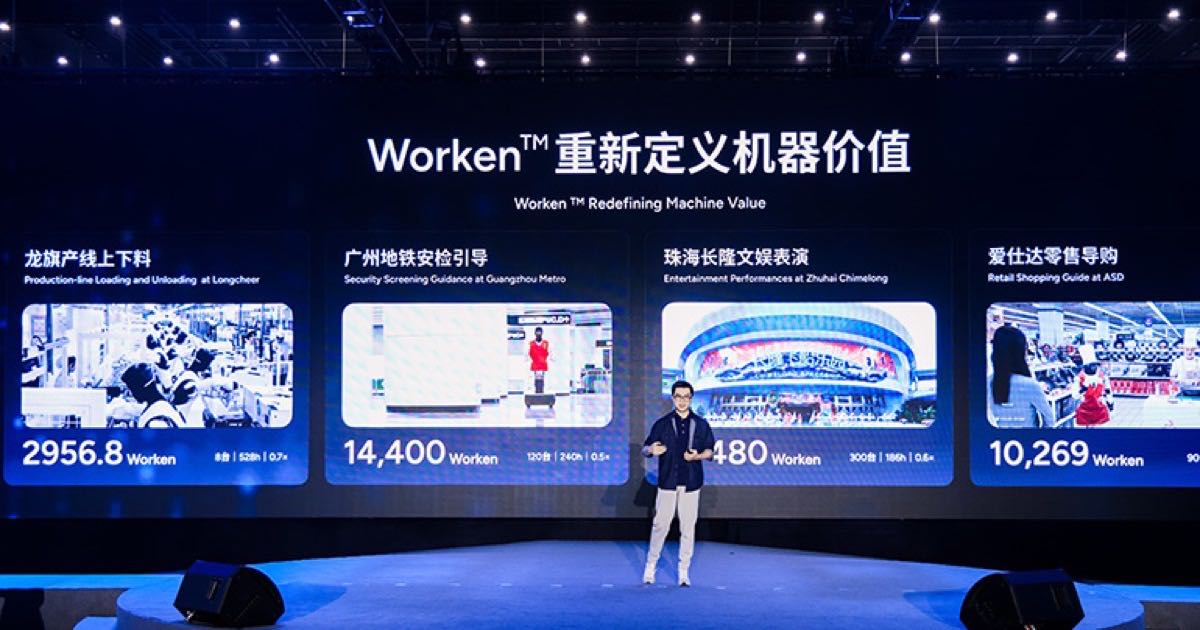
Here is the uncomfortable part, and the keynote itself illustrated it. Event photography published by The Robot Report shows AGIBOT scoring its own deployments on stage during the announcement: Longcheer production-line handling at 2,956.8 Worken, Guangzhou Metro security-screening guidance at 14,400, an ASD retail shopping guide at 10,269, and a Chimelong entertainment role at 480. Every number on the board is a robot AGIBOT built, graded by rules AGIBOT wrote. And two of Worken’s three factors are measured by the company that sells the robots: “autonomous working hours” depends on how you log interventions, and “output efficiency ratio” needs a per-task benchmark — whoever sets the benchmark sets the score. A vendor-run metric naturally drifts toward flattering its vendor, which is precisely what an industry standard exists to prevent.
AGIBOT does deserve some credit for structure. Task-specific benchmarks tied to established human operating standards are more falsifiable than most vendor marketing, and the company says the framework will be refined through real deployments and operational data, with the aim of becoming a widely applicable reference for physical AI. The 2026 Embodied Intelligence Industry Innovation Report, jointly compiled by China Economic Information Service and a Shanghai centre of state standards body CAICT, includes Worken in its industry analysis — so the proposal is already attached to official-adjacent machinery.
That points to the real game. If “effective intelligent work hours” becomes the unit Chinese industrial buyers negotiate in, AGIBOT — which claims the largest installed base — writes the yardstick everyone else is measured with. Standards are a moat: think of how Universal Robots’ “cobot” category framing shaped an entire market segment, and note that this is a company announcement, not an audited industry number.
Innovation Day offered the supporting cast too: AHA3, a third-generation hardware platform unifying locomotion, interaction and manipulation intelligence with joint liquid-cooling and IP67-rated joints; GO-3 Preview, an embodied foundation model built on a World Reasoning Action Model; WITA-Omni 1.0 for omni-modal interaction; the G2 Max industrial robot with 21 degrees of freedom and 40-kilogram dual-arm capacity; and Link-U OS 1.0, an embodied-intelligence operating system donated to the OpenAtom Foundation with full open-sourcing planned by the end of 2026. The ecosystem, per the release: 255 universities, 511 enterprises, 80,000-plus developers.
What It Means for New Zealand
New Zealand’s automation buyers are mostly mid-sized manufacturers, and their honest question about humanoids is exactly the one Worken gestures at: not “how many can you ship” but “what does a shift of useful work cost against a reliable human”. A deployment-first metric — output per autonomous hour against lifecycle cost — is the right comparison frame even before anyone agrees on benchmarks. If the framing survives contact with independent audits, it will be useful here regardless of whose robots do the work. Until someone outside AGIBOT computes it, treat every vendor-issued number in this market as marketing wearing a unit.
Sources: AGIBOT release via PR Newswire; The Robot Report; Unite.AI; The AI Insider.