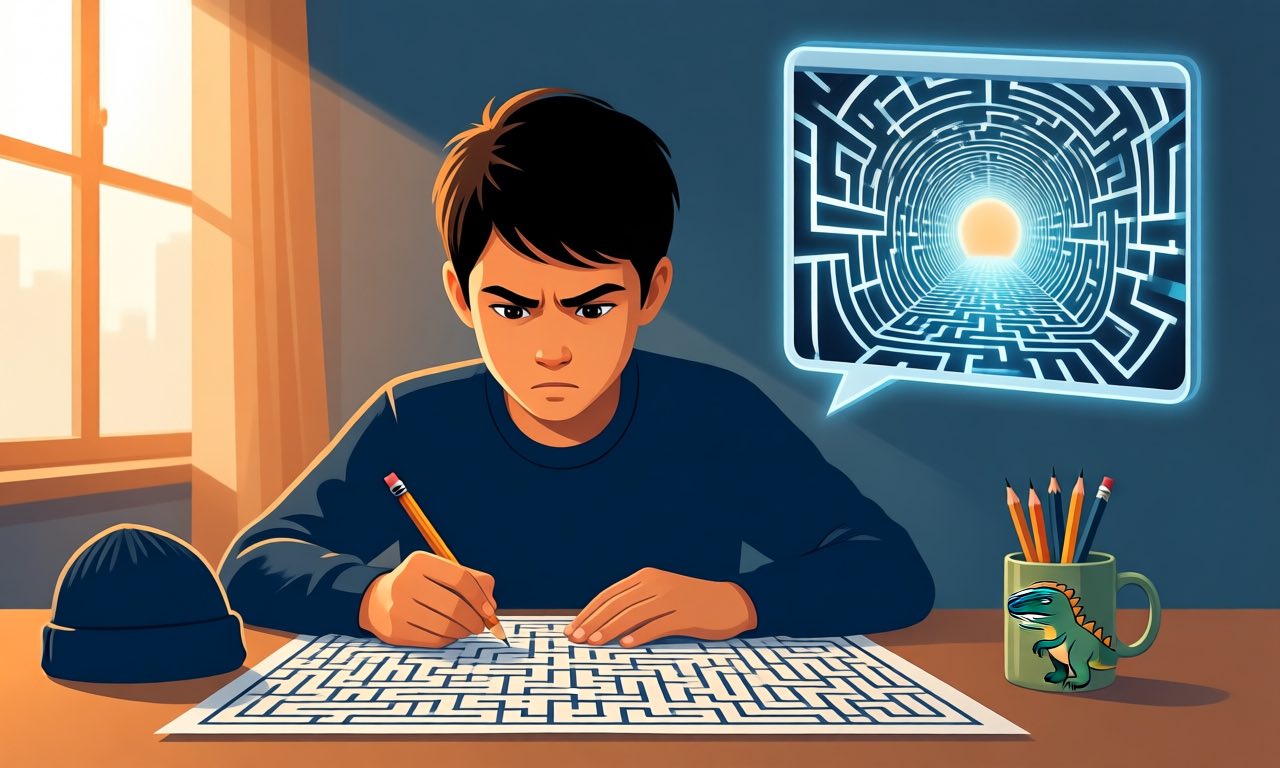
The most-cited worry about AI in education — that easy answers quietly erode the ability to work without them — now has a peer-reviewed causal result, and it arrives faster than most people assumed. A team led by Grace Liu (Carnegie Mellon) with Brian Christian and Tsvetomira Dumbalska (Oxford), Michiel Bakker (MIT) and Rachit Dubey (UCLA) presented “AI Assistance Reduces Persistence and Hurts Independent Performance” at the Conference on Language Modeling this month, after a preliminary draft circulated earlier in 2026. UC Berkeley News reported the updated paper on 9 October: across three randomised controlled trials with 1,222 participants, roughly ten minutes of AI-assisted problem-solving measurably reduced how long people kept trying once the tool was gone — and how well they performed without it.
What the trials actually showed
The design is clean. In the first experiment, 354 participants solved fraction problems; one group worked unaided, the other had ChatGPT available — up to and including asking it for the answer. The AI-assisted group was more accurate while it had the tool. Then, after 12 problems, researchers took the tool away. As Berkeley News describes the result: “almost immediately, the people in that group stopped solving questions accurately.” A second, larger trial (667 participants) reproduced the pattern, and a third (201 participants) extended it to SAT-style reading comprehension. In the paper’s abstract, the authors state the finding plainly: “although AI assistance improves performance in the short-term, people perform significantly worse without AI and are more likely to give up,” with effects emerging “after only brief interactions with AI (~10 minutes).”
The nuance worth holding onto is what changed. The measured decline was not only accuracy — it was persistence, the willingness to stay with a hard problem. When the tool vanished, the assisted group’s solve rate dropped and its skip rate rose, while the never-assisted control group held steady, as Aivio’s summary of the paper puts it. The authors’ proposed mechanism is psychological rather than neural: AI “conditions people to expect immediate answers, thereby denying them the experience of working through challenges on their own.” Persistence, they note, is foundational to skill acquisition and among the strongest predictors of long-term learning — which is what makes a ten-minute effect more than a curiosity.
Where it fits in the offloading literature
This paper lands alongside a growing stack of warnings, and its design is what distinguishes it. The retention studies this site covered in 2025 found students who used AI to study remembered less — and didn’t realise it; others have correlated heavy chatbot use with dependence or worse advice-following. What most of that literature cannot claim — and this paper can — is causation under randomised conditions, at known dosage: ten minutes, then withdrawal, with a control group. Earlier correlational studies left room for “already-disinclined people use AI more”; randomised withdrawal designs close that door for the acute effect, while leaving the durable question open, as the authors themselves flag: short online tasks measure what happens minutes after the tool disappears, not weeks later.
Brian Christian, the study’s co-author and author of The Alignment Problem, told Berkeley News the finding supplies “ammunition for a story that a lot of us kind of feel in our gut” — and he keeps a paper notebook on his desk for exactly that reason. The paper’s own conclusion is aimed at builders, not users: current systems are “fundamentally short-sighted collaborators,” optimised to answer instantly and to never say no, and model development should “prioritize scaffolding long-term competence alongside immediate task completion” — a mentor’s job description, not a search engine’s.
The New Zealand angle sits exactly where this effect bites hardest
New Zealand’s education system is already negotiating ChatGPT’s role in classrooms while carrying the youth-joblessness numbers NZIER put at 25.3 percent for 15-19-year-olds — a cohort for whom persistence is the very thing employers report missing at entry level, and which this study suggests AI could quietly thin further in the ten-minute doses between lessons. The apprenticeship pattern this site analysed on Monday made the adjacent point about skills that only form through unrewarded repetition; persistence is the classroom version of the same asset. A tool that conditions teenagers to abandon problems the moment they stop being fun is not a small side effect of a useful product — it is a direct tax on the trait the whole education-to-work ladder runs on.
The honest caveat, stated above and worth restating: ten-minute laboratory effects are not decade-long classroom outcomes, and no study yet shows the effect persists. Also open: whether a differently designed assistant — one that withholds the answer, or asks questions back — avoids the harm entirely. Until a vendor ships that mode by default, the reading list for parents and teachers is short: the cost of the shortcut arrives sooner than anyone expected, and it is measured in something no dashboard tracks.