Dyna Robotics released Dyna-2 on August 10, 2026, a world-action model pre-trained on more than one million hours of egocentric human video. That is roughly 170 years of continuous waking experience, and the company says it proves a scaling law for robot manipulation that holds across four orders of magnitude of training data.
The result matters because robot learning has been bottlenecked by a data problem that language models never had. Text is abundant, cheap, and already digitised. Robot action data requires teleoperation — a human physically moving the robot or a surrogate through each task. It is slow, expensive, and does not scale. Dyna-2 tests whether ordinary first-person video of humans doing things can substitute.
What is a world-action model? A world-action model (WAM) is a single generative model that simultaneously predicts future video frames and generates a stream of robot actions. Think of it as a video prediction engine bolted to a motor cortex. The video side imagines what happens next in the scene. The action side decides what the robot should do. Dyna-2 uses a mixture-of-transformers architecture where video and action tokens are processed by separate DiT layer stacks that attend to each other, with the action network kept deliberately shallower for real-time latency.
The scaling law that matters
Dyna Robotics trained nested subsets of 1,000, 10,000, 100,000, and 1,000,000 hours, keeping identical proportions from each source so distribution shift cannot explain differences. All four metrics improved monotonically and fit power laws. Held-out MSE followed 0.0691 × D^-0.0184 with R² = 0.919. Across the ladder, accuracy at the strictest threshold rose 51 per cent against 12 per cent for MSE.
This is the same kind of power-law relationship that drove language model scaling from GPT-2 to GPT-4. The difference is that the training data is free. Anyone with a body-worn camera generates it.
The second result is more striking: the same checkpoints were scored zero-shot on 39 tasks across two stationary bimanual YAM platforms the model had never seen. Zero-shot action MSE followed 0.306 × D^-0.0713 with R² = 0.884. The scaling law learned from human video transferred to robot hardware that was not in the training set.
Video is the secret ingredient
The third finding is the one that changes strategy. Joint denoising — training the model to predict both video and actions simultaneously — beat action-only training on all 39 tasks at every data scale. Holding action-labelled data fixed at 50,000 hours and adding video-only hours dropped zero-shot robot MSE from 0.340 to 0.120.
The video is not improving the model’s understanding of human behaviour. Held-out human error did not improve. The benefit is specifically cross-embodiment generalisation. The model learns something about how physical scenes unfold that transfers to robot bodies it has never controlled.
On-robot performance
Each rung was post-trained on 14 tasks with at most 10 hours of robot data each, across three embodiments: 6-DOF YAM arms with parallel-jaw grippers, the same arms with WUJI-2 20-DOF dexterous hands, and a semi-humanoid prototype. Mean normalised score rose 20 per cent, 28 per cent, 45 per cent, and 53 per cent across the ladder. The lockbox key turning task went from 0 per cent up to 100,000 hours to 90 per cent at one million. Bottle cap untwisting was post-trained on roughly 10 minutes of demonstrations and still reached 50 per cent.
Against Dyna-1, the company’s production vision-language-action model initialised from Qwen3-VL-4B, an early Dyna-2 reached 1.55× success rate pooled over 7 tasks. At unseen customer sites, Dyna-2 passed production criteria 87 per cent of the time versus Dyna-1’s 46 per cent. Both pass near 100 per cent in house, which tells you the real challenge is generalisation, not capability.
A distillation pipeline cuts video sampling from 10,203 ms to 110 ms on a single H100, which is what makes deployment feasible.
No weights, no API
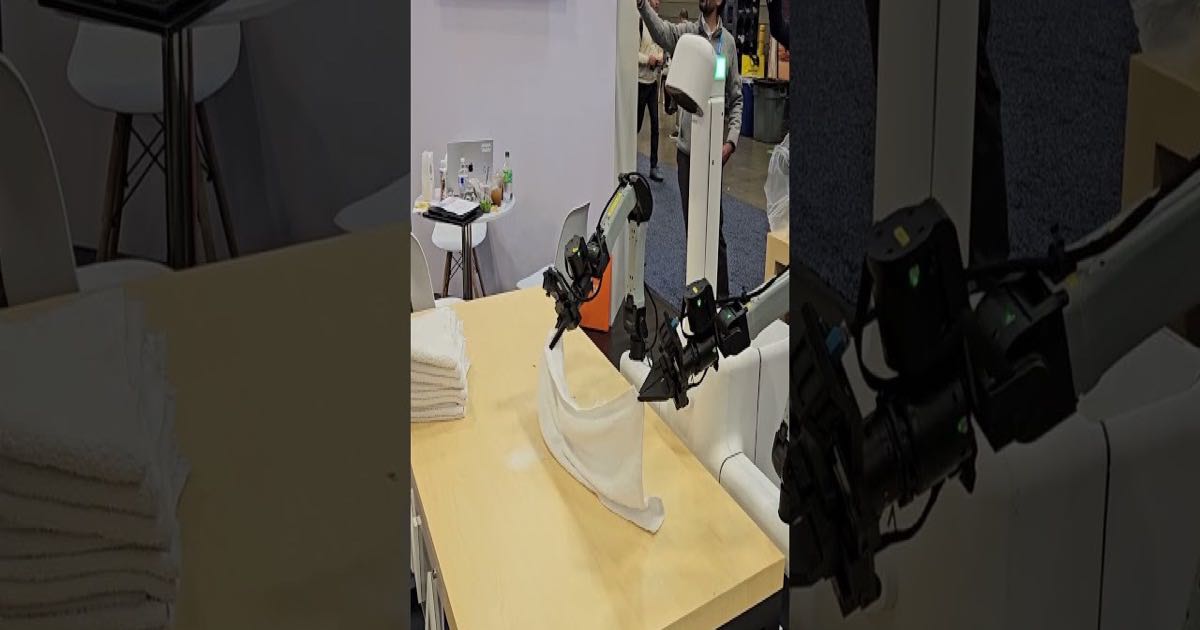
Dyna-2 is not open-source. There is no public checkpoint, no API, no license. Deployment means buying a Dyna robot cell. Dyna-1 robots are already running in production in hotels, restaurants, and laundromats, according to the company’s August 10 announcement. The target customer is a mid-market service operator with repetitive, stationary manipulation work — tray clearing, kitting, food scooping, tote construction.
That is a narrow commercial proposition, and it is honest about it. Dyna is not selling a general-purpose humanoid. It is selling a manipulation engine that learned from watching humans.
What this means for robotics
The economics of robot data collection have been the field’s biggest constraint. Teleoperation is expensive. Simulation helps but has a sim-to-real gap. Egocentric video is neither expensive nor bounded by the sim-to-real problem — it is just people wearing cameras.
If the scaling law holds beyond one million hours, and there is no obvious reason it would not, then the path to better robots is not more teleoperation labs. It is more GoPros. The bottleneck shifts from data collection to compute, which is a problem the AI industry already knows how to solve.
The question for competitors is whether this approach is replicable without Dyna’s specific architecture. The paper describes the method in enough detail that other labs will try. The technical report is public. The weights are not.
For New Zealand, the angle is indirect but real. A country that cannot afford a national teleoperation programme can contribute to robot training data collection. Egocentric video does not require a frontier lab. It requires a camera and a person doing a job. If the data scaling approach spreads, the cost of building useful robots drops in a way that benefits smaller economies, not just the ones with billion-dollar compute clusters.