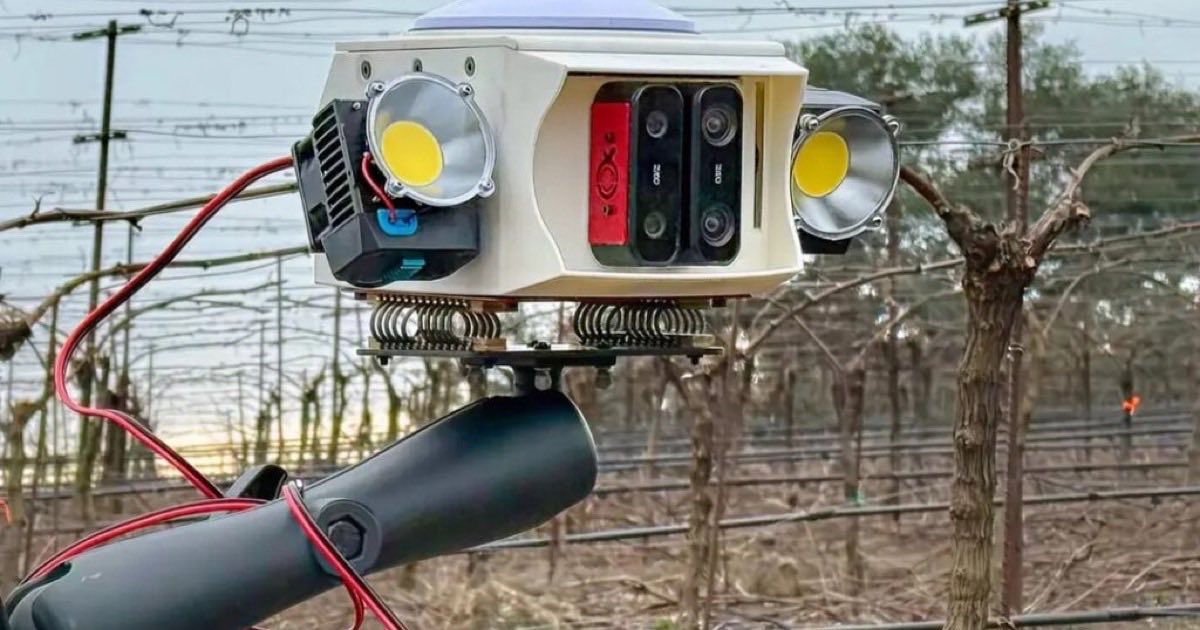
The biggest agricultural equipment maker on earth just bought itself eyes at tree level. John Deere announced this week — reported November 19–20 in the US, per Unite.AI and Robotics & Automation News — that it has acquired Orchard Robotics, the San Francisco company operating as Orchard AI, whose vehicle-mounted cameras scan every tree, vine and plant on a farm, all season long. Terms were not disclosed.
Orchard’s system rides through orchards and vineyards on tractors and utility vehicles the farm already owns — product documentation says the cameras operate at 1 to 12 mph — analysing hundreds of images per tree on each pass. The output is per-plant: yield estimates, fruit counts, fruit size and colour, canopy measurements, surfaced through the company’s FruitScope software platform. Founder and CEO Charlie Wu’s team has deployed in apples, wine grapes, table grapes, cherries, blueberries, almonds, pistachios and citrus, and says it has “hundreds of systems” in fields — and notably, the processing happens on an onboard NVIDIA Jetson computer, because many farms lack the connectivity to move terabytes of raw imagery anywhere.
Deere’s framing of the deal, from Tim Marquis, its director of farm systems innovation: “This acquisition connects crop-level intelligence with John Deere technology and equipment that can precisely execute the work in the field.” Orchard, Wu said, “will be the same team you’ve always known, you’ll still come straight to us,” operating as a Deere subsidiary with its existing products.
The latest move in a deliberate sequence
This is not Deere’s first robotics acquisition — far from it. Per AgFunderNews, it bought Blue River Technology, the computer-vision outfit behind See & Spray targeted spraying, for $305 million in 2017; Bear Flag Robotics, which autonomated tractors, in 2021; and, in 2025, both Sentera (drone imagery and crop intelligence) and GUSS Automation (autonomous orchard and vineyard sprayers). Orchard slots in as the data layer nobody else in that stack provides for permanent crops.
The people close to both deals see a trendline. Jorge Heraud, who sold Blue River to Deere in 2017 and is now Deere’s vice president of automation and autonomy, told AgFunderNews the deal was “further validation that large companies in agriculture are finding that actionable data is very valuable to farmers,” with the trend “driven by cheaper cameras and new sensors paired with AI to process the data.” Agronomist-turned-analyst Shane Thomas of Upstream Ag Insights went further in a LinkedIn post: Orchard was founded in 2022 and raised its $22 million Series A only about a year ago, “so this doesn’t look like a distressed sale and likely suggests a nine-figure exit” — his estimate, not a disclosed figure. His shorthand for the combined stack: “Orchard gives Deere the plant-by-plant crop vision in orchards and vineyards that Blue River and See & Spray gave it in row crops, and paired with GUSS autonomy and Smart Apply sprayers, Deere can now see, decide and execute in permanent crops.”
Why the data layer keeps winning deals
There are two ways to read a farm-equipment giant buying a camera company. The cynical one: Deere wants to lock farmers into its data ecosystem the way it already locks them into its parts. The structural one — and Heraud’s quote supports it — is that autonomy without perception is just machinery, and perception without a machine to act on it is just a report. The last decade of agricultural robotics has been a long demonstration that the money flows to whoever owns the see-decide-execute loop end to end. A farm can buy autonomy from anyone; it cannot buy autonomy informed by three seasons of its own per-tree data from anyone else. That is the same consolidation logic playing out in factory automation, where fleet-level industrial autonomy keeps rolling up under the big integrators.
Wu’s own framing to AgFunderNews was telling for where this goes next: “Data is only useful if there is an actual use for that data, and it’s not just a fancy map on screen.” A crop-scan platform inside the company that builds the sprayers, the tractors and the autonomous pods is a map with an execution path attached. Whether that integration stays open to equipment Deere doesn’t sell — the question growers will actually care about — was not addressed in the announcement.
It is also worth noting what this deal says at a moment when farm robots are learning new crops in days rather than seasons. Orchard’s cameras and Aigen’s simulation-first weeding robots are different bets on the same underlying economics: in high-value crops, the cost of a skilled decision per plant is enormous and the cost of a camera frame is falling off a cliff. The companies that bridged that ratio first are now being bought by the incumbents who own the iron.
For New Zealand, the fit is close to exact. This country’s horticulture is built on permanent plantings — apples in Hawke’s Bay, kiwifruit in the Bay of Plenty, wine grapes from Marlborough to Central Otago — grown by operations smaller and more labour-dependent than the Californian almond and citrus blocks Orchard cut its teeth on. NZ growers already run Deere equipment and Deere-owned autonomous sprayer platforms are in market here; a per-plant data layer bundled with the iron, with on-vehicle processing that assumes poor connectivity, arrives closer to off-the-shelf for a Hawke’s Bay orchard than for most of the world. The open question, again, is lock-in.
Wu, for his part, told AgFunderNews: “As we grow and expand our capabilities, you’ll be able to do more with our tech than ever before. Over these next few years, our goal is to bring the power of Orchard’s industry-leading technology and AI farming capabilities to every farmer out there.” The transition to “every farmer” now runs through Deere’s sales channel — which is precisely what one of the world’s most valuable ag-tech exits-in-waiting was for.
Further reading: the consolidation pattern in industrial autonomy M&A, how farm robots are cutting crop-training to days, and why wheeled, functional machines keep beating humanoids on real work.