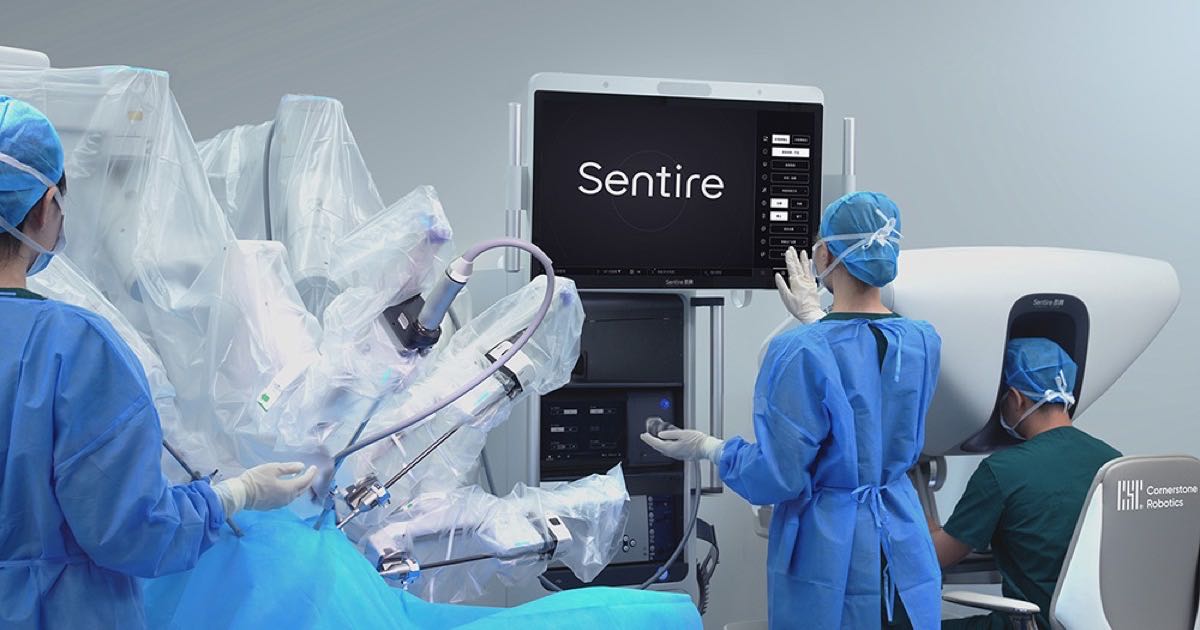
Medtronic announced on September 3, 2026 a $700 million investment in Cornerstone Robotics, the Hong Kong company behind the Sentire surgical robot, along with rights to distribute Sentire in select markets outside the United States where the system is approved. Sentire will sit alongside Medtronic’s own Hugo robotic-assisted surgery system — which puts two surgical robot platforms under one sales force, a structure that is rare in this industry.
The strategic logic is in Medtronic’s own framing. Matt Anderson, the company’s president of surgical, said surgeons and health systems “have varying needs and preferences, which is why we are investing across robotic platforms.” In other words: no single robot wins every hospital tender, so the largest players increasingly buy their way to a portfolio instead.
What Cornerstone actually brings
Sentire is a multi-port surgical system developed entirely in-house by Cornerstone Robotics, founded by Samuel Au. The system has completed multi-specialty clinical trials and holds market approvals in China, the European Union, and Singapore — including a CE Mark granted in May 2026 covering general, gynaecologic, thoracic, and urologic procedures. The company’s architecture includes an immersive surgeon console with dual-console capability, which lets two surgeons work or train together at the same console configuration.
That regulatory footprint is the real asset here. Sentire is already sellable in the EU and much of Asia; Medtronic’s distribution muscle converts approvals into installed bases far faster than a Hong Kong startup could on its own.
Two platforms, one sales pitch
The deal tells you something about how the surgical robotics market is shaking out. Intuitive Surgical’s da Vinci has dominated for two decades, but the challengers are multiplying — Medtronic’s Hugo is now in use across more than 35 countries and received US FDA clearance for urology within the past year. The next phase of competition isn’t one robot versus another; it’s ecosystems. Medtronic is explicitly claiming to be “the only company offering this two-platform portfolio combined with our surgical ecosystem.”
What stands out to me is what this says about Chinese-origin robotics. Cornerstone is the second Hong Kong/China-adjacent surgical robotics company in recent memory to land a major Western medtech partnership rather than fight the incumbents alone. For hospital procurement in markets like New Zealand, where capital budgets for surgical robots are thin and single-vendor lock-in is a genuine concern, a two-platform catalogue changes the negotiation.
It also puts Medtronic in an awkward but deliberate position: selling a system that competes with its own Hugo. The company is betting that hospital choice matters more than internal product discipline. Given Hugo’s US clearance came only recently and Sentire has none, the two platforms largely won’t cannibalise each other in the short term — Sentire’s runway is Europe and Asia, Hugo’s is everywhere else.
For patients, the near-term effect is probably pricing pressure and faster access in approved markets. For Cornerstone, $700 million and a global distributor is the difference between being a regional challenger and a genuine one. The surgical robotics market just got a proper oligopoly-with-tension structure, and that’s usually when prices and innovation both start moving.
FAQ
What did Medtronic invest in? A $700 million investment in Cornerstone Robotics, announced September 3, 2026, plus distribution rights for Cornerstone’s Sentire surgical robot in select non-US markets where it is approved.
What is the Sentire surgical robot? A multi-port robotic-assisted surgery system from Hong Kong’s Cornerstone Robotics, approved in China, the EU (CE Mark, May 2026), and Singapore for minimally invasive soft-tissue procedures.
Will Sentire be sold in the US? No — Medtronic’s distribution rights cover markets outside the United States. Sentire has no US FDA approval; Medtronic sells its own Hugo system there.
— CJ Murden, editor of Singularity.Kiwi. Former digital technologies teacher, author of AI-focused books. Writing with a New Zealand focus.