For eighteen months, a San Francisco robotics startup quietly put its machines on real construction sites before telling anyone. On 15 October, Origin finally emerged from stealth with $20 million in funding and a flagship robot called OG-1 that — the company says, and has posted video of — applies joint compound, sands and primes drywall on live job sites without a human hand on the tool.
The round was co-led by Accel and Zacua Ventures, with Ronnie Screwvala’s Unilazer Ventures, Schema Ventures, Z21, ISAI and Imad Ventures also participating, according to Origin’s launch announcement. It carries backing from an unusual angel roster for a construction startup: engineers from Anduril, Skild AI, 1X and Tesla.
What OG-1 actually does today
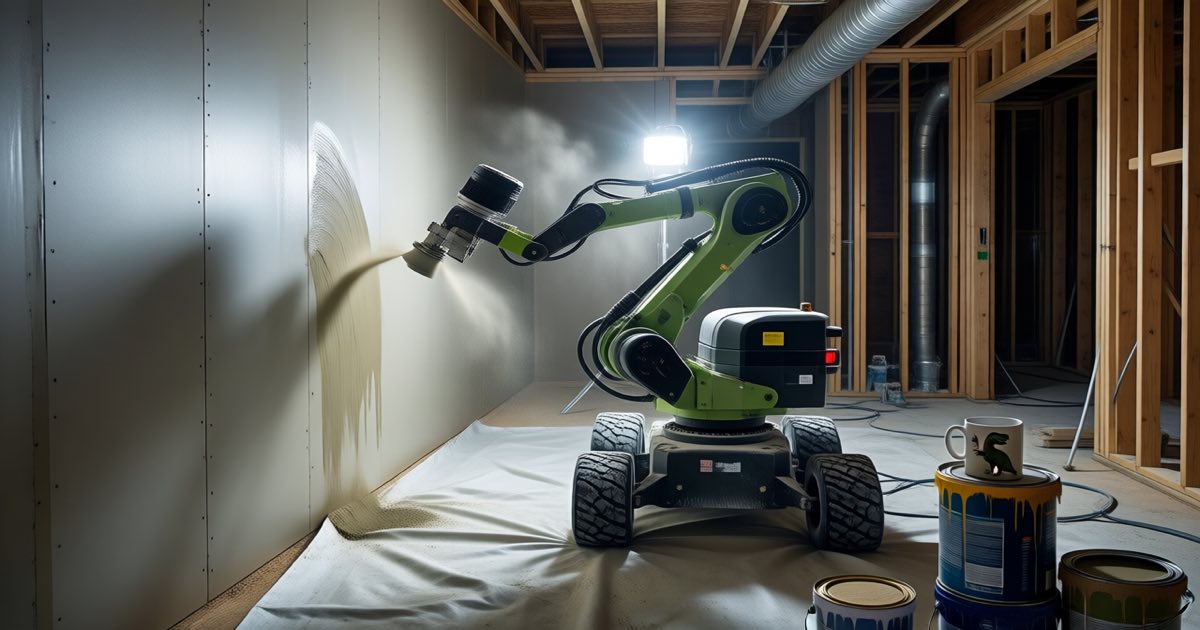
Strip away the launch-day optimism and the claim is narrower than “construction robot.” OG-1 is a three-wheeled mobile platform with an interchangeable tool arm and a 360-degree camera view, currently scoped to one trade: interior wall finishing. It sprays compound, sands it back with real-time force control to keep even pressure on the wall, and primes — reaching up to 14 feet on high walls and ceilings. It fits through a standard door and works without a cordoned-off zone, which is what makes it usable on sites where other trades keep moving around it.
That narrowness is deliberate, and it is also what makes the announcement interesting rather than speculative. Drywall installation, drilling and conduit work appear in the press release only as expansion plans. RoboTomorrow’s hands-on assessment of the company’s demonstration footage makes the same distinction from the outside: the tool touching the wall with controlled force is the hard, verifiable part; the transitions — who maps the room, who refills the compound, how the robot handles corners and edges — are where a machine’s real shift output is won or lost.
Where is it working? Origin says OG-1 units are finishing walls at New York job sites, with pilots underway or planned with two of the largest drywall finishing contractors in the US, and further pilots scheduled for Germany, Sweden, France and Saudi Arabia. The fleet target: 150 robots deployed by the end of 2027, as StartupFeed and Startup Rise both report from the launch statement. Forbes, reporting the launch the same day it landed, put the current fleet at four active robots with more than 100,000 square feet of finished wall behind them — the number that best frames how early this actually is.
The three-times-faster claim, handled with care
The headline figure doing the rounds — OG-1 finishing drywall up to three times faster than humans — is a company claim from company-run sites. It has not been independently measured, and Alpha Bionic’s analysis of the launch does the useful work of defining what evidence would settle it: output per full shift after setup, relocations, refilling and rework, not just sanding-head throughput while the machine is moving. In Forbes’s interview, Origin’s CEO said the claimed advantage does already include setup, tool changes and end-of-day maintenance, which is the more honest version of the number — but it is still a version told by the company selling it.
The economics of that claim matter more than the speed. Interior finishing is some of the last work on a build, it is dusty, precise, chronically understaffed — and it is exactly where New Zealand feels it too: every local build waits on GIB stopping crews, the wall finishers whose schedule slips flow straight into handover dates. If a robot can genuinely compress that stage, the shortage story that carried Monumental’s bricklaying robots and D.R. Horton’s robot-built homes applies doubly here. Nobody in Tauranga is watching for a humanoid to replace their builder; they are watching for anything that gets a finished house to market weeks earlier.
Why this round signals a pattern
Construction robotics funding used to come in two shapes: huge rounds for heavy machinery autonomy on the dirt side, and long-shot humanoid bets. 2026 added a third, and Origin is a textbook case — mid-sized rounds ($200 million for SoftBank-backed autonomous excavators, $20 million here) for robots scoped tightly to one profitable trade, with fleet expansion as the growth model rather than platform generality.
The founders’ origin story is also part of why this got funded: CEO Yogesh Ghaturle previously built Perpule, a Bengaluru retail-tech startup Amazon bought in 2021 for about $14.7 million — and all three co-founders are of Indian origin, a detail StartupFeed highlights because it shows again how Indian founders keep surfacing in global robotics, not just software. Co-founder Tushar Makkar leads autonomy from an AI background at Eightfold; Ashish Daga built precision hardware at Morphle Labs. Zacua founding partner Vivin Hegde, who joined Origin’s board with the round, put the thesis plainly: “Too many construction robots perform well in a lab and fail within a week on a live job site.”
Whether OG-1 avoids that fate is an empirical question the 2027 fleet target will answer. The same economics we examined in Anthropic’s robot exposure study apply: robots are technically capable of three-quarters of physical work, yet cost-competitive for a rounding error of it — and a machine whose business case rests on sanding walls faster than paid tradespeople has to beat that 0.3% bar squarely. Wall finishing might be one of the very few places it can.
- Walls as a Service: Monumental’s Robots Take On Construction’s Hardest Hiring Problem
- America’s Largest Homebuilder Will Robot-Build 1,250 Homes
- SoftBank Puts $200 Million Behind Autonomous Excavators
- Robots Can Already Do 74% of Physical Work. They’re Cheaper Than People for 0.3% of It.
Sources: Origin press release, 15 Oct 2026; StartupFeed and Startup Rise, 16 Oct 2026; Alpha Bionic, 18 Oct 2026; RoboTomorrow assessment of the company video; Business Standard, 19 Oct 2026; Forbes, 15 Oct 2026 (page returned 403 to our fetch and is cited via search-index excerpt — named but not counted toward the three-source bar); LinkedIn Origin Autonomy. Speed and quality claims in this article are the company’s, as flagged in the text; as of publication no independent measurement of OG-1’s throughput has been published.