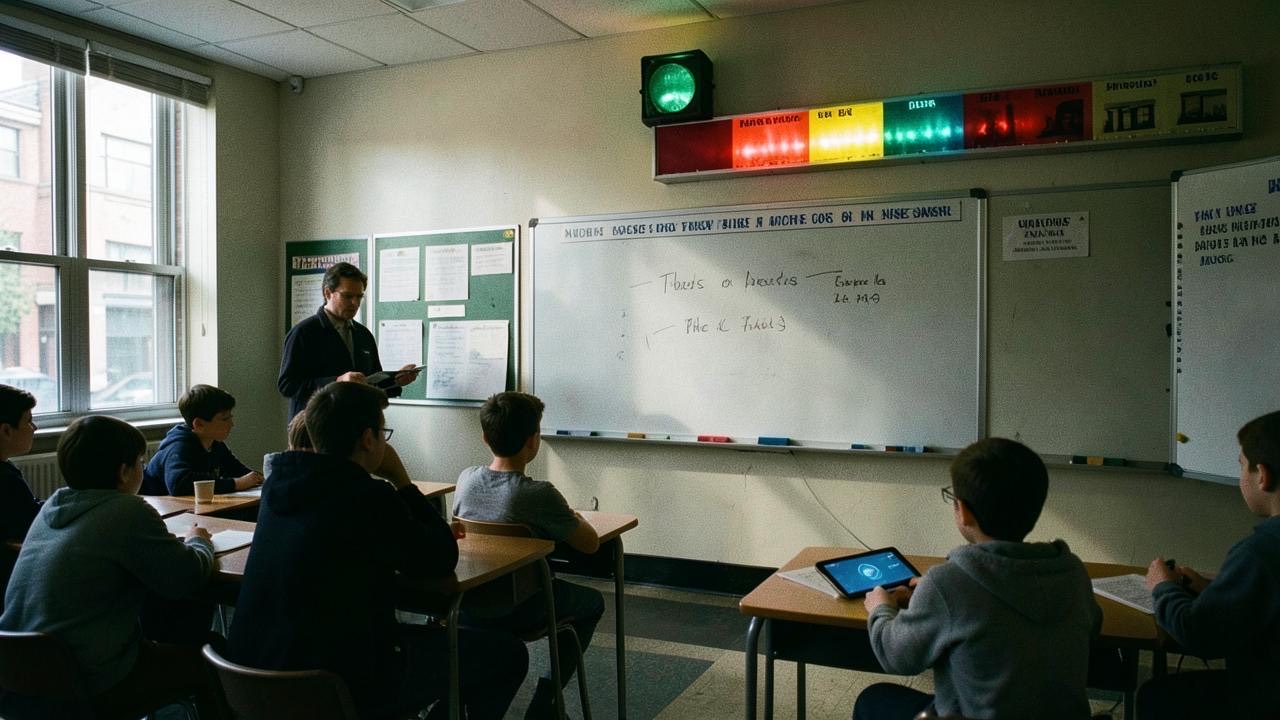
Most school AI policies read like legal disclaimers — vague principles that leave teachers guessing. New York City just did something different: they built a traffic light.
Red, Yellow, Green — No Guessing
NYC Public Schools released detailed AI guidance organized around a traffic light framework that gives educators something rare in AI policy: actual clarity.
Red (Prohibited): AI cannot make student-facing decisions, grade student work, or write Individualized Education Programs. These are hard boundaries. No AI substitution for professional judgment where students are directly affected.
Yellow (Caution): AI can identify data patterns or support student use — but only with human review and approved tools. This covers the grey zone: AI can surface insights, but a person must verify and decide.
Green (Allowed): AI can assist with lesson planning, administrative tasks, and professional development. The green light covers productivity tools that help teachers work faster without touching student outcomes.
The framework also requires that only tools approved through the Education Risk Management Assessment (ERMA) process can be used — closing the loophole where teachers might bring in unvetted AI apps.
Why This Matters More Than Another State Bill
Idaho just enacted the first statewide AI education law. Multiple states have introduced guidance. But NYC is different for three reasons:
-
Scale. NYC Public Schools is the largest district in the US, serving over 900,000 students. What NYC does, other districts watch closely.
-
Specificity. State laws and executive orders tend to set principles. NYC’s traffic light gives teachers a decision framework they can use on Monday morning. Red means no. Green means yes. Yellow means slow down and check.
-
Enforceability. By tying AI use to the ERMA approval process, NYC created an actual gate — not just advice. Schools using unapproved AI tools are now out of compliance.
The Problem It Solves
The national AI education landscape is a mess of good intentions and unclear rules. Teachers hear “use AI responsibly” and reasonably ask: what does that mean, exactly? Which tools? For what tasks? Who checks?
The traffic light answers those questions. It trades philosophical elegance for practical usability — and that trade is exactly right for schools that need to act now, not debate for another year.
What Could Go Wrong
The framework’s strength is also its risk. Rigid categories can age poorly as AI capabilities evolve. A tool that’s “green” today for lesson planning might develop student-facing features next month. The yellow zone depends heavily on how districts interpret “human review” — which can range from meaningful oversight to a rubber stamp.
There’s also the question of whether ERMA approvals can keep pace with the speed of AI tool releases. If the approval process becomes a bottleneck, teachers may quietly use unapproved tools the way they’ve always quietly used unapproved apps — just off the radar.
The Bigger Picture
NYC’s traffic light is the latest signal that AI governance in education is shifting from “should we?” to “how exactly?” The era of vague AI principles is ending. What replaces them will be frameworks like this — specific, actionable, and tied to real compliance structures.
Other large districts will likely adapt the traffic light model. It’s simple enough to communicate, specific enough to enforce, and flexible enough to update. That combination matters more than any single policy detail.
SOURCES
- NYC Public Schools — Guidance on Artificial Intelligence
- schools.nyc.gov/about-us/vision-and-mission/guidance-on-artificial-intelligence