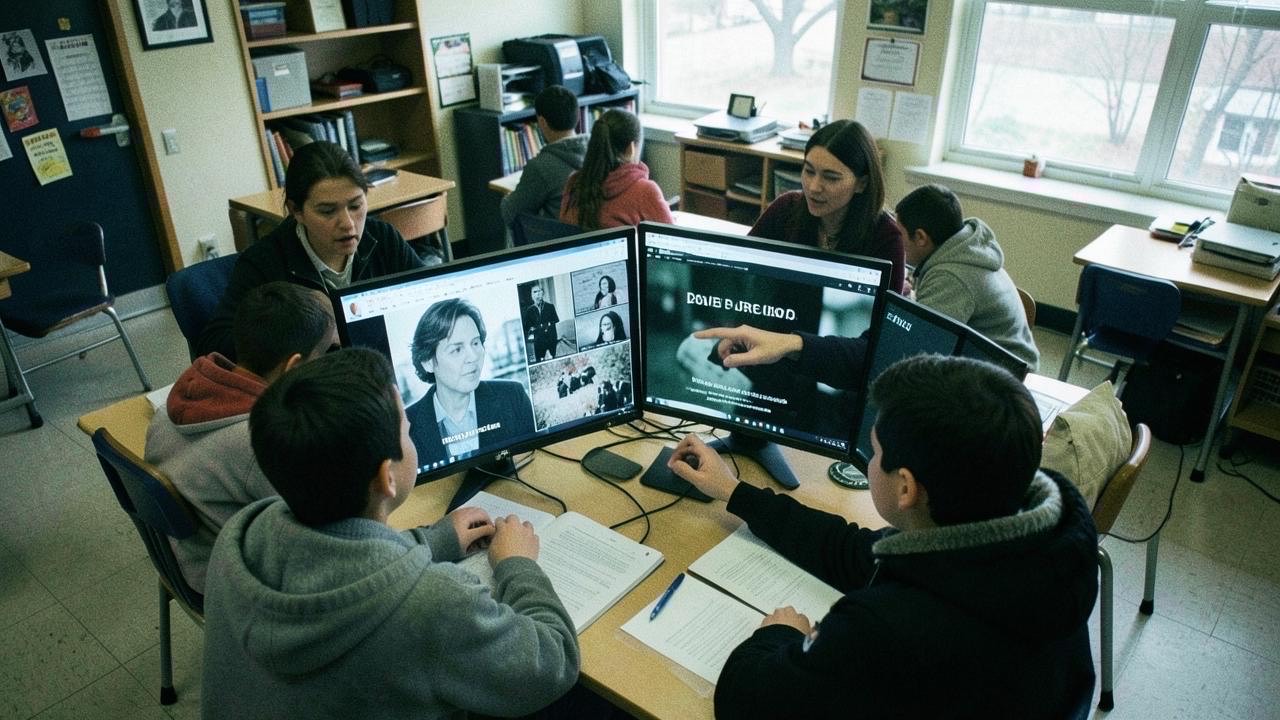
New Jersey education officials have proposed sweeping K-12 curriculum revisions with a premise that flips the usual AI-in-education conversation on its head: students don’t just need to learn AI tools. They need to defend themselves against AI-generated lies.
The initiative, framed explicitly around navigating the “age of fakery,” treats AI literacy as information defense — teaching students to identify deepfakes, spot synthetic media, and evaluate the authenticity of digital content before it tricks them.
Not Tool Proficiency. Survival Skills.
Most AI education policies focus on access and tool use: teach students ChatGPT, integrate AI into assignments, prepare them for an AI-augmented workplace. NJ’s approach is different.
The curriculum revisions focus on:
- Identifying synthetic media — teaching students to spot deepfakes, AI-generated images, and synthetic audio across all grade levels
- Source verification — evaluating where information comes from and whether the source is human or machine-generated
- Understanding AI manipulation — not just how AI works, but how it can be used to deceive, influence, and distort
- Information hygiene — treating AI-generated content the way previous generations treated misinformation: with systematic skepticism
This is a defensive posture rather than an optimistic one. It acknowledges that the most urgent AI skill for young people isn’t prompt engineering — it’s not being fooled.
A Model for Other States?
New Jersey isn’t operating in isolation. There are currently 134 AI-in-education bills across 31 state legislatures this session. But most of those bills focus on access, ethics, or workforce preparation. Few take the anti-deception angle that NJ is pursuing.
If the approach works — and if the state can train enough teachers to deliver it effectively — it could become a template. The problems it addresses are universal. Every student in every state is already encountering AI-generated misinformation. Most have no framework for recognizing it.
New Zealand, for context, has no equivalent policy. AI in NZ classrooms is still largely at the “should we ban ChatGPT?” stage.
The Teacher Training Gap
There’s an inherent tension in the plan: you can’t teach students to identify deepfakes if their teachers can’t identify them either.
The same survey data that shows 74% of schools have AI policies also shows 76% of teachers lack adequate AI training. NJ’s curriculum overhaul doesn’t fully address this gap — it’s heavy on what students should learn, lighter on how to prepare the adults who need to teach it.
The state has pledged additional professional development funding, but the timeline is tight. Curriculum changes are slated to begin rolling out next academic year, while teacher preparation programs typically take 18-24 months to reach critical mass.
Why This Matters Now
Deepfake incidents in schools have increased 400% since 2023, according to recent reporting. AI-generated misinformation has been documented in school board meetings, student social media, and even homework submissions. The “age of fakery” framing isn’t hyperbole — it’s a description of the current environment.
NJ’s bet is that teaching defense is more urgent than teaching offense. In a world where any student can generate convincing fake content in seconds, the ability to recognize and resist that content may be the most important AI skill of all.
SOURCES
- NJ Spotlight News: How NJ plans to modernize curriculum in the age of fakery and AI