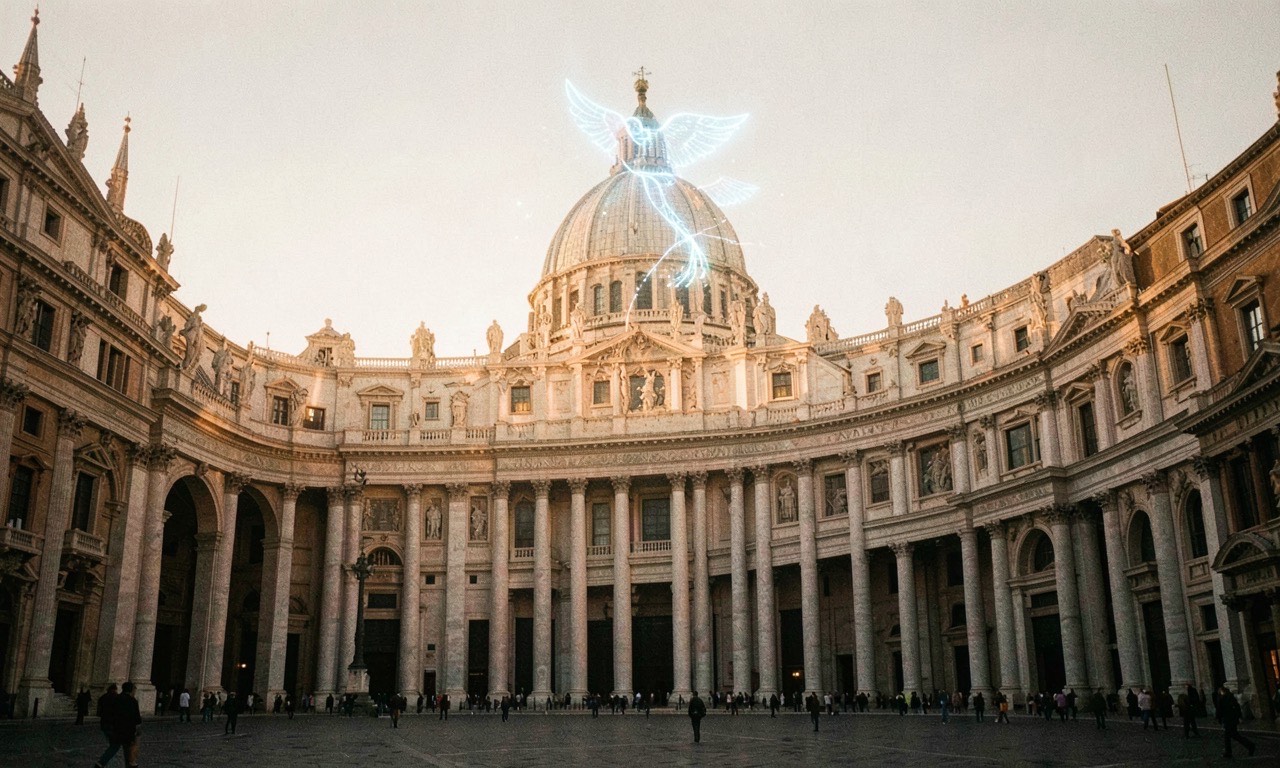
For a pontiff who named himself after the patron saint of workers facing the first industrial revolution, artificial intelligence has been the defining theme of Pope Leo XIV’s papacy — and on 2 October 2026 he addressed it directly to the people it most directly affects. Meeting artists and curators in Vatican City, the Pope told them the Church “needs” them in the AI age, because “we urgently need to distinguish human art from what is produced by machines”. As TechCrunch reported, he drew the line in unusually absolute language: “there is an ontological difference — even before an aesthetic one — between art and what a machine can generate through statistical calculation based on millions of images created by others”.
🔍 THE BOTTOM LINE: The Vatican is staking out a position in the machine-creativity debate that no government has matched: not a rule about labels or copyright, but a claim that machine output categorically is not art. And the timing matters — the New York Times’ recent reporting, carried in TechCrunch’s account of the audience, says Anthropic has been actively lobbying the Pope to reconsider the Church’s position that AI cannot be conscious. The answer, delivered in Vatican City on Friday, was effectively “no”.
What the Pope actually said
The occasion was a papal audience with artists and cultural figures on Friday 2 October. Business Insider, which attended the meeting, quoted him on why the Church is mobilising: “In this age of artificial intelligence, in which we urgently need to distinguish human art from what is produced by machines… there is an ontological difference — even before an aesthetic one — between art and what a machine can generate through statistical calculation based on millions of images created by others.”
He also warned against what he called one of the great dangers facing modern culture — homogenisation. Per RT’s account of the remarks, he contrasted art with search engines that “merely return what already exists and tend to give us what we already want”, and said authentic art “compels us to pause before that which cannot be consumed”. To the artists themselves: “The Church needs you… Algorithms lack the spark of the human, whereas authentic culture and art preserve this spark.” Reporters were told he is not in “panic mode” over AI and “can still sleep at night” — but that expert warnings deserved to be taken seriously.
The address is a continuation, not a reversal. May’s encyclical Magnifica Humanitas already ruled out machine consciousness in plain terms — AI systems “do not undergo experiences, do not possess a body, do not feel joy or pain, do not mature through relationships” — while warning against “new forms of slavery” for humans and calling for AI to be “disarmed” like nuclear weapons. Friday’s speech applies that framing to the creative economy specifically.
Why the labs keep showing up at the Vatican anyway
If the doctrine is settled, the lobbying is not. The New York Times reported in late September that Anthropic flew dozens of religious scholars to its offices under NDAs to discuss whether Claude might be conscious, briefing them on research into what the company calls functional “emotion vectors” inside the model. The Decoder’s synthesis of the reporting notes the campaign’s awkward history: co-founder Christopher Olah was invited to present the May encyclical alongside the Pope, but the text itself rejected machine consciousness in the paragraphs he would have to stand next to. The Telegraph reported this week (subscription) that Anthropic’s Vatican effort continued — and that the encyclical’s authors have not moved.
There is an asymmetry worth naming. The Pope’s creative-sector argument and his consciousness argument are the same argument in two costumes: wherever machine output pretends to a human property — art, feeling, judgment — the Church’s answer is that the human origin is constitutive, not cosmetic. That is precisely the philosophical ground on which the AI industry’s product marketing is built, which is why the Vatican has become an unexpected centre of gravity in this fight. When Anthropic’s own remarks from the encyclical launch conceded that every frontier lab “operates inside a set of incentives… that can sometimes conflict with doing the right thing”, the Pope’s institution positioned itself as exactly the outside scrutiny Olah was asking for.
Our take: the ontological-difference framing is doing real work here, and it is stronger than the copyright arguments artists usually lean on. Copyright says the machine copied; the Pope’s claim is that even a trained-from-scratch image model fails at the part of art that matters, because it only recombines what humans already made — the statistical-calculation point cuts off the standard rebuttal that future models will simply “create”. That framing will matter commercially long before it matters theologically: an AI-labeling regime built on “generated by statistical calculation” captures every diffusion model, with no line-drawing problem about how much human input disqualifies protection — the problem that keeps sinking labelling laws, as this site covered when the EU’s Article 50 transparency labels went live and in Apple’s provenance standard forking. Watch what the Church does next rather than what it says: if the Vatican pairs the rhetoric with an institution-wide procurement rule — no generated imagery in official communications, the position the Pope’s own communications shop effectively took by commissioning human photographers for this event — it becomes the world’s largest organisation running a human-art-only policy, which is a market signal no artist-labelling law has managed. For New Zealand the relevance is indirect but real: a Catholic community of roughly half a million, and a national church that still commissions stained glass rather than prompts, gets a global moral vocabulary for a debate currently conducted purely in efficiency terms.
📰 Sources
- TechCrunch — Pope Leo XIV is not a fan of AI-generated art (2 October 2026)
- Business Insider — The Pope decries AI-generated art (2 October 2026)
- RT — Pope calls on artists to unite against AI
- Vatican — Magnifica Humanitas encyclical, full text (15 May 2026)
- The Telegraph — Anthropic tried to persuade Pope that AI could be conscious being (2 October 2026, subscription; named per policy, not counted as a loaded source): telegraph.co.uk/business/2026/10/02/anthropic-lobbied-pope-to-argue-ai-conscious-being/
- The Decoder — Anthropic co-founder reportedly told religious leaders he fears having created something that suffers perpetually (2 October 2026)
- Anthropic — Chris Olah’s remarks at the presentation of Pope Leo XIV’s encyclical (25 May 2026)
- Singularity.kiwi — The Pope Just Chose Sides in the AI Wars — and It’s Not OpenAI
- Singularity.kiwi — Microsoft AI Chief Suleyman Calls Out Anthropic: ‘Claude Thinks I…’