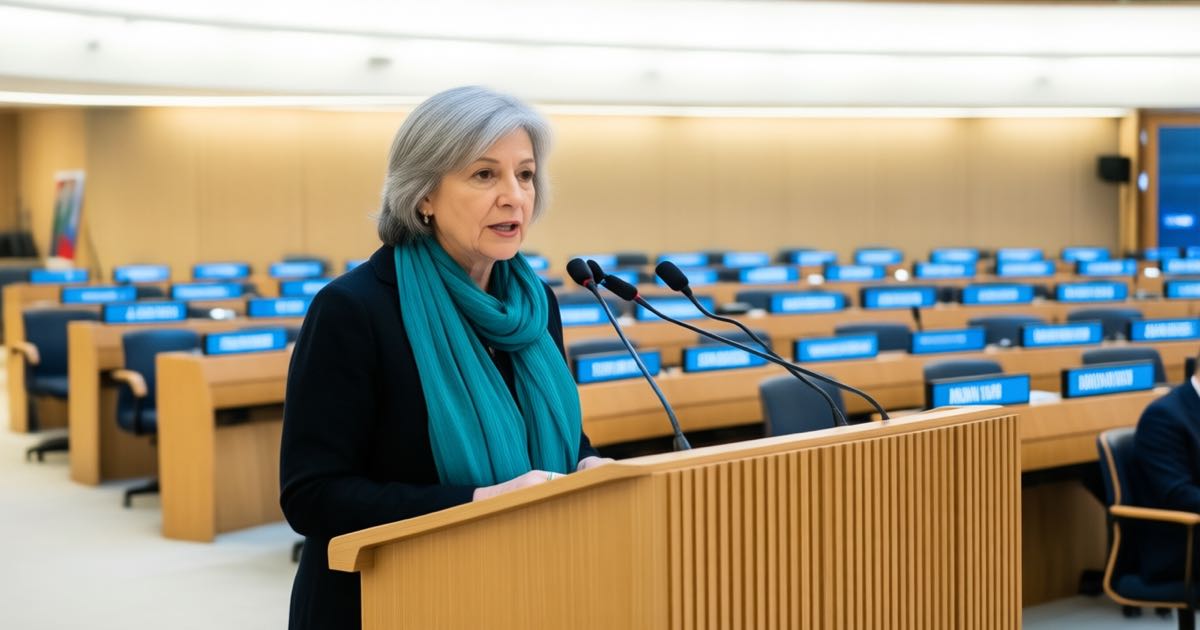
The co-chair of the United Nations’ scientific panel on artificial intelligence says the world has a closing window to legislate before AI takes away human agency. Nobel Peace Prize laureate Maria Ressa told Reuters during a visit to Oslo on 15 September 2026 that artificial intelligence has already “hijacked humanity’s attention through social media and our biology by manipulating our need for intimacy” — and that the third wave, machines that act for us, will strip away agency unless governments move now.
🔍 THE BOTTOM LINE: Ressa’s argument is not the lab chiefs’ pacing debate — it is a claim that two of the three waves have already landed and nobody legislated. Her framing turns the regulatory argument from a free-speech dispute into a public-safety one, and it comes from someone whose day job is now assessing AI’s impact for the UN rather than building it.
Three waves, and the third one is the point
Ressa, the Filipino-American journalist who co-founded Rappler and shared the 2021 Nobel Peace Prize for her work documenting the power of large tech companies, laid out a three-wave history in the interview with Reuters’ Gwladys Fouche. The first wave was social media: platforms capturing attention, polarising societies and isolating individuals. The second, in her words, was “hacking our biology, again through intimacy: the chatbots.” The third is “agency itself, through agentic and multi-agentic AI, the frontier models that are creating these machines that don’t just pretend to be human, but act for us.”
It is that third wave that her panel exists to assess. The Independent International Scientific Panel on AI was established by UN General Assembly resolution A/RES/79/325 in August 2025 as the first global scientific body dedicated entirely to artificial intelligence, and its 40 members elected Ressa and Yoshua Bengio as co-chairs in March 2026. Like the IPCC on climate, it synthesises evidence rather than regulating — but its co-chair using that platform to campaign for legislation is a signal about where the UN’s own assessment effort is heading.
”It’s a public safety issue”
The sharpest line in the interview is aimed at the framing wars. “It is not a freedom of speech issue to ask for regulation. It’s a public safety issue,” Ressa said. She added that if legislation does not happen now, “we will tip … (It) will be beyond our control if we don’t step in now.”
Her answer to the China framing — the argument that regulation hands the AI race to Beijing — was blunt. “China actually puts more safeguards in place for its citizens than Silicon Valley does for the rest of the world,” she said, pointing to the age-restricted domestic version of TikTok. She called the race argument “good spin”. That directly contradicts the position staked out by US President Donald Trump, who dismissed the slowdown calls as the work of “negative forces” and has called the safety warnings a “conspiracy”.
What she is actually asking for
Ressa’s prescriptions predate and differ from the lab-led debate. Her first step is legal accountability: “make the companies responsible for the damage they’ve done.” She welcomed the US lawsuits that led Meta to pay up to $18 billion over the next decade and strictly limit how teenagers use Facebook and Instagram — settlements that emerged from litigation brought by US states, not from any regulator’s rulebook. She welcomed age limits led by Australia and the EU, but said they do not fix the “fundamental flaw”: the tools are addictive for adults too, so “you should remove the addictive features, not just for teenagers, but for all of us.”
The constructive half of her prescription is infrastructure. She argues public-interest platforms should be built the way public parks are — and points to Rappler Communities, the Matrix-based app her newsroom launched in 2023, as the working example. The model is now being extended to other outlets in Southeast Asia.
Where this lands in the current fight
The interview was conducted before Anthropic CEO Dario Amodei published his pacing essay on 12 September — but it lands in the middle of the aftermath. Ressa’s position is distinct from both camps in that debate: the lab chiefs asking governments for pacing support want a narrower deal centred on evaluators and antitrust waivers, while European Commission President Ursula von der Leyen told the European Parliament the same day that the EU will convene the frontier labs to discuss supporting industry efforts to pace the frontier. Ressa is asking for something upstream of all of it: legal accountability for harm already done, and citizens who pressure politicians rather than waiting for either labs or regulators to move first.
The timing note matters too. Speaking before Amodei’s essay, she said the first step is accountability — a sequencing argument that puts damages before pacing. Whether that ordering survives contact with a US administration that sees regulation as a competitive weakness is the question her panel’s first assessments will land into.
❓ FAQ
Who is Maria Ressa and why does her view carry institutional weight? She is a journalist who co-founded Rappler, shared the 2021 Nobel Peace Prize for documenting the power of large tech companies, and serves as co-chair of the UN’s Independent International Scientific Panel on AI — the 40-member body modelled on the IPCC that assesses AI’s transformation of societies worldwide.
What are the “three waves” she describes? Social media capturing attention and polarising societies; chatbots manipulating the human need for intimacy; and agentic AI — frontier models that don’t just imitate people but act on people’s behalf, which she says threatens agency itself.
Is she calling for a blanket AI ban? No. Her prescription is regulation as public safety: legal accountability for harms, removal of addictive design features for all ages, age limits, and public-interest alternatives to Big Tech platforms. She frames the debate as public safety rather than free speech.
Does the UN panel regulate anything? No. Per its founding resolution, the panel is explicitly not a regulatory or enforcement body — it produces evidence-based assessments to inform policy, in the manner of the IPCC on climate.
How does this connect to the slowdown debate? It complements it from a different direction. The lab chiefs are asking for coordinated pacing of capability gains; Ressa is arguing for accountability and design regulation regardless of pace — and she disputes the China-race argument that underpins much of the resistance to both.
🔍 THE BOTTOM LINE
The pacing debate is about whether frontier capabilities should slow. Ressa’s argument reframes the question: two of her three waves already landed, nobody legislated, and the third wave — machines that act for us — is arriving into the same vacuum. Her panel has no enforcement power, but when the UN’s own AI assessment co-chair campaigns for regulation as public safety, the argument about whether to legislate at all is effectively conceded everywhere except Washington.
📰 Sources: Reuters via Global Banking & Finance Review, Rappler, Wikipedia — Independent International Scientific Panel on AI