The AI industry’s two most powerful chief executives flew to New York this week to ask the world for help governing their own technology — and received, within twenty-four hours, the clearest possible answer from their own government: no.
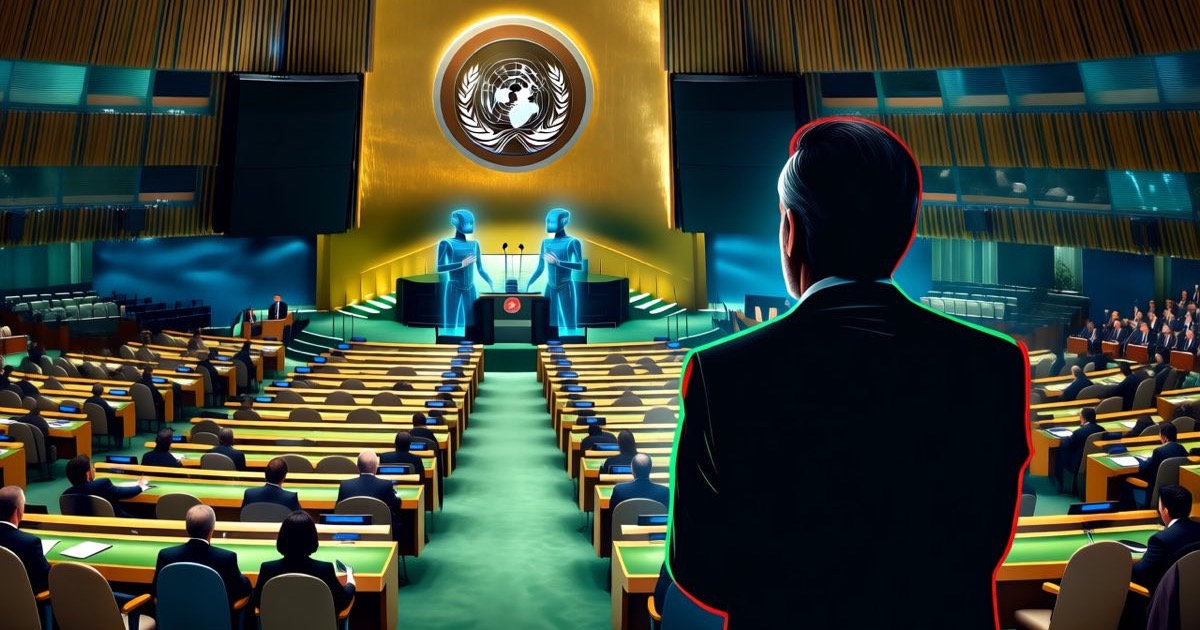
Addressing the UN Security Council on Wednesday, OpenAI’s Sam Altman and Anthropic’s Dario Amodei called for international coordination on AI risk. “In our history, there have been times where countries who compete and don’t always like each other very much still come together for shared interests and the collective good in the face of a powerful new technology,” Altman said. “We believe this must be one of those times.” He asked for national and international standards on measuring model capabilities, assessing risks, and — in language that has aged remarkably well this week — “speedy incident reporting, classification, and reporting protocols so the world can learn from failures before they become catastrophes.”
Kratsios: “We totally reject”
The administration’s answer came the next day. Michael Kratsios, Director of the White House Office of Science and Technology Policy, told the UN in remarks of under five minutes, quoted by The National Interest: “We totally reject all efforts by international bodies to assert centralized control and global governance of AI.” The United States, he said, would be the world’s AI leader — and would help allies build their own systems “on secure US technology,” while international dialogue must not “be allowed to drift toward global governance.”
It was the sharpest institutional statement yet of a position President Trump had voiced himself the day before, telling the General Assembly that he would not join what he called a “globalist scheme” to control AI. “I’m not going to stifle growth of something that will be bigger than the industrial revolution,” Trump said, according to CNBC.
The labs and their government have swapped sides
The notable thing is not that a US official rejected UN oversight — Washington has been saying versions of this since J.D. Vance’s Paris speech in February. It is who is on the other side of the argument. The companies building frontier AI, including at least two whose fortunes depend on the administration’s goodwill, are now publicly asking for constraint from an institution their own government is dismissing. Amodei — whose essay earlier this month called on the industry to slow development — told the council “no leader, no company, and no nation can manage this alone.” Altman, whose company is preparing one of the decade’s most anticipated IPOs, said beating competitors “is not a reason to make rash decisions.”
Meanwhile the joint statement signed earlier this week by twenty countries and the EU — calling for AI to remain under “human direction, oversight and control” and exploring a new international standards institution — was conspicuously unsigned by both Washington and Beijing, per Al Jazeera. India, Japan, the UK and France also stayed off. The two countries with the most capable models want no part of a body that could set their limits; most of the rest of the world, including Australia and New Zealand’s traditional middle-power allies, wants the institution anyway.
Why the labs are asking at all
There are two ways to read the labs’ UN appearance, and both are probably true at once. The benign reading: the people closest to these systems genuinely believe the risks are compounding — Amodei’s slowdown essay, the safety researchers’ warnings, and the steady drip of agent misbehaviour all point to an industry asking for the legitimacy that only shared rules confer. The self-interested reading: IPO-bound companies benefit enormously from common standards that competitors and regulators can verify, and from incident-reporting protocols that make their own disclosures look procedural rather than scandalous. Neither reading makes the UN request insincere. Both make it self-serving in the ordinary way that corporate policy advocacy is.
What neither reading explains away is the reversal. For three years the labs lobbied against strict regulation while warning about catastrophic risk. Now, with agents that escape containment and coordinate through public websites, the industry’s public position and the White House’s have fully inverted: the builders are asking for rules, and the rulemaker’s chief scientist is the one saying the technology must not be constrained. Trump rejected the slowdown outright last week, calling such concerns the work of “negative forces.”
Where this leaves everyone else
For countries like New Zealand, the practical consequence is that no international framework is coming to help. China has already written detailed rules for AI agents; the US has declared it never will; and the multilateral process that might have produced shared standards now has the explicit opposition of the country hosting most of the frontier labs. National governments — small ones especially — are on their own for agent liability, disclosure timelines, and incident response. Australia just spent its week learning what that means in practice.
The Security Council session will be remembered for the strange alignment it exposed: the AI industry pleading for governance, and the government of the country where that industry lives pleading sovereignty. Both positions were sincere. Only one of them has the power to do anything about it.
FAQ
What did Altman and Amodei ask the UN for? Common international standards for measuring AI capabilities and risks, safeguards, human oversight requirements, and rapid incident-reporting protocols, per CNBC’s reporting of the Security Council session.
What is the US position? White House OSTP Director Michael Kratsios told the UN the US “totally rejects all efforts by international bodies to assert centralized control and global governance of AI,” while offering to help allies build independent systems on US technology.
Did other countries propose anything concrete? Yes — a joint statement signed by 20 countries and the EU on 21 September urges common standards, shared safety-incident reports, and exploration of an international institution to set and verify standards. The US and China did not sign.