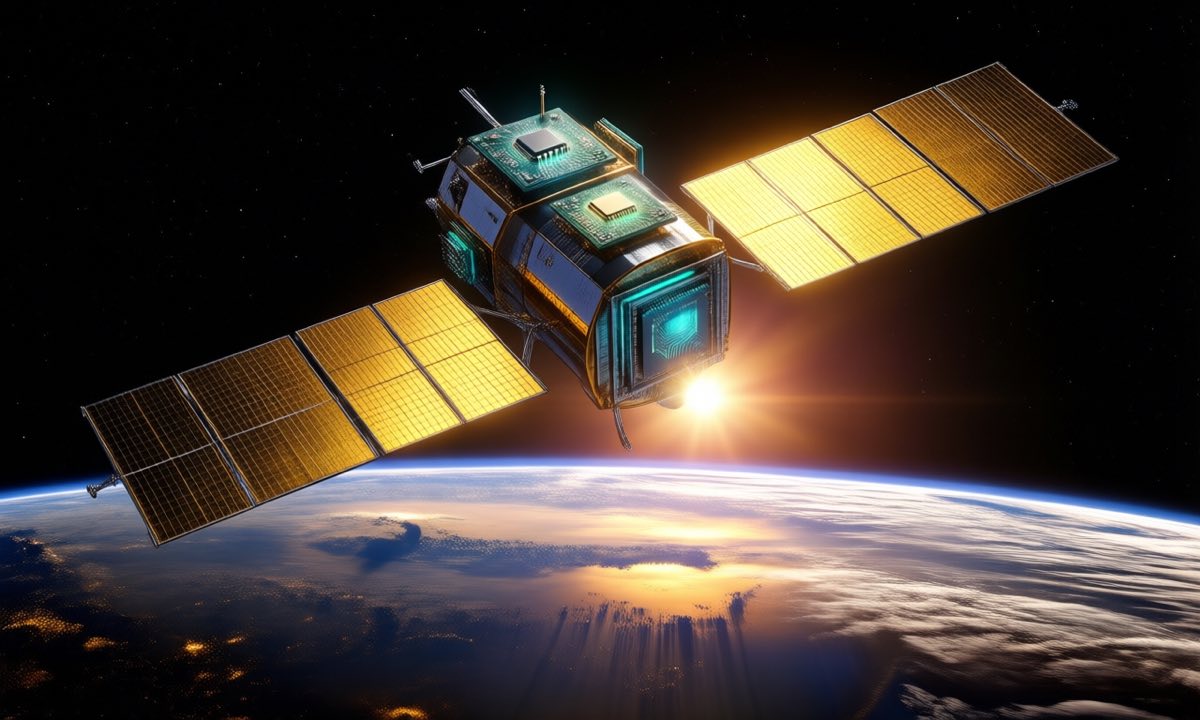
Google is launching its first prototype satellite under Project Suncatcher on October 1 — the first hardware test of a research moonshot the company has been quietly building toward since announcing the project last year. The goal is not another Earth-observation platform. It is to find out whether Google’s Tensor Processing Units, the AI accelerator chips behind its Gemini training runs, can survive in space.
What the test actually measures
The prototype exists to answer three engineering questions, according to Google’s Project Suncatcher team, led by Travis Beals:
- Radiation — how TPU silicon holds up against cosmic rays and solar particles that would never reach a rack in an Iowa data center.
- Vibration — whether chips survive the violent shaking of a rocket launch in the first place.
- Cooling in vacuum — how to move heat away from compute hardware when there is no air to carry it.
The team is blunt that this is a learning exercise: the launch helps them find out what works before any attempt to scale, with follow-on missions aiming to link satellite clusters using high-bandwidth laser links and scale the concept up by 2027.
Why Google is looking up
The motivation is the same one squeezing every frontier lab on Earth: power. Training clusters now rival small countries in electricity demand, grid connections take years, and communities are pushing back on new build-outs. Orbit promises continuous solar exposure and radiative cooling without a utility in sight — if the hardware cooperates.
We’ve covered this ground before. In April, the largest operational orbital compute cluster went live as terrestrial data centers stalled on power constraints, and Google has been quietly building its space-compute position through a $30 billion GPU rental arrangement with SpaceX. Anthropic’s 300-megawatt Colossus compute deal showed the same pressure from the tenant side: the compute has to go somewhere, and Earth’s grids are the bottleneck.
The honest caveats
One surviving prototype proves nothing about economics. The hard problems in orbital compute — launch cost per kilogram, radiation-hardened packaging, laser crosslinks between satellites, and maintenance that can’t send a technician — are all still ahead of this test, and Google’s own team frames the scale-up as a 2027 question, not a 2026 one. Suncatcher is explicitly a research moonshot, not a product roadmap.
But it is a real step past the renderings stage: on October 1, actual TPUs will be on an actual rocket. The next frontier for AI infrastructure may be decided by whether they come back with data worth scaling.