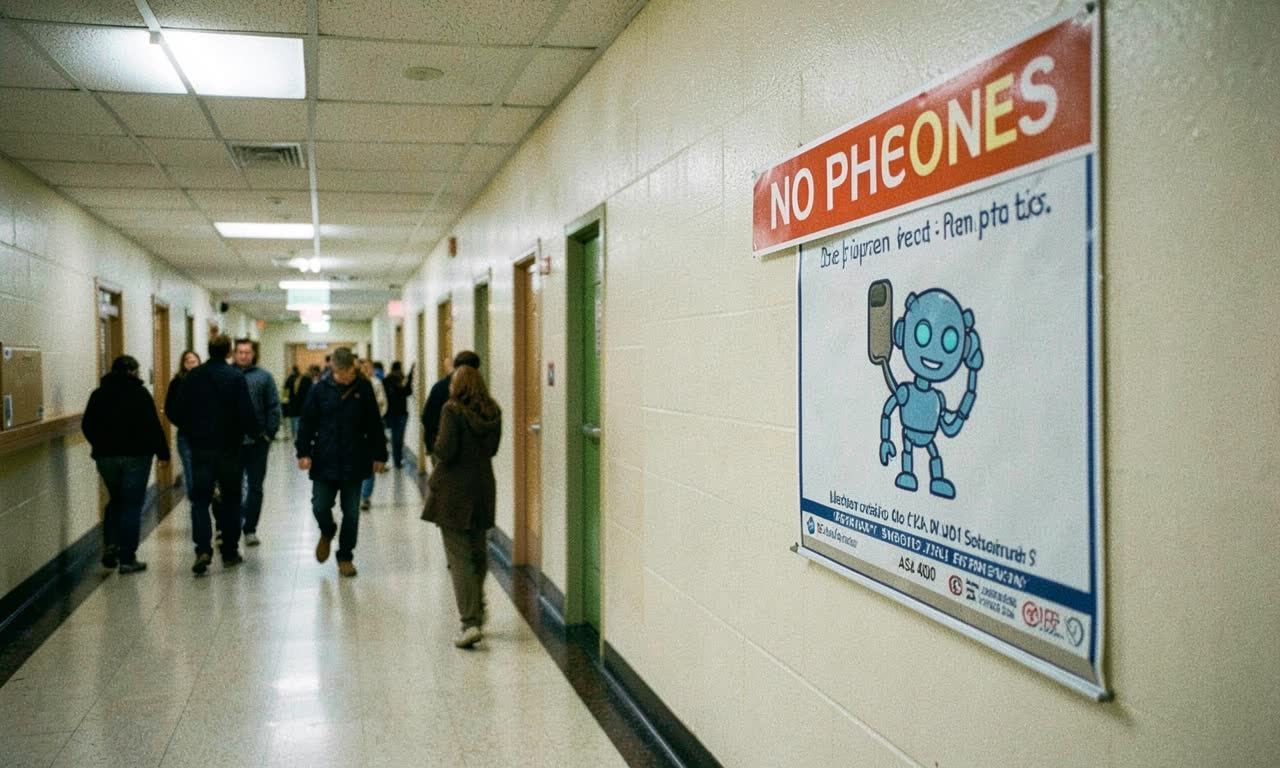
While other states are either banning AI in schools entirely or handing it to every student with no guardrails, Utah just did something different. It built a staircase.
Governor Spencer Cox signed a package of education bills on April 9 that together form the most coherent, age-appropriate approach to technology in schools that any U.S. state has produced so far. The vision is simple: protect the little ones, teach the older ones, and make the platforms pay for the damage they’ve caused.
📱 Bell-to-Bell Phone Ban
The headline-grabber is a default policy prohibiting cellphones during the entire school day — not just during class, but from the first bell to the last. Individual schools can opt out, but the default is no phones. The logic is direct: social media use has climbed, literacy has declined, and the two are not unrelated.
First lady Abby Cox put it bluntly at the bill signing at Valley Elementary in Eden: “As we’ve seen social media uptick over the last decade, we’ve seen literacy decline, and that is not unrelated, and we need to make sure that, as we’ve done as a state, pull that out of the classrooms, out of the hands of kids, and get us reading again.”
Almost half of Utah’s third-graders don’t read at grade level. The new laws pair the phone ban with a $16 million investment in early literacy interventions for K-3 students, plus funding for earlier dyslexia detection and a statewide intervention plan developed with the University of Utah.
🤖 AI: Restricted for Young Kids, Taught to Older Ones
The AI-specific legislation, sponsored by Kaysville Republican Rep. Ariel Defay, takes a graduated approach that’s notably different from the all-or-nothing policies emerging in other states:
- Elementary school: AI and technology use is limited, so students develop foundational skills in literacy and math first
- Middle school: A new required digital skills course for 7th and 8th graders — unanimously approved by lawmakers — covers both the benefits and risks of AI and digital technologies
- High school: Technology access expands progressively, with the expectation that students learn to navigate AI tools in a “balanced way”
This is the staircase. Don’t hand a 7-year-old ChatGPT. Don’t keep it from a 15-year-old either. Build the skills incrementally, the same way you teach reading before writing essays.
💰 The Social Media Tax
Perhaps the most inventive piece: a 4.7% tax on social media companies that collect user data for targeted advertising. The revenue funds youth sports, recreation, volunteerism, and mental health programs for young Utahns.
Cox framed it as accountability: “The money that we’ll collect will go back to helping our young people who have been so damaged by social media and the wealthiest companies in the history of the world. We think that they should be able to pay a little bit to make up for the harms that they’ve caused.”
Rep. Jordan Teuscher, who sponsored the bill, acknowledged it was controversial in a tax-averse state: “In Utah we don’t like raising taxes. But in this case, when you see that there’s opportunities where we need to get less of something, the best thing that we can do is tax it.”
🎯 Why This Package Works
What makes Utah’s approach notable isn’t any single bill — it’s the combination:
- Remove the distraction (phone ban) before trying to teach
- Build the foundation (literacy investment, AI limits for young kids)
- Teach the skills (mandatory digital literacy in middle school)
- Expand access (more AI use in high school, with balance)
- Make platforms accountable (social media tax)
Most states are picking one or two of these. Utah did all five, and the through-line is consistent: kids need face-to-face interaction and foundational skills before they need AI tools, but they absolutely need AI skills before they graduate.
🌍 The Bigger Picture
Utah’s laws arrive as AI education legislation is exploding nationwide. Over 134 AI-related education bills have been introduced across 31 states in 2026 alone. But most are narrow — mandating AI curriculum, restricting AI cheating, or setting data privacy rules. Few attempt what Utah is doing: a comprehensive, age-appropriate framework that treats technology as something to be learned gradually, not either feared or embraced wholesale.
The digital literacy course is particularly significant. It’s not just “AI is bad” — Teuscher emphasized it covers benefits as well as risks, helping students balance virtual and real-world engagement. That’s the kind of nuanced digital citizenship education that most states haven’t even started designing.
🔍 The Bottom Line
Utah didn’t panic about AI in schools, and it didn’t pretend everything’s fine either. It built a framework: phones away, foundations first, skills later, platforms pay. It’s the most coherent K-12 technology policy package in the country right now, and other states should be taking notes.
The question isn’t whether Utah got everything right. It’s whether anyone else is even trying to think this holistically about kids, screens, and AI.