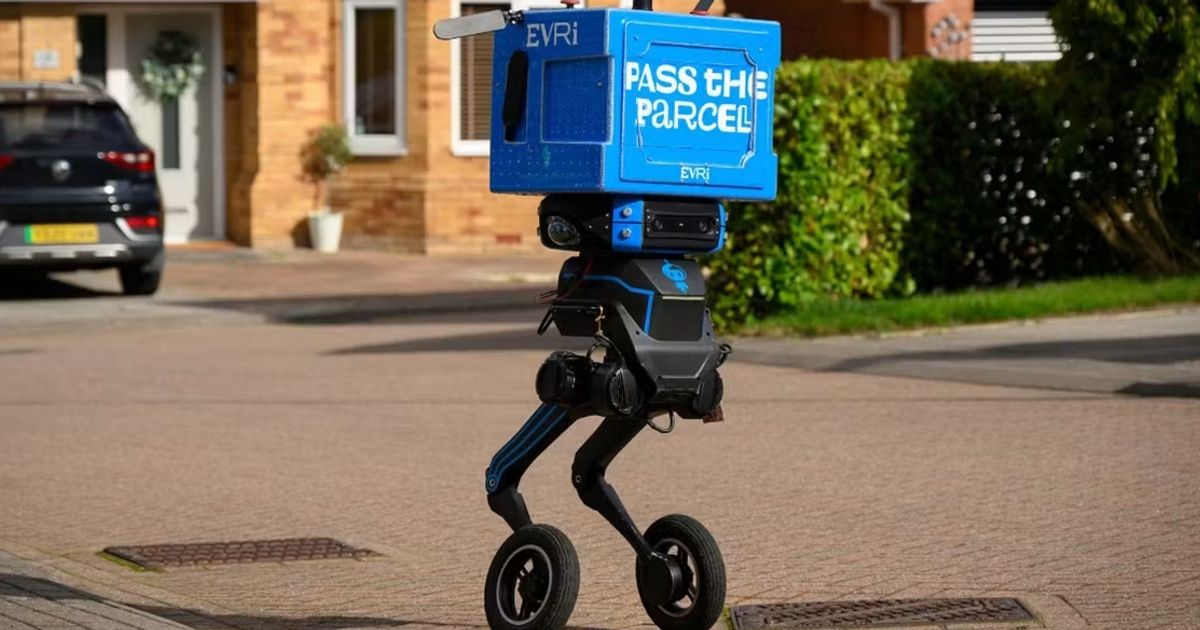
The parcel on your doorstep was carried up your stairs by something with legs. That is the pitch, at least, behind a trial that went live across UK coverage yesterday: Evri, the delivery firm that moves roughly a billion parcels a year, has started what it calls Europe’s first trial of a two-legged autonomous delivery robot, working with Japan’s Refined Robotics in Barnsley. The machine is called Iris, it stands about 4 feet (1.2 metres) tall, and per BBC Yorkshire’s report it carries loads of about 20kg, travels at up to 6km/h and is initially expected to focus on fashion parcels.
The companyline is support, not replacement. Evri Group chief technology officer Marcus Hunter called the Barnsley launch “an exciting milestone” in a statement carried by Retail Times, arguing that Barnsley — the UK’s first government-backed “Tech Town” — “has built a reputation as a place where innovation thrives and new technologies can be tested in real-world environments.” Refined Robotics founder Nick Hafner, whose company started in Tokyo and trialled the robot there first, had the more practical framing: “There’s always something not perfect about the real world, there’s going to be a branch from a tree trunk or a wheelie bin or something,” he told the BBC. The legs exist for exactly that residue of reality.
Why legs, when everyone else settled for wheels
Most of the delivery robots you have seen are boxes on wheels — Starship’s six-wheeled pavement cruisers, Serve’s tall coolers on casters. Hafner’s argument for Iris is that wheels stop at the kerb’s edge of what is possible: legs let the robot handle obstacles, uneven ground, and — the genuinely differentiating trick — stairs. If a parcel can be walked to an apartment door on the third floor of a walk-up, the addressable delivery universe expands well beyond what any wheeled platform can reach. Iris can also enter and exit delivery vans on its own, according to Evri’s release, which matters for the depot-to-door hop that current pilots mostly paper over with human drivers.
Iris is a legged-wheeled hybrid rather than a pure biped — a wheeled base with articulated leg assemblies — which is precisely the kind of honest engineering compromise that rarely survives into the viral versions of this story. One quirk of the rollout: the robot is “likely to focus on delivering fashion parcels” first, per the BBC. Lightweight, high-value, forgiving of a slow 6km/h pace — e-commerce’s least awkward cargo is getting the robot first.
The Tokyo pilot offers an early satisfaction number, with caveats. Hafner told the BBC that “96.2% of the participants really enjoyed the robot,” that they “think it’s cute, and they said it didn’t feel as machine-like” — survey data from a selected participant group, but a data point nonetheless on the acceptance question that has dogged doorstep robots since the first viral hoaxes. Hafner also claimed the flexibility to deliver at times no human courier would — the middle of the night, or a long wait on a doorstep for someone with limited mobility. Evri says Iris can operate autonomously or under remote monitoring, and supports both attended and unattended handoffs.
Barnsley’s robot chronology is the real story
Under the newness, there is an eighteen-month pattern worth naming. Barnsley has now hosted three distinct Evri robot trials: the dog-like RIVR robots in April 2025, a wheeled robot trial reported by Parcel + Postal Technology International in February 2026, and now the two-legged Iris this week. Each generation was announced with similar language about the future of the doorstep. None has yet produced a reported full-scale UK rollout — the 2025 trial was billed as three months with a summer rollout to follow if successful, and no such fleet materialised.
That is not a gotcha; it is how this technology actually matures. Campus robots work because campuses are semi-closed environments with predictable geographies. A humanoid loading a delivery bot on a convention floor photographs well precisely because it is a staged sequence. The sidewalk, with its tree roots, wheelie bins and weather, is where robot delivery designs go to be humbled — and Evri’s answer to being humbled appears to be iterating hardware generations in the same forgiving spotlight until one sticks. A Starship pilot ending after five months in nearby Sheffield, which the Evri release notes preceded this trial, fits the same arc.
What Britain gets that New Zealand can watch
For a UK audience, the interesting variable is the doorstep itself: British streets are the worst-case scenario for wheeled delivery bots — terraced houses, stairs, kerbs, rain — which is why the legged bet is being made there and not, say, in the flat suburbs of Texas. For New Zealand, the transferable observation is narrower. Our last-mile economics already run on contractor density and weather-tolerant couriers; a 20kg-capable, 6km/h biped is nowhere near displacing that, and retailers here will watch the UK’s customer-acceptance data before anything else. Barnsley, a town of roughly 100,000 that also gets the robots’ public-services halo via its Tech Town designation, is functioning as a controlled experiment in whether people will accept a small polite machine on their footpath — results from which will arrive long before the hardware does anywhere in the South Pacific.
What we still don’t know
Evri has not said how many Iris units are in the trial, how long it runs, or what success metrics it set. There is no cost data, no reliability figures from Tokyo beyond the 96.2% satisfaction claim, and no timeline for any wider rollout. Hafner says the robot can climb stairs; no published footage yet shows Iris doing it on a real UK staircase. As of publication, no independent outlet has verified the overnight-delivery capability in operation. What is solid: the trial exists, the machine exists, and the company behind it chose a town that has already hosted two generations of competitors’ ambitions. Third time on the same cobblestones — watch whether the third robot is the one that stays.