Teachers’ biggest AI problem isn’t cheating itself — it’s what trying to catch cheating is doing to the relationships classrooms run on. That is the argument of a new report from Harvard Graduate School of Education’s Center for Digital Thriving, covered by Education Week and in Education Week’s syndicated piece on GovTech, both published on 30 September. In a nationally representative survey of more than 1,000 US public school teachers and principals, 74% of teachers and 69% of principals who described an AI dilemma raised cheating. The report — “An AI Policy Isn’t a Playbook,” free on the Center’s site — argues the fixation is producing something worse than hidden essays: two-way suspicion that no one can disprove.
🔍 THE BOTTOM LINE: Students can’t prove they didn’t use AI and teachers can’t prove they did; the result is teens hiding use, some deliberately underperforming to dodge accusations, and — per the Harvard report — skipping teachers entirely: “I don’t usually go to my teachers. I kind of just go to Chat.”
What the researchers found
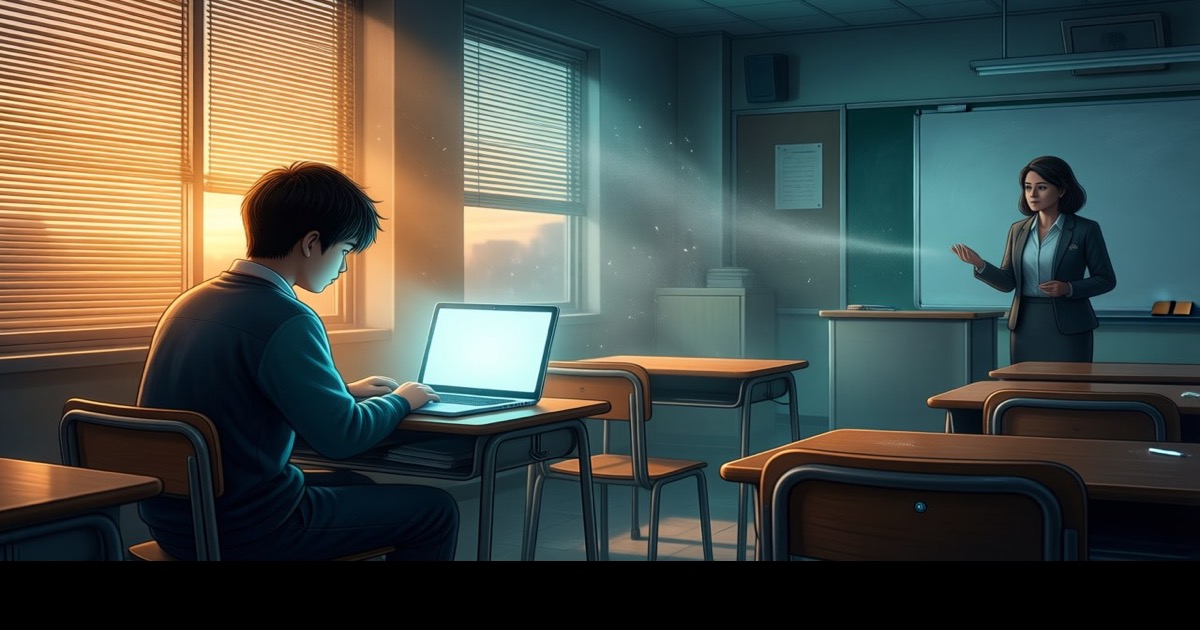
The survey ran in spring 2025 with in-depth interviews from April to June 2026 with 31 teens aged 15–19, plus a dozen educators. The mechanics of suspicion are almost designed, in the researchers’ telling, to be unresolvable. Teachers develop what they call “AI-dar” — a hunch a student used AI — that can’t be proven either way. Some students deliberately underperform so their work doesn’t look machine-polished. One high-school sophomore, 16, told the researchers the current state is “kind of like a hellscape for both students and teachers.” Another student said: “It sucks because I never was going to cheat, but now it feels like I have to.”
Beck Tench, a co-founder of the Center and one of the report’s researchers, gave Education Week the sharp version: teachers hide absurd instructions in white text to trap copy-pasting AI tools, AI homework apps counter by letting students photograph the assignment instead. “It doesn’t breed trust. It breeds a race to the bottom.” Teachers who police students while using AI to write and grade assignments get read as hypocrites; students stop asking teachers anything. “Learning is a process that is relational,” Tench said — and the tool arrived in the classroom with no plan for what it would do to the relationship.
The report’s response is a set of five free classroom “plays” — conversation scripts for talking about values, pressures and grey areas — plus three mindshifts: ask instead of assume, student-centred instead of tech-centred, “us-and-them” instead of “us-versus-them.” The bet is that teachers’ relational skills matter more right now than technical ones. Tench’s own analogy: Ted Lasso coaching a sport he never played.
The Google backdrop
The report lands the same week the Wall Street Journal published an investigation (paywalled, “Inside Google’s Gemini AI Push Into Schools: ‘It Slowed My Thinking Down’”) that examined Google’s push to put AI in front of schoolchildren through Chromebooks and school software partnerships. The Journal’s reporting, built on interviews with more than 60 teachers, school officials, parents, children and clinicians, describes students becoming academically and emotionally dependent on AI — and notes Google’s own researchers have written that the technology can pose elevated risks to children and carries potential for cognitive and emotional harm, citing interviews and more than a dozen Google research papers. One Pennsylvania eighth-grader told the paper he popped algebra questions into the AI-assisted search bar until he failed his maths final: “When I was in a test and I couldn’t use AI, it was hard to think.” (The Journal piece is paywalled; the headline figures here follow its outline and the Harvard report’s independently published data.)
Google’s involvement matters because scale is the variable. Chromebooks already sit on millions of school desks; as the site covered when a Los Angeles school cheating wave surfaced through Google Lens, the infrastructure makes AI use ambient before any policy is written. A Denver district’s classroom AI rollout showed the same pattern: deployment first, consequences later.
The evidence that the worry is real
None of this means cheating panic is baseless. Students do use AI to cheat at scale — the site has covered global exam protests over AI cheating, AI glasses used in East Asian exam halls, and ANU’s blunt take that universities are losing the assessment arms race. Early-2026 survey evidence from England found pupils reporting declining thinking skills linked to AI reliance, carried by The Guardian. And sites such as the UK’s classroom substitution shortage point the same direction: when teacher capacity shrinks, chatbots fill the gap faster than policy can.
The Harvard argument is a redirection, not a rebuttal: the cheating is real, but a surveillance response damages the one mechanism — trust — that makes teaching work at all.
What this means for New Zealand
New Zealand schools are living a smaller-scale version of the same dilemma. NZQA’s rules bar chatbots and generative AI from all external assessment: “The use of chatbots, generative AI, paraphrasing tools… is not permitted,” per NZQA’s published guidance, while the Ministry of Education’s guidance leans on school-level AI policies and teacher judgement rather than detection tools — and explicitly affirms that the teacher-student relationship remains central, with AI tools for marking supporting, not replacing, teachers’ professional judgement. That split — ban AI at the exam boundary, relationship-first everywhere else — is closer to the Harvard framing than either pure surveillance or pure permission. NCEA’s authenticity rules keep colliding with the question no tool can answer: was this the student’s thinking? The Harvard data suggests the cheapest intervention available to a Kiwi teacher is also the most old-fashioned — a conversation. The report’s own framing: teachers are being asked to referee a game whose rules they didn’t write, when what students actually need is a coach.
Our take: the two-way suspicion problem has a shape the tech industry should recognise, because it is the same shape as bot-detection on the open web — CAPTCHAs, device fingerprints, adversarial arms races — and everyone in the industry already knows how those end: honest users pay the friction, sophisticated bypasses win anyway. Classrooms don’t have to run that playbook. Education Week’s reporting on students turning to AI before adults for homework help suggests the schools that talk openly about AI use will keep the relationships; schools that build detection regimes will train students to hide better — the exact opposite of the “transparency” every AI policy on Earth claims to want.
❓ FAQ
What is “two-way suspicion”? The Harvard report’s term for the situation where teachers suspect students of AI use and students suspect they’ll be accused — eroding trust regardless of whether AI was actually used, because neither side can prove anything.
Did the report find students avoid AI entirely? No — the opposite. Teens described pressure to use AI to keep up with peers, and the Harvard report records students going to chatbots before teachers. One quote: “I don’t usually go to my teachers. I kind of just go to Chat.”
Is this relevant outside the US? The mechanism is universal even if the survey is US-based. England already has survey evidence of pupils losing thinking skills, per The Guardian, and New Zealand’s guidance-based approach makes the report’s trust-first framing directly applicable to NCEA debates.
What should schools actually do? The report’s five plays and three mindshifts are the concrete offer: conversation-first policies built with students and teachers, not detection-first policies. Education Week’s write-up has Tench’s examples, including teachers moving from referee to coach.
🔍 THE BOTTOM LINE
The Harvard report’s uncomfortable finding is that the anti-cheating apparatus is now doing measurable damage of its own: students hiding good uses, underperforming by design, and routing around teachers. Detection was supposed to protect learning. The data says it is now one of the things learning needs protection from.
📰 Sources
- Education Week (30 September 2026) — How AI Suspicions Are Undermining Student-Teacher Relationships
- GovTech / Education Week wire (30 September 2026) — AI Cheating Concerns Harm Student-Teacher Relationships
- Harvard Center for Digital Thriving (September 2026) — An AI Policy Isn’t a Playbook (primary report, 1,000+ survey respondents, 31 teen interviews)
- The Wall Street Journal (1 October 2026) — Inside Google’s Gemini AI Push Into Schools (paywalled)
- The Guardian (2 April 2026) — Pupils in England are losing their thinking skills because of AI, survey suggests