Most warehouse and factory robots know where they are the way self-driving cars do: LiDAR and cameras. That works until the air fills with dust, steam or smoke — then the sensors that give an autonomous mobile robot its position on the floor start losing track, and automation quietly hits a wall in exactly the industries that most need it, like steel, chemicals and food processing.
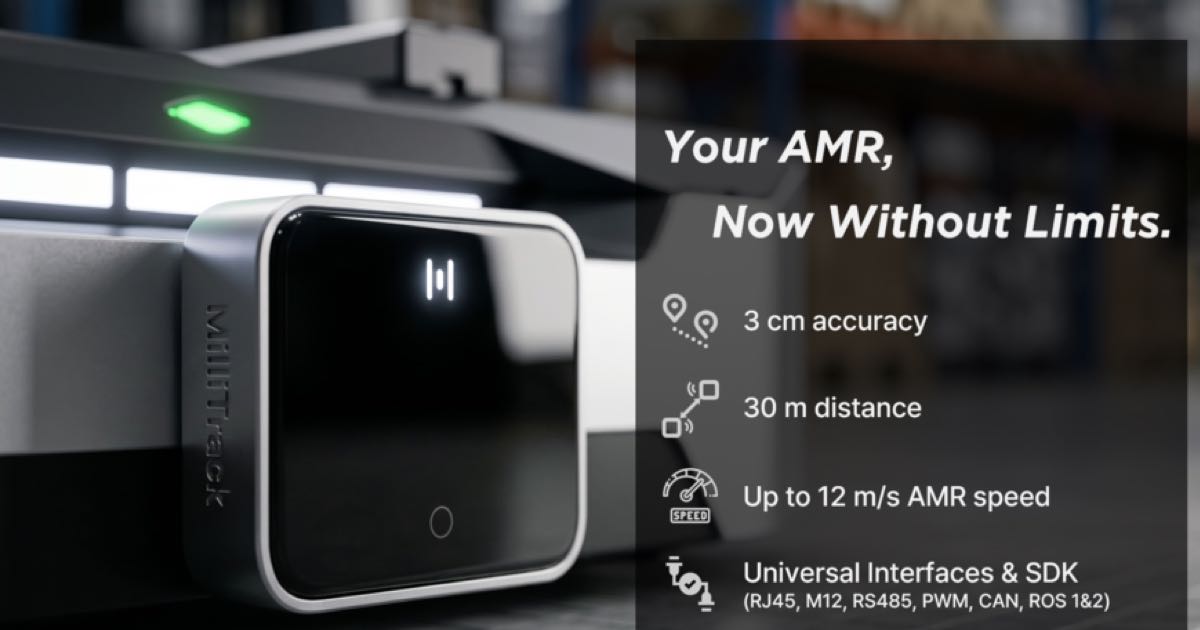
MilliTrack, a spin-off from the Korea Advanced Institute of Science and Technology (KAIST), is launching a product aimed at that gap. AMR+ is a millimeter-wave radio localization add-on: a Tracker unit mounts on the robot, and small Tags placed only in the low-visibility zones keep the robot’s position fix alive when its own sensors can’t. Korean tech outlet AVING News detailed the launch on 18 September.
The numbers, as claimed
MilliTrack says the system delivers 3 cm localization accuracy at ranges up to 30 metres, even in environments dense with metal structures and machinery — a level the company describes as the best among RF localization products on the market. Collision avoidance meets the IEC TS61496-5 safety standard. The core technology carries 22 patents.
The deployment model is the more interesting half. Tags require no network and no power cabling, with battery life of up to 20 years, and MilliTrack says installation takes minutes. Robots keep their existing localization stack; AMR+ only covers the zones where it fails. That’s a retrofit pitch, not a rip-and-replace one — the difference between selling a factory a sticker and selling it a new nervous system.
Why low visibility is the real bottleneck
The company’s framing of the problem is backed by industry safety data it cites: in the global steel industry, 36% of accidents occur under low-visibility conditions, and in the UK’s food and drink industry such conditions account for 25% of casualties. If a robot can hold its position through a steam cloud, the argument goes, plants in those industries can automate zones they currently leave to humans in respirators — or leave unautomated entirely.
MilliTrack was founded by CEO Songmin Kim, a KAIST professor with more than 15 years in mobile sensing research; the company says its localization technology has won 11 awards, including multiple best paper awards from the Association for Computing Machinery. Those are the founder’s claims, and an AVING product-launch piece is not an independent benchmark — 3 cm through steel-heavy clutter is a strong claim that deserves independent measurement. But the architecture, robot-side tracker plus passive zone tags, is a sensible answer to a problem every AMR operator with a washdown or foundry floor will recognise.
It also fits the broader pattern in industrial robotics right now: the frontier is less about new robots than about making existing ones dependable on real factory floors — whether that’s Google and Fanuc wiring Gemini into industrial arms, Honda building hands that can feel, or navigation that survives the conditions where delivery robots do their real work.
Source: AVING News