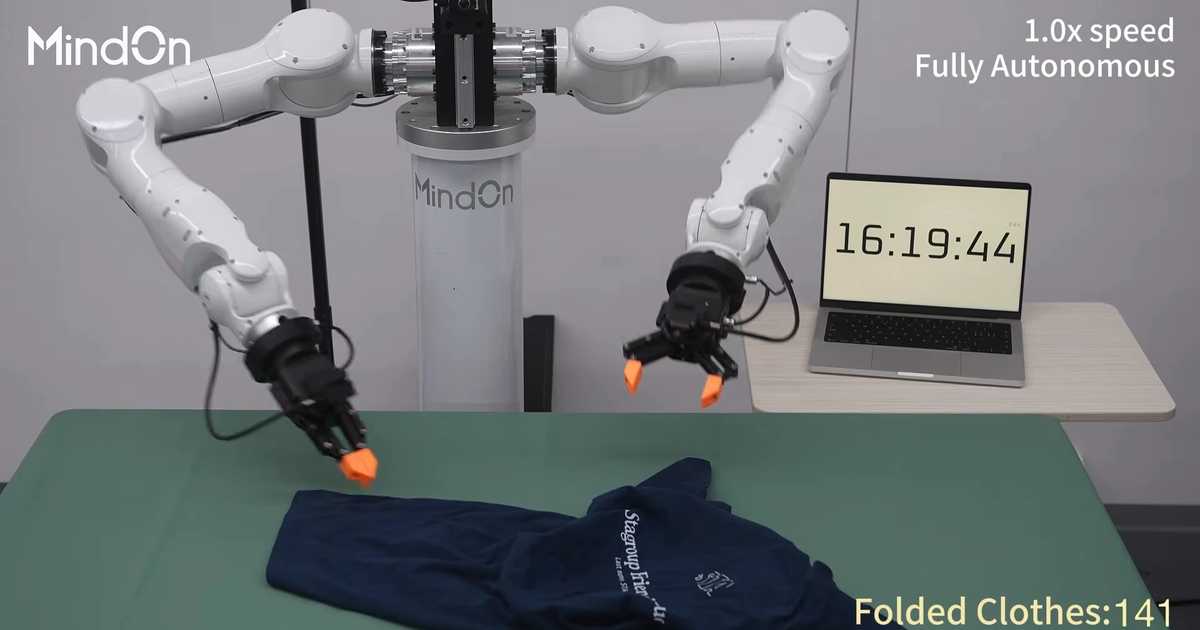
MindOn has put a number on its folding robot. A 59-minute, 22-second video uploaded on October 12 shows the company’s fixed dual-arm Mind-1 station lifting, spreading and folding shirts continuously while an on-screen counter climbs to 142 — a claimed throughput of 142 garments per hour, or roughly one every 25 seconds. In its announcement on X, MindOn calls it “the industry’s fastest robotic clothes folding.” The full video is on YouTube.
The footage carries two self-applied labels: “1.0x speed” and “Fully Autonomous.” Both are doing real work, and one of them needs a footnote. The station — dual arms with grippers over a green work surface, a laptop in frame displaying a clock — never stops moving across the full video. But a person throws a new garment onto the table after each completed fold, so the demonstration measures folding throughput within a human-fed workflow. Humanoids Daily, which reviewed the full footage, puts the caveat plainly: the headline rate “alone does not establish performance across different clothing types or an entire laundry workflow.” The robot does not find the shirt, separate it from a pile, or clear the finished fold away.
The number is still notable for what it replaces. When MindOn last demonstrated Mind-1 in September, the pitch was human-level task cycle times across packaging, parcel sorting and folding — an intelligence layer built to move between robot platforms, rather than a new robot — but without any quantified throughput. Nearly a month later, the company has attached its first public figure to the folding task and framed the video description around what it says actually matters for useful work: sustained operation, throughput and reliability. An hour of continuous footage is a different genre from the 30-second highlight reel; it is harder to cherry-pick, and it invites the viewer to look for cuts or resets. MindOn’s bet is that duration is proof.
The claim has a shape, though, and it is worth comparing to neighbouring claims. When we covered X-Square Robot’s 1,816 parcels per hour, the same pattern held: an impressive rate, company-labelled footage, and a workflow with humans stationed at the boundaries of the task. The alternative shape is end-to-end: Humanoids Daily recently covered Dyna Robotics’ Taku, which the company describes as a full hour-long laundry workflow — wash, dry, fold, shelve — run autonomously and uncut across machines and a folding station. MindOn optimises the folding step; Dyna optimises the choreography around it. Operators buying either will be paying for very different things.
What is unmeasured is as telling as what is claimed. There is no intervention count, no error rate, no breakdown across garment types — a dress shirt and a crumpled t-shirt are different problems — and no figure for what happens when the human feeder is late. Nor is there third-party timing; the 142 comes from MindOn’s own on-screen counter. The verification-minded end of the field has been pushing toward causal checks of what a robot actually did — verifiable task claims rather than plausible footage — and this demo sits some distance from that bar.
For the operations this technology targets, the human-fed detail is not a nitpick. Hospital and aged-care linen services — a natural early market for laundry automation, including in New Zealand where those laundries face the same staffing squeezes as everywhere else — already employ people whose whole job is feeding the folder. If Mind-1 replaces the folding step but still requires a worker stationed at the table, the economics improve less than the headline suggests. The value arrives either when the feeding step goes too, or when one worker can keep several stations supplied at once. Neither is shown here.
The honest read: MindOn has demonstrated a genuinely impressive folding cadence and — rarer — left a full hour of evidence on the table for anyone to inspect. The claim it has not yet demonstrated is the one printed in its own announcement: fastest, in the industry, at folding clothes. That gap is closable, and the video format they chose is exactly the kind that lets the next demo close it.
Source note: story draws on MindOn’s X announcement and full YouTube demo, Humanoids Daily’s review of the footage, and Interesting Engineering’s September background on Mind-1.