A Beijing physical-AI startup called Striding AI has wheeled its retail robotics system onto a public stage: a bipedal humanoid, a slim wheeled-aisle robot and a fleet-management platform, pitched at convenience stores that trade around the clock. The company showed the system on October 8 at the 22nd Asia-Pacific Retailers Convention and Exhibition (APRCE 2026), according to Pandaily, citing a company release carried by QbitAI.
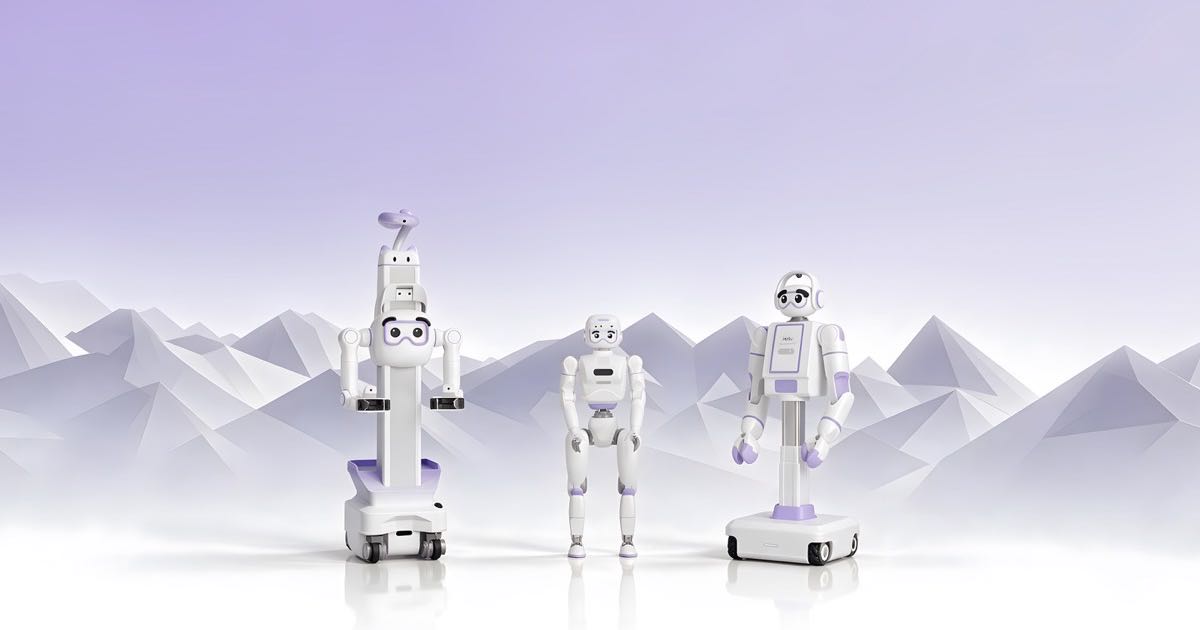
The trio splits the work. H1, the bipedal humanoid, is built for spaces where customers move around: the company says it speaks more than 20 languages, shows 45 facial expressions and 36 gestures, and exposes an open API for developers. C1 is the workhorse — a robot with arms on a slim omnidirectional base for narrow aisles, reaching from about 100 millimetres off the floor to more than 1,750 millimetres, handling moving goods, restocking shelves and loading. Striding says C1 senses nearby shoppers with fused sensors and stops within 10 centimetres of an obstacle in an emergency, with front and rear depth cameras plus 360-degree vision. M1, the platform layer, assigns tasks, tracks status and lets human staff take over when the robots get stuck.
The headline claim is “zero retrofit”: no changes to store shelves or walkways, so the robots slot into existing stores as-is. The company also says its robots complete 99% of tasks on their own — a figure it has not explained in detail, and worth treating with the usual skepticism until an independent deployment proves it. Underneath sits the model stack: SLM-0.5, a lightweight world action model the company says scored 98.6% average task success on the LIBERO benchmark with inference 24 times faster than mainstream approaches; STEAM, a reinforcement-learning post-training system built on the open-source RLinf framework, claimed at 95% success on a shelf-stocking task; and Rpent, an agent layer developed with Tsinghua University and Infinigence AI. AX Brief’s write-up adds that human-in-the-loop RL — humans correcting robot behaviour in real time — has lifted task success rates up to 3x in internal testing.
The company is far from an unknown quantity. Striding AI launched publicly in June 2026 with plans to build next-generation robotic foundation systems, per a GlobeNewswire release carried by Yahoo Finance, and Grishin Robotics’ Dmitry Grishin has publicly noted the company raising nearly $100 million. Its founding team pairs serial entrepreneur Song Yao with Yang Yuxin, Tsinghua researcher Yu Chao and the Charoen Pokphand Group — the Thai agribusiness giant, which is exactly the sort of backer with retail footprints across Asia. The plan: pilot with a large global retail chain, start commercial service in 2027, sold outright or as Robotics-as-a-Service, with a checkout-and-bagging A1 robot and a heavy-duty model on the roadmap.
The convenience store is an interesting landing spot. Unitree’s consumer-priced R1 humanoids show Chinese makers racing down the price curve, while BYD’s design filings suggest even carmakers see humanoids as products rather than PR. Striding’s angle is narrower and arguably smarter: instead of one general-purpose humanoid, it pairs a pedestrian-friendly biped with a wheeled unit and confines both to a bounded, mapped, camera-saturated environment where “zero retrofit” is the difference between a pilot and a sale.
The hedge belongs in the same paragraph as the excitement. The 99% autonomy figure is unexplained. The benchmark numbers are the company’s own. And the gap between an exhibition floor demo and a 3am restock in a crowded, taped-over-milk convenience store — where a dropped sauce bottle at speed near a customer is the entire risk case — is where most retail-robot pilots have died. Walmart’s experience with warehouse automation is the standing reminder: even at a decade and billions of dollars, the simple physical tasks keep winning.
China’s 24/7 convenience-store sector is the natural first market, and it is a tough one: thin margins, high labour churn, and night shifts that are genuinely hard to staff. If Striding’s zero-retrofit pitch survives contact with even a handful of real stores in 2027, the economics write themselves; if it slips, the RaaS subscription model quietly becomes a leasing company for robots that can’t quite finish the shift. Watch the pilot partner announcement — that name, not the benchmark table, will tell you whether this is a product or a demo.
Sources: Pandaily · AX Brief · Striding AI · Yahoo Finance / GlobeNewswire