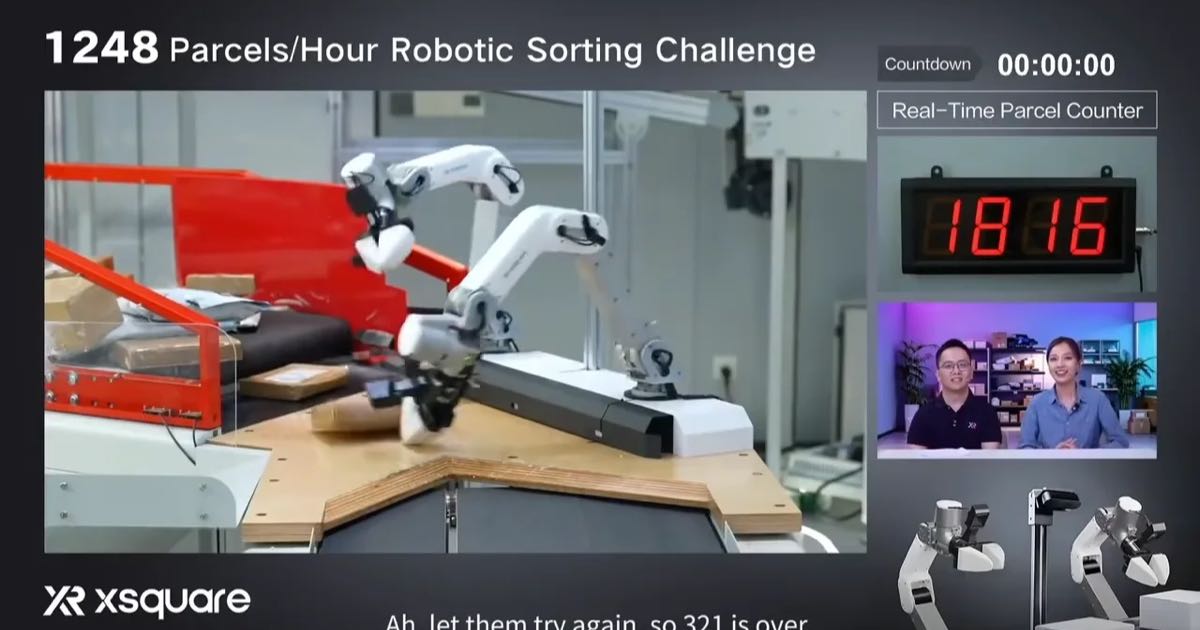
A Shenzhen-based startup called X Square Robot sorted 1,816 parcels in a single hour during an unedited livestream on August 12, beating its self-imposed target of 1,248 — a number chosen because it matches Figure AI’s sustained hourly rate. The 45 per cent margin wasn’t a lab demo. It was a raw, one-shot broadcast with real parcels of varying shapes and sizes moving down a conveyor belt.
🔍 THE BOTTOM LINE
The humanoid robotics industry has been obsessed with five-finger dexterous hands and full bipedal platforms. X Square Robot just proved that for warehouse logistics — the actual paying use case — simple grippers on a stationary dual-arm system deliver more throughput at lower cost. The gap between demonstration theatre and commercial deployment is narrowing, and Chinese startups are closing it faster than most expected.
Grippers Over Hands
The most striking design choice was what X Square deliberately left out. Instead of the articulated five-finger hands that companies like Figure AI and Tesla have been showcasing, the system used purpose-built grippers — essentially industrial tongs. The company addressed this head-on in statements on X: “We often ask ourselves why we remain committed to a purpose-built gripper. The answer is simple: not for hype, and not for a demo, but for real-world deployment. Our goal is to deliver high efficiency at a lower cost.”
The sorting task required the dual-arm system to grasp incoming packages, flip them so barcodes or QR codes faced upward, and route certain package types into alternative chutes. The parcels ranged from rigid cardboard boxes to soft, irregular poly bags. During the stream, the system even recovered a package that was about to fall off the workstation — the right arm intervened mid-sequence to rescue it. A success rate above 98 per cent across 1,816 randomly selected parcels is not a controlled-environment number.
The Figure AI Parallel
The format was no accident. In May, Sunnyvale-based Figure AI ran what was supposed to be an 8-hour unedited shift of its Figure 03 humanoids sorting packages. That stream escalated into a viral 26-hour milestone, then 64 hours, and ultimately concluded as a 200-hour marathon with zero hardware failures. Figure’s demonstration used full bipedal platforms that autonomously swapped out to recharge.
X Square’s approach was different: stationary dual-arm manipulation, no walking, no humanoid body. But the core technical challenge is identical — using vision-based AI foundation models to process camera pixels and generate real-time motor torque for manipulating unpredictable objects in continuous, unscripted conditions. The comparison is less about which platform is more impressive and more about which solves the customer’s problem at the right price point.
Chinese developer AGIBOT also recently shifted the benchmark from lab to factory floor, hosting a six-day livestream from an active tablet mass-production line. Multiple robots collaborated with human workers for quality inspection. The trend is clear: unedited endurance tests have become the industry’s new credibility standard.
A $1 Billion War Chest
X Square Robot was founded in December 2023. In less than two years, it has secured multiple financing rounds, including a 1 billion yuan (approximately NZ$230 million) Series A++ in January 2026 and a Series B in April backed by Xiaomi. Meituan, Lightspeed China, and Legend Capital are also on the investor list.
The company has released its WALL-A and WALL-B foundation models, built China’s first large-scale industrial data acquisition facility, and open-sourced its WALL-OSS ecosystem. Its “General Embodied Foundation Model” architecture is the technical backbone behind the sorting performance. X Square will showcase its complete logistics sorting line at the upcoming World Robot Conference in Beijing, running August 19-23.
Why This Matters for the Market
The robotics industry has a history of scripted demos that collapse under real-world conditions. The livestream trend — pioneered by Figure AI, now adopted across Chinese competitors — is forcing a discipline that marketing videos never could. You cannot edit out a dropped parcel in a live broadcast.
What stands out here is the economics. A stationary dual-arm system with simple grippers is dramatically cheaper to build, install, and maintain than a full humanoid. If a warehouse operator can get 1,816 parcels per hour from a system that costs a fraction of a bipedal robot, the business case for humanoid platforms in pure sorting applications gets harder to make. The humanoid advantage — mobility, multi-task flexibility — matters in less structured environments. In a warehouse sorting station, it may be overkill.
This connects to a broader pattern we’ve been tracking: the gap between companies targeting full humanoid platforms and those building task-specific robotic systems is widening. Both can win, but in different markets. The companies that will lose are the ones trying to do both badly.
NZ Angle
New Zealand’s logistics sector — particularly the e-commerce fulfilment centres run by NZ Post, The Warehouse Group, and Amazon’s Auckland facility — represents exactly the kind of market where stationary dual-arm sorting systems could deploy. The technology doesn’t require a humanoid body or autonomous navigation, which means lower capital cost and faster ROI. For NZ’s apple industry, which is already exploring automation for harvest and sorting, the gripper-over-hand philosophy is directly relevant: purpose-built end-effectors for specific produce shapes will outperform generalist hands every time.
❓ FAQ
How does 1,816 parcels per hour compare to human performance? A skilled human sorter typically handles 800-1,200 parcels per hour depending on package variety. X Square’s system exceeded the top of that range by 50 per cent, with a 98 per cent success rate.
Why did they choose 1,248 as the target? That number corresponds to Figure AI’s sustained hourly sorting rate during its marathon demonstration. X Square explicitly set Figure’s benchmark as the baseline, then beat it — a competitive signal aimed at the global market.
Is X Square Robot a humanoid company? Not in the traditional sense. The company builds embodied AI systems, but its current commercial focus is stationary dual-arm manipulation for logistics. Its foundation models could eventually power humanoid platforms, but the go-to-market strategy is task-specific.
What happens at the World Robot Conference? X Square will demonstrate its complete logistics sorting line live at WRC Beijing, August 19-23. The company joins roughly 300 exhibitors and 2,000 products at what has become the world’s largest robotics trade event.
🔍 THE BOTTOM LINE
X Square Robot’s livestream is less a story about a single company and more a signal about where the robotics market is heading. The companies winning commercial deals are not necessarily the ones with the most impressive humanoid bodies — they are the ones solving specific industrial problems at a price that makes the unit economics work. Grippers over hands. Throughput over aesthetics. Deployment over demos. The Shenzhen startup scene has absorbed that lesson faster than anyone expected.
📰 Sources
- Humanoids Daily — No Fingers, No Problem: X Square Robot’s 1,816-Parcel-Per-Hour Livestream
- PR Newswire — X Square Robot Demonstrates Embodied AI in Real-World Logistics Operations
- Pandaily — X Square Robot Set Its Benchmark at Figure AI’s Number, Then Beat It
- RobotToday — X Square Robot Exceeds Figure AI’s Benchmark