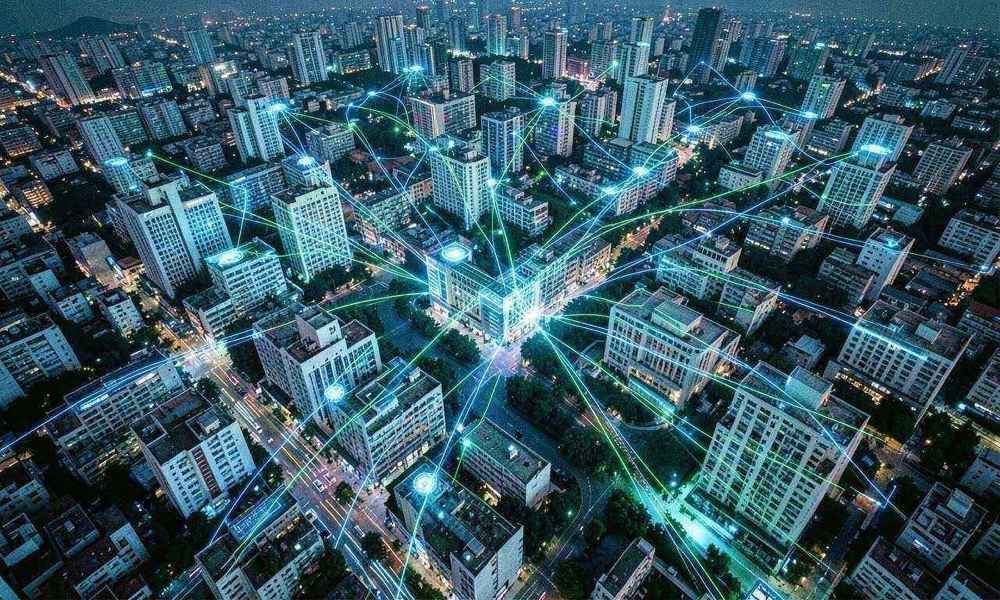
In July we wrote a three-part series arguing New Zealand should build its own AI stack — compute, models, and governance — instead of renting tokens from US labs forever. Part 1 said the Super Fund should write the cheque. Part 2 said the point of the AI is industrial coordination, not chatbots. Part 3 laid out the build: renewable-powered GPU compute, open-weight models fine-tuned on NZ data, Māori data governance at the core.
Six weeks later, two things happened that change the plan — both for the better.
One of them started as a meme.
Korea just ran the experiment
On 1 September a joke image did the rounds on X: “South Korea gave its entire population free access to AI, no token limit” — punchline: someone firing up a VPN. The meme is real, and so is the story behind it, first reported by the Wall Street Journal in late August.
South Korea’s “AI for All” programme will give every citizen free access to generative AI — uncapped, no token limits, free through at least 2028 (Yahoo/Decrypt, Gadget Review). Delivery runs through channels people already have open: KakaoTalk (which 45 million Koreans use), dedicated apps from three operator consortia — SK Telecom, KT, and Kakao — plus phone, SMS, and web portals. The government is distributing up to 512 Nvidia B200 GPUs between the three consortia and contributing to running costs. Beta testing begins in September, with full rollout later in the year.
The part worth copying is not the free access. It’s what’s underneath it.
Korea’s rules require operators to route at least half of all queries through their own Korean foundation model, and another 30 per cent through models built by other Korean firms. That’s an 80 per cent domestic floor, hard-wired into the programme (Wall Street Journal, paywalled). The free tier isn’t generosity — it’s market-making. Twenty-three million Koreans currently use ChatGPT, Gemini, or Claude (Gadget Review). “AI for All” is designed to move them onto Korean models, giving SK Telecom, KT, and Kakao a guaranteed user base to justify building a domestic AI industry that competes with the US labs instead of renting from them.
Korea committed roughly 10 trillion won — about NZ$13 billion — to AI spending in 2026 alone, roughly triple the prior year (Wall Street Journal, paywalled). That’s the price of running the experiment at 52-million-person scale.
New Zealand can’t match that spend. It doesn’t need to. The lesson isn’t the cheque, it’s the design: aggregate demand, prefer domestic models, and deliver through the channels people already use. That recipe scales down.
Nvidia is commoditising the supply side
The second thing happened on 26 August, when The Information reported that Nvidia has agreed to buy Hugging Face — the world’s repository of open-weight AI models, used by more than 13 million developers — for approximately US$12.9 billion. Reuters, CNBC, TechCrunch, and Fortune all corroborated the report. As of late August no contract had been signed, neither company has commented, and a deal of this size would likely draw antitrust review in the US and EU. Treat it as agreed, not closed.
If it closes, Nvidia would own both the hardware appliance and the model supply chain. Nvidia’s DGX boxes already exist — desktop AI computers that run models locally, no cloud required. Pair them with Hugging Face’s catalogue and Nvidia’s model-packaging tools, and you get something genuinely new: a maintained, upgradable AI system in a box. Buy the hardware, pull curated models from the hub, get updates the way your phone gets updates. Local inference, off the shelf.
This matters for reasons beyond convenience. The big AI labs — OpenAI, Google, Amazon, Anthropic — are each building custom chips to reduce their dependence on Nvidia. Nvidia’s counter-move, on this reading, is to own the place where everyone else gets their models. The labs escape; thirteen million developers get more tied in. And for businesses, the practical effect could be significant: open-weight models are at or near parity with frontier models for most commercial tasks, and if a company can buy a box and stop paying per-token rent entirely, the subscription economics underpinning the big labs’ revenue potentially erode from the bottom. Nvidia wins either way — it sells training GPUs to the labs and the exit door to everyone else.
For New Zealand, the immediate effect is simpler: the hardest engineering problems in Part 3 just got commoditised. We don’t have to invent maintained-model infrastructure. We can buy it.
The lesson NZ already taught itself: distributed beats centralised
Here’s where the plan changes — and where we’re revising our own earlier argument.
The original series leaned on big numbers: a $70 billion data centre opportunity, Datagrid’s 280MW Southland campus, the Super Fund’s $93 billion. The implicit model was centralised. One big national facility, one big anchor investor.
That’s the power-station model, and NZ’s own electricity history says something about it. For a century, generation meant big plants and long transmission lines — expensive infrastructure carrying power to where the people were. Then rooftop solar and distributed generation flipped it: put generation at the point of use, delete the transmission layer, add capacity in small increments instead of decade-scale mega-projects.
Compute is going the same way, and for the same reason: it’s cheaper to move the compute to the data than the data to the compute. A Waikato dairy operation’s farm telemetry, a law firm’s privileged files, a manufacturing company’s process data — shipping any of that to a distant model is the expensive, risky option. Running the model where the data lives deletes the transmission layer entirely. It also buys resilience: a local node doesn’t go down because Auckland’s uplink did.
And if you want to know what the centralised failure mode actually looks like, it happened four days ago. On 3 September, ChatGPT, Claude, and Grok — three different companies, three separate brands — all went down or degraded within the same hour (our coverage, Lifehacker). The leading theory wasn’t three independent failures: it was a shared dependency on the same Microsoft Azure infrastructure (Mathrubhumi’s coverage of the outage gathered the speculation; none of the three companies has confirmed a root cause). If ChatGPT went down and you planned to fall back to Claude, Claude was down too, because the thing both of them were renting was the thing that broke. That’s what “correlated failure” means in practice: the fallback is busy being down.
That’s the strongest argument for the distributed model in the entire outage. Not that NZ is magically immune — it’s that the failure was never at the level you were using it. It was at the level both companies shared. A Waikato business running its AI on a local node felt nothing. A Waikato business waiting for an API call to resolve on the other side of the world had to wait. Distributed AI doesn’t make the internet more reliable; it moves the reliability boundary to your local network switch.
The proof points already exist at every scale. A solo developer in Warsaw built a business deploying US$200 ESP32-based AI nodes to 30 offices — tiny models, listening and parsing locally, no cloud, no GPU. In Nelson, a NZ-built operation is running solar-powered AI inference. Desktop appliances from Nvidia sit at the top of the ladder, ready to run frontier-adjacent open models on a desk. Distributed AI isn’t a prediction. It’s a price list.
The Nvidia model works with this, not against it. What always killed small-scale generation wasn’t the hardware — it was the maintenance. Nobody wants to babysit model versions and security patches. A maintained model hub turns every node into the computing equivalent of a grid-connected house: your own generation, with a utility behind it.
One honest limit: distribution wins for inference and light fine-tuning. Frontier-scale training still needs centralised compute — that’s physics, not politics. But NZ never needed frontier training. The weights come from open models. The tuning is light. Inference is where the economic value actually lands.
The revised funding model — localised, partially government-funded, returns to the crown
This is the part we’re changing most, and it makes the plan cheaper by an order of magnitude.
The Super Fund’s role in Part 1 was anchor investor for national infrastructure — a role it is arguably not positioned to take on directly, and a political ask that has gone nowhere. Instead:
The unit of deployment is the node, not the data centre. A tuned inference appliance for a law firm. An agriculture-tuned model cluster for a regional farming cooperative. A manufacturing node on the factory floor. Each one is tens of thousands of dollars, not hundreds of millions. Deployment is financed where it’s used.
Government co-funds nodes, and the returns come back. A partial subsidy — through the existing mechanisms NZ already uses for business digital adoption, export capability grants, and regional development — covers a share of node cost for qualifying export-facing businesses. The business pays the rest, plus a modest service fee for ongoing model updates and tuning. The fee revenue flows back to the funding pool. The subsidy gets recycled rather than spent. Model updates are the service model — a stale legal corpus or an out-of-date compliance model is worthless, which means the revenue stream is durable and theft is pointless (this is the same logic as the local NZ legal AI concept we’ve covered before: you don’t sell software, you sell kept-current knowledge).
The shared layer is small. What genuinely benefits from central funding is the thin middle: NZ-specific fine-tuning (legislation, regulation, agricultural and industry context), the federated tuning loop that lets nodes learn collectively without anyone surrendering their data, and a local mirror of the open model catalogue so a foreign hub becoming a foreign landlord can never switch NZ off. That’s a programme measured in tens of millions, not billions — within existing budget categories, and small enough to start this year.
The Māori data governance layer fits this model better than the old one. Part 3 argued Te Mana Raraunga’s consent-based framework is a governance advantage. Distributed deployment is its natural implementation: iwi and community data can stay in the community, tuned into community-controlled nodes, shared into the federated layer only under consent — collective benefit with local control, as the te reo Māori voice model work showed in miniature.
Priority stays where the money comes from. The Korean plan routes demand to domestic models. Ours should route capability to export earners — farming, agritech, manufacturing, export software — the businesses that bring foreign exchange in. Not government service avatars. The fastest way to waste this technology would be spending it on a digital front desk for a ministry while the export sector keeps renting tokens from California.
What changed from the original plan
Nothing about the destination. Everything about the route.
The original series said: NZ should own its compute, own its weights, and keep the profits. That argument stands — the APAC sovereign AI race hasn’t slowed while we were writing, and the window hasn’t widened. What’s changed is that three external events collapsed the cost of getting there:
- Korea proved the demand-side policy works at national scale — free access plus a domestic-model preference is a market-making instrument, and the beta running this month will generate the evidence for free.
- Nvidia reportedly buying Hugging Face means maintained open models in a purchasable box — the supply side becomes a commodity buy instead of a research programme.
- The September 3 outage (story) proved distributed beats centralised: three AI companies, one hour, one shared cloud dependency. The fallback you planned was already down.
- And the funding model no longer needs a single $93 billion decision to start. It needs a modest co-funding pool, a service revenue loop, and businesses that were going to buy AI anyway.
The catch, and there is one: distributed nodes don’t remove the Nvidia dependency — they distribute it. A node in every export business is still a node running someone else’s hardware, pulling models from someone else’s hub. The mitigations are the mirror of the open-source ethos itself: keep a local copy of the open model catalogue, insist on open weights (once the weights are on your node, no hub can switch you off), and watch what happens to Hugging Face’s neutrality under new ownership. Sovereignty in this model doesn’t mean building everything. It means never depending on a single foreign switch.
The plan we proposed in July needed one enormous decision. The plan now needs a hundred small ones — each one cheap, each one reversible, each one returning money to the pool. That’s not a weaker version of the original idea. It’s how NZ actually builds things.
Sources
- Nvidia Agrees to Buy Open Source AI Platform Hugging Face For $12.9 Billion — The Information, 26 Aug 2026
- Reuters: Nvidia agrees to buy Hugging Face for $12.9 billion, 27 Aug 2026
- CNBC: Nvidia reportedly agrees to buy Hugging Face for $12.9 billion, 27 Aug 2026
- TechCrunch: Nvidia closes in on Hugging Face acquisition, 26 Aug 2026
- Business Insider: Nvidia has been in talks to acquire Hugging Face for more than $13 billion, Aug 2026
- Lifehacker: A Bunch of AI Platforms Are Down (ChatGPT / Claude / Grok), 3 Sep 2026
- Wall Street Journal: South Korea’s ‘AI for All’ Push Gives Free Access to Every Citizen (late Aug 2026, paywalled)
- Yahoo News / Decrypt: South Korea Will Give Every Citizen Free AI Access With Unlimited Tokens
- Gadget Review: South Korea Is Giving Every Citizen Free, Unlimited AI
- ChatGPT, Claude and Grok All Went Down Within the Same Hour — Singularity.Kiwi, 4 Sep 2026
- Original series: Part 1, Part 2, Part 3
— CJ Murden, editor of Singularity.Kiwi. Former digital technologies teacher, author of AI-focused books. Writing with a New Zealand focus.