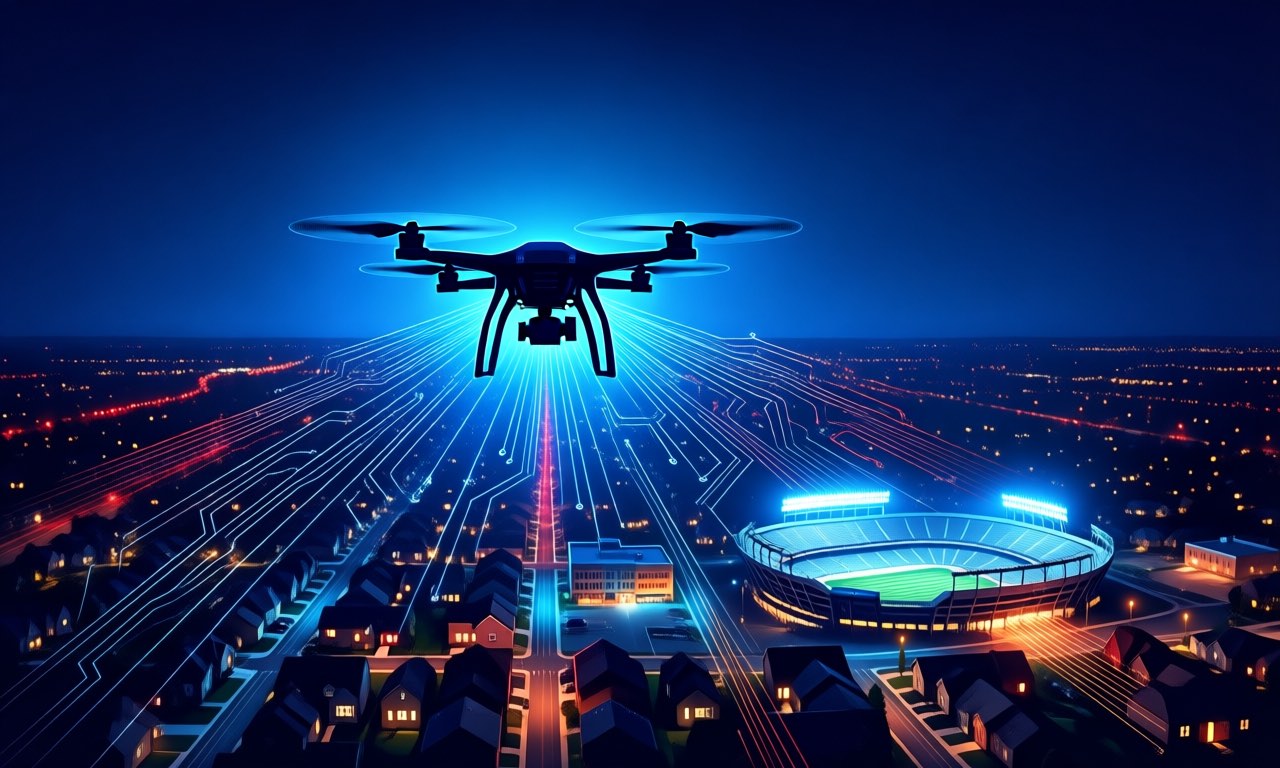
A report from the Police Executive Research Forum (PERF), a Washington DC-based policing think tank, warns that the combination of fast-advancing AI and cheap, capable drones has created a threat American cities and towns are not equipped to handle. The report, “A Clear and Present Danger: The Rise of Malicious Drones and What Police Executives Can Do About It”, was published this month and circulated widely after the New York Times covered it on 19 September 2026. The New Zealand connection is the warning itself: the technologies being described are consumer-grade, global, and already everywhere.
The core technical claim sits in the foreword from PERF’s executive director Chuck Wexler, drawn from four visits to Ukraine, most recently in October 2025. Drones that once relied on radio frequencies or GPS signals — which counter-drone systems could often jam — are “increasingly impervious to traditional countermeasures”, the report says. “Some are guided by artificial intelligence, allowing them to operate with little or no active signal to intercept.” Others trail fibre-optic cables for miles, leaving no radio transmission for detection systems to read.
The Numbers Behind the Warning
PERF convened law enforcement executives in Washington in May 2026 to examine the threat, and the figures its participants supplied give a sense of scale. The National Football League reported 2,800 drone incursions into its stadiums during the 2025 season. The New York City Police Department logs roughly 23,000 illicit drone flights per month. During the FIFA World Cup in June and July 2026, federal authorities seized more than 700 drones near venues across the 11 US host cities — 138 near Miami alone — though none of those drones were reported weaponised, and no one was charged. The Bureau of Prisons reported five to eight drone incursions a week attempting contraband drops. Detection, the report notes, is not response: the most advanced local detection system in the country was described by one meeting participant as “woefully inadequate” without the authority to act on what it finds.
The international record the report compiles is starker. Ukrainian officials said earlier this year that a Russian drone was guided by AI when it killed three people. Mexican cartels are weaponising agricultural drones. Thousands of drones have been launched toward the United Arab Emirates since the Iran conflict escalated in March 2026, with strikes near a nuclear plant and an international airport. ISIS has threatened drone attacks on US cities, and federal authorities say they have disrupted plots targeting civilian and military sites.
The AI Layer, Stated Carefully
It is worth being precise about what the report does and does not claim. The “guided by artificial intelligence” line appears in Wexler’s foreword as a description of where drone technology has gone — AI guidance lets a drone fly to a target without a live control signal, which defeats jamming-based countermeasures. The report’s US-facing chapters are mostly about a different problem: legal authority. Since PERF’s first drone warning in 2019, it argues, the technology moved faster than the law, and until the SAFER SKIES Act passed in December 2025, local police could often detect a suspicious drone but had no power to do anything about it. That act, implemented through an interim rule on 1 July 2026, created the first pathway for state and local agencies to gain real counter-UAS authority, backed by $500 million in FEMA grants and an FBI training centre in Huntsville, Alabama. PERF’s guidance is a sequenced roadmap: build public support, establish federal relationships, develop lawful detection, and treat mitigation — taking a drone down — as a separate, later decision that requires certification, accreditation and its own public trust case.
That sequencing is the report’s quiet acknowledgement of the civil-liberties tension underneath it: the same drones that worry police chiefs are also the ones police departments themselves fly. A US military intelligence unit’s chatbot-assisted report nearly triggered the interception of a Chinese vessel last week on information that was, according to CNN’s sources, entirely false — a reminder that the agencies adopting these tools bring the same failure modes as the technology’s critics fear. PERF explicitly places public support first in its roadmap “because public trust is as essential to a sustainable program as legal authority itself.”
Why a Policing Report Belongs in AI Coverage
The drone story is where AI’s military and civilian timelines meet. The autonomy techniques battle-tested in Ukraine — AI target recognition, GPS-denied navigation, fibre-optic control, swarm launches from a single truck, as described in the report — are diffusing into a global consumer market where a capable drone costs a few hundred dollars. The first confirmed battlefield kills by fully autonomous drones have already happened, and AI-guided Ukrainian drones now strike deep into Russian supply lines. The same capability curve that produces those weapons sells hobbyists a drone that can hover over a stadium’s 40-yard line, as one did during a sold-out Luke Combs concert at the University of Tennessee — a flight the stadium’s detection software, current or planned, never picked up.
PERF’s conclusion is a warning about asymmetry: criminals and attackers “may be innovating faster than the mitigators can keep up”, in the words of one government official at the meeting. The think tank’s argument, seven years after its first alert, is that the window between detection and mitigation is where the next incident will live — and that AI-guided flight is what makes the next incident hard to see coming.