Samsung Electronics has completed the command structure for its robotics business, and the shape of it tells you what kind of robot the company intends to build. Yoon Jang-hyun, chief technology officer of the Device eXperience (DX) division, has been named head of both the hardware development team and the AI software development team at the Robotics (RX) Business Promotion Office, according to industry sources cited by Seoul Economic Daily on September 8.
That is an unusual arrangement. In most robotics programmes, the mechanical frame and the AI stack answer to different executives, because they are different disciplines with different timelines. Samsung has deliberately collapsed them under one software specialist. The stated logic: a humanoid built the traditional way — mechanical frame first, software layered on top — cannot keep pace with AI models that change weekly. Give one software-focused executive full development authority, the reasoning goes, and the robot gets designed around the AI algorithms from day one, shortening the development cycle. Whether that works in practice is exactly the experiment.
The RX Business Promotion Office was created in July 2026 as the control tower for Samsung’s robotics business, reporting directly to DX Division Head Roh Tae-moon. Around Yoon, the bench is now complete: Executive Vice President Lee Dong-gun, formerly of Hyundai Motor Group — where he led the acquisition of Boston Dynamics — heads the strategy team, and Vice President Kim Eui-gyeom, an Ajou University professor, leads manipulation development. One strategy lead who has bought a robotics company before, one academic specialist in manipulation, and one CTO running body and brain together.
The CES 2027 clock
Samsung intends to unveil a humanoid prototype at CES 2027 in the United States early next year. That is roughly sixteen months of runway for a first public hardware reveal, which is aggressive for a company that has so far shown trademarks rather than machines: the “SAMSUNG BOT” trademark dates to 2022, a 2024 patent covers humanoid hip joint design for bipedal walking, and an April 2026 US patent describes a robot hand that uses camera vision to rearrange its fingers to match the shape of an object it is about to grasp.
That hand patent is the one worth watching. Grasping is where humanoids embarrass themselves in industrial deployments, and a fingers-that-adapt design, if it works outside the patent document, addresses the actual bottleneck rather than the photogenic one.
Why the rush
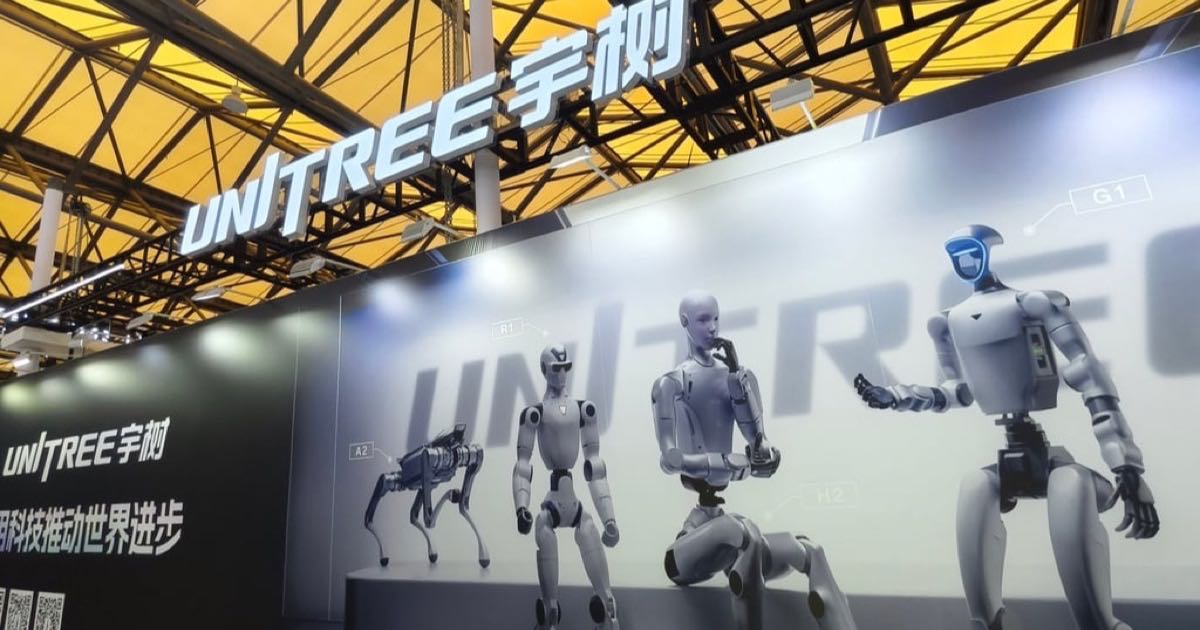
The urgency has a number attached. Global humanoid shipments reached 19,100 units in the first half of 2026, up 272 per cent from a year earlier, according to market research firm Smart Analytics Global — and Chinese companies accounted for more than 97 per cent of them. AgiBot led with a 44 per cent share, followed by Unitree at 31 per cent, Galbot at 5 per cent, UBTech at 4 per cent and LeJu at 3 per cent. Over 70 per cent of the first half’s humanoids went to industrial and commercial use, deployed on automobile assembly and parts lines.
We tracked that shift in August, when AgiBot overtook Unitree atop the market and Chinese factories started buying humanoids in production volumes rather than pilot quantities. Samsung’s share of those 19,100 units is, on this evidence, nothing. The company is not entering a promising new market; it is entering a market that is already being harvested by rivals moving on speed and volume. Samsung’s counter-strategy is the opposite of theirs: bring everything in-house, from product design to the AI brain, and try to take command of the ecosystem in one move — rather than shipping thousands of units and iterating in public the way the Chinese leaders are doing.
Whether an in-house, design-to-the-algorithm humanoid can leapfrog a 272-per-cent-growth incumbent ecosystem is the genuine open question. Chinese makers are iterating against real factory feedback every week. Samsung is optimising for a single well-finished reveal. The IFA floor in Berlin earlier this month showed how far the Chinese machines have come in public; CES in January will show whether Samsung’s structure-first bet produces anything that changes the comparison.
For New Zealand, the near-term relevance is limited — SAMSUNG BOT consumer applications remain speculative, and the first Samsung units, if they arrive, will target industrial buyers. The interesting watch-item is the second-order one: if Samsung applies the same body-and-brain co-design logic to home robots built on its appliance platform, the company that already sits in New Zealand kitchens and laundries becomes a distribution channel no robotics startup can match.
— CJ Murden, editor of Singularity.Kiwi. Former digital technologies teacher, author of AI-focused books. Writing with a New Zealand focus.