Four stories this morning share one shadow: a factory robot thinking in a Google datacentre, a drone steered from an Amazon server, a central bank counting vacancies that never open, a freelance market paying for briefs nobody wrote in 2023. Not four stories — one architecture. The intelligence now lives on someone else’s server, and the device is getting dumber and cheaper on purpose.
🔍 THE BOTTOM LINE: AI’s centre of gravity has moved decisively from devices into cloud infrastructure, and this week’s coverage shows the economics following it. Whoever runs the server sets the ghost’s price, keeps the flight plan and holds the off switch. New Zealand already lives inside that architecture — its hiring, freelancing and living rooms — and has never negotiated the terms.
DeepMind’s public concession: the ghost must pass a test now
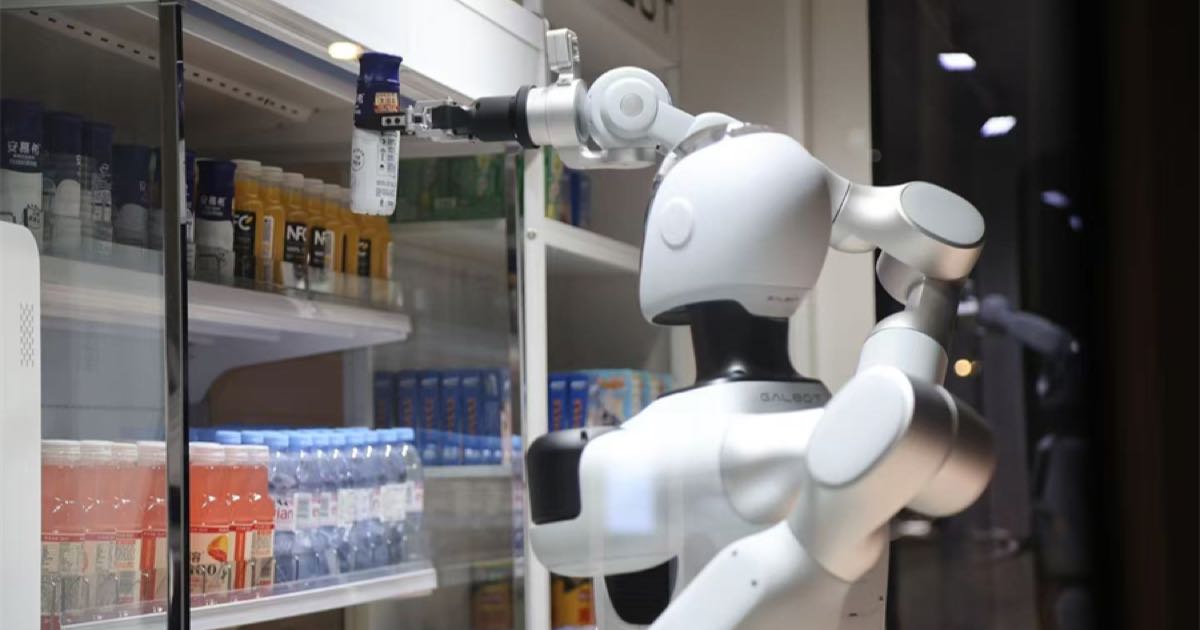
The loudest event is Google DeepMind’s Gemini Robotics 2.5: Apptronik Apollo 2 humanoids kitting brackets on live Mercedes-Benz lines at 96% success. Equal attention goes to the posture — DeepMind published an adversarial safety benchmark the same day, opening its failure modes to inspection as covered by Ars Technica. Safety becomes something you publish, not assert. Kanishka Rao priced the road left: the residual 4% is a “steep road”.
The primary pull is worth archiving. Google’s safety dataset asimov_agentic was created on 21 July 2026 and last modified on 10 November 2026 — the exact date Gemini Robotics 2.5’s factory results and 99.5% jailbreak-resistance score landed per the DeepMind release. Five months of maintenance closed the day the pilot went public. A 241-download asset is modest; one versioned against model releases is what makes robot AI auditable. When Gemini Robotics 2 arrived in July, whole-body control was the story; the 2.5 differentiators are line proof and safety with receipts.
Ring: the home drone that is a service, not a product
$400 buys a drone that flies five to eight minutes and cannot finish a thought — the Drone Cam and its $999 Rover sibling (US shipping from 16 December) leave steering to Ring’s server-side AI Pilot agent, as WIRED’s hands-on details. Six years after the Always Home Cam stalled in invitation-only limbo, the fix was not better on-board compute; it was less of it. The product became a subscription to intelligence on Amazon infrastructure — the structure in which Amazon pivoted its Astro team and folded Fauna into a Personal Robotics Group: products as conduits to the cloud.
Two labour datasets that agree without planning to
Yesterday the Reserve Bank of Australia’s liaison found the standard firm response is a hiring-gate change — about 12% of firms leaving roles unfilled or hiring slowly, against 8% cutting headcount (Assistant Governor Sarah Hunter’s speech). A firm stops backfilling the way it drops a licence: the capability moved. The note is careful — tentative effects, young workers most exposed, 75% no headcount change — and the care is the point. Layoffs hit the person; the gate hits the vacancy. NZ workers see fewer listings, not letters: entry-level white-collar demand is already contested ground.
The OpenAI-Upwork data inverts the pattern for freelancers: budgets up 52.4%, hours up 40.6%, rates flat, task-mix diversity up 45% as briefs that used to be separate contracts become one. One mechanism explains both: the cloud absorbed the task and human work re-bundled around the remainder. In the RBA’s firms an existing team absorbs it silently — the role evaporates. On Upwork it is sold as a project, so it shows as thicker budgets. The missing job and the enlarged brief are one re-bundling, viewed from each end.
Not everyone is repositioning for the cloud
The counter-position is Tesla’s: its Optimus bet puts the intelligence, the humanoid and the line inside one vertically integrated company. DeepMind says the opposite — the model is a service any integrator can build on, which is why Apptronik, Agile Robots, Boston Dynamics and Mercedes-Benz sit on one partner list, and why Mercedes publishes line numbers for a robot built on someone else’s model. Tesla releases milestones, not benchmarks, as in its early-production reporting, so the architectures are measurable on one side only. Inside DeepMind the same choice recurs smaller: its leadership concede specialists beat a generalist on any task, wagering cloud inference gets cheap enough that breadth wins within 12-24 months. Either way the decider is shared: whoever runs inference at scale sets terms.
What a cloud-priced New Zealand should watch
- Privacy follows the architecture. A cloud-piloted camera hands Amazon the flight plan, the video and the schedule. NZ’s privacy talk is about chatbots; cameras thinking in foreign datacentres barely register.
- The hiring gate leads the payroll. RBA says watch postings, not redundancies. The ladder thins where the gate hits — the response our coverage keeps converging on is demonstrable AI-skill pairing over single-skill depth.
- Freelance contracts re-bundle around the cloud. The money goes to people delivering outcomes across skills; checking what models produce is an income line of its own, as the slop-cleanup market shows.
Almost nobody asks what evicting the ghost costs, or what sovereignty means when intelligence is rented. The region’s first structural response is Australia’s move to force breach reporting on AI firms: if the ghost lives in a datacentre, the operator can be made to fill in forms. NZ’s closest equivalent is a warning.
FAQ
What does “the intelligence moved to the cloud” actually mean? The model deciding where a drone flies, how a robot grips a part or what a brief is worth runs on servers, not the device — sensing stays local, decisions are licensed services.
Why does the Ring drone need the cloud at all? That is what makes it $400 and 165 grams; on-board compute was why the Always Home Cam stalled for six years. Moving AI Pilot to Ring’s servers made it shippable.
Is DeepMind’s 96% a sign robots are ready to replace line workers? Not yet — Rao calls the residual gap a “steep road” and demos run at double speed. New is proof on live Mercedes lines plus a published safety benchmark.
What can New Zealand actually do about it? Watch postings, not redundancies; treat home robotics as a privacy object, not a gadget; build the AI-skill pairing the freelance data shows carries the money. Cloud operators set the structure; how NZ uses it is a local choice.
🔍 THE BOTTOM LINE
The releases, filings and labour data agree on a layout most have not internalised: intelligence is centralised infrastructure, and everything sold with AI in it — factory robots, home drones, project budgets, vacancies — is priced around that. The deeper risk is not the robot doing the task; it is the terms on which the thinking is rented. Devices get cheap. The ghost gets a subscription. New Zealand’s opening is to price the ghost, not just rent it.
📰 Sources
- Google DeepMind — Gemini Robotics 2.5 release
- Ars Technica — Rao and Parada interviews
- Hugging Face — ASIMOV dataset timestamps
- Reserve Bank of Australia — AI labour-market note
- Sarah Hunter, RBA — speech, 9 November
- OpenAI — freelance study
- The Verge — Drone Cam hands-on