IEEE Spectrum published a story this morning with a headline that sounds like a rejected film treatment: cyborg roaches that can stab you with needles. Underneath the provocation sits one of the more interesting robotics papers to come out of Australia this year — and a genuinely different answer to a question the rescue-robotics world keeps asking. What happens after a search robot finds a trapped person, when the rescuers still can’t reach them?
From finding people to helping them
The Paraborg platform comes out of the University of Queensland’s Biorobotics Lab, working with biomedical engineers at UNSW. It was published in the journal Advanced Science in August. Dr Thang Vo-Doan, who directs the UQ lab, framed the gap plainly: for two decades, cyborg insects have been built for search and explore missions. “Once they find someone, can they actually help?”
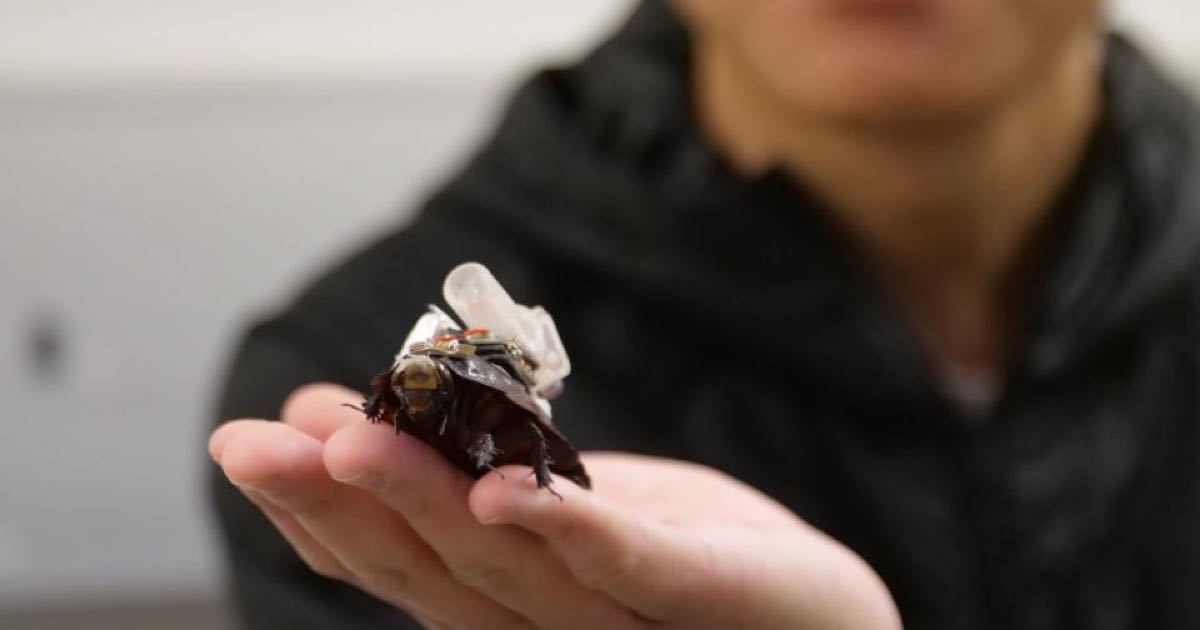
The team’s answer was to strap electronics to the world’s heaviest cockroach. The giant burrowing cockroach, Macropanesthia rhinoceros, is a roughly 40-gram Australian native that can carry a payload over half its body weight. Electrodes implanted in the antennae and cerci — the small tail appendages — let a human operator steer the insect with, of all things, a handheld gaming controller. Each roach carries either a wireless camera or a remote-activated injector: a spring-loaded syringe that fires at a nearby target, then uses a chemical reaction to generate carbon dioxide pressure that pushes the plunger and delivers the drug.
The numbers
In proof-of-concept trials, roaches navigated a 2.5-metre obstacle course past three checkpoints and then fired at an 8-by-10-centimetre silicone target. The insects completed the course in all 25 trials. Injection succeeded 72 per cent of the time. Close-range injection, when the roach had already positioned itself within 15 centimetres of the target, hit 95 per cent.
Those last two numbers tell you where the engineering challenge actually lives. Getting a living insect to a target is nearly solved. Getting it to hold still, stay stable and place a needle is the hard part — the researchers list compensating for a victim’s movement, wireless communication inside collapsed structures, and rubble, dust and climbing as the open challenges. The team is explicit that this is not a medical device ready for people. Drug choice, dosage, sterility, needle safety and regulation all remain unanswered.
There’s also an honest admission about who’s in charge. “We are not piloting them like conventional wheeled robots,” Vo-Doan told IEEE Spectrum. Electrical stimulation influences direction, but the insect still generates most of its own locomotion. That’s the bargain of cyborg engineering: you inherit millions of years of locomotion R&D, and you accept a worker with a mind of its own.
Why an insect instead of a robot
The sceptical question — why not build a tiny robot instead — has a fair answer. A machine that can move reliably through rubble, climb irregular surfaces, recover from falls, carry its own power and still have room for sensors is extraordinarily difficult to build at insect scale. The cockroach already does all of it. Grafting electronics onto the animal borrows that capability for free.
The swarm concept is where it gets practical — the same divide-and-specialise logic behind other insect-scaled robotics work. The team found that a camera and an injector together overburden one insect, so the design splits roles: some roaches carry cameras and environmental sensors, others carry medication, and a human supervisor coordinates the team. Fire and Rescue NSW Superintendent Tim Hassiotis, quoted in the university’s release, described the concept as a potential future tool for urban search and rescue. Vo-Doan’s estimate for real-world deployment is five to ten years, conditional on funding and field testing.
What stands out here is the division of labour between biology and machine, a contrast with the everything-in-one-machine bets on DeepMind’s Gemini Robotics 2 and general-purpose humanoids. Most robotics coverage assumes the machine must do everything. This team assumed the insect does what it evolved to do and the technology fills only the gaps — sensors, steering, and now intervention. The same logic explains why the rescue response is cautiously positive rather than squeamish: a device that reaches victims in the first hour, when most survivable injuries are decided, doesn’t need to be elegant.
New Zealand sits on the same fault lines that make this research relevant across the Tasman. Alpine fault planning assumes people trapped in collapsed structures for days. This is early laboratory work with clear limits, not a product — but it’s the first cyborg insect platform to move from locating survivors to treating them, and that’s a line worth marking.
FAQ
What is a Paraborg? A cyborg insect developed by University of Queensland and UNSW researchers — a giant burrowing cockroach fitted with steering electrodes and either a wireless camera or a remote-controlled micro-injector, intended for supervised emergency care in disaster zones.
Can cyborg cockroaches really inject medicine? In lab trials, yes: a spring-loaded syringe fired at a silicone target succeeded 72 per cent of the time after the insect navigated a 2.5-metre course, and 95 per cent at close range. It has not been tested on people, and the researchers say it is not a medical device ready for use.
When could Paraborgs be used in real rescues? The research team estimates five to ten years, pending funding, field testing and unresolved questions around sterility, dosage, needle safety and regulation.
— CJ Murden, editor of Singularity.Kiwi. Former digital technologies teacher, author of AI-focused books. Writing with a New Zealand focus.