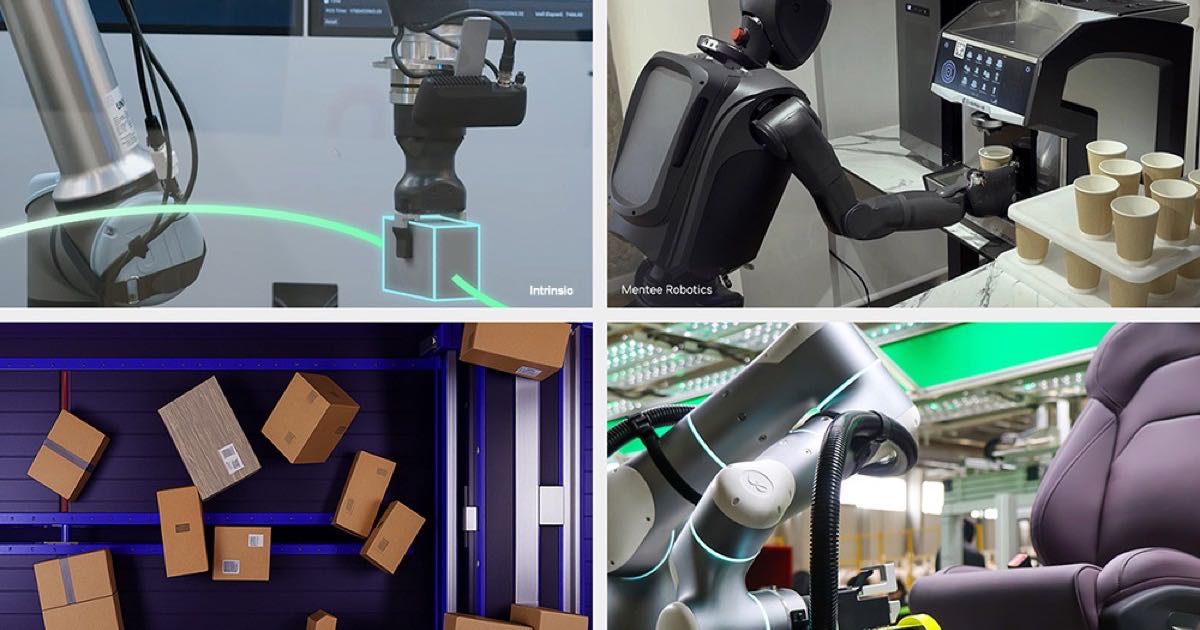
Google’s Intrinsic released Intrinsic Core on Tuesday, an open-source collection of ROS-compatible building blocks for industrial robot applications — and the timing, one day into ROSCon week in Toronto and hours after NVIDIA’s Isaac ROS 5.0 announcement, made the strategic point better than any press release could. The two companies that spent August circling each other over the future robotics platform are now competing in the open.
What’s in the box
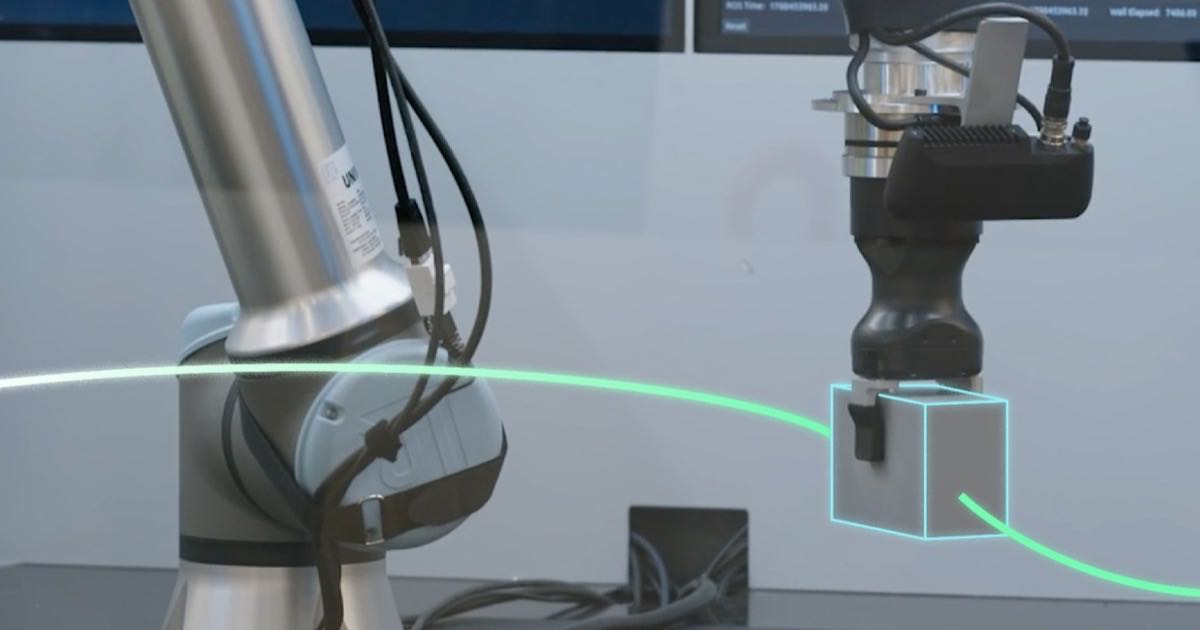
At the centre of Intrinsic Core sits Intrinsic Control, a hardware-agnostic real-time control framework. Its selling point is portability: swap robot arms, grippers or sensors without rewriting drivers, and let a robot adapt its behaviour mid-trajectory from sensor input rather than freezing into a pre-baked motion.
Around that core, the release bundles a set of capabilities that industrial teams otherwise assemble themselves over hundreds of hours, according to Intrinsic:
- 6-DoF pose estimation built on NVIDIA’s FoundationPose model
- Auto-generated, collision-avoiding motion planning
- Sensor-driven grasp planning
- Gazebo-powered simulation services
- Camera calibration
- Pre-configured ROS drivers
It runs on local hardware using standard Linux containers and Kubernetes — a deliberate nod to factory floors where cloud round-trips are a liability, not an architecture.
The CTO’s pitch: this is not a code dump
Open-source robotics announcements have a long history of being marketing exercises — a handful of libraries with a permissive licence and no maintenance behind them. Intrinsic’s CTO Brian Gerkey, who co-founded Open Robotics, the organisation behind ROS itself, went out of his way to pre-empt that read.
“This is not us coming by and dropping off some code and saying, Have fun,” he told The Robot Report. “What we’re sharing this week is the core of our own software stack, this is a thing that we’re also depending on. This represents a durable commitment from Intrinsic to share this with the community.”
The ambition was framed even more explicitly by his colleague Biggs: Intrinsic Core is “a step towards the point in the future where we get to have the equivalent of the red hats and the canonicals of robotics.” That is the business model said out loud — give away the stack, sell the support and enterprise layer on top, and become the Red Hat of industrial robotics.
Why this week matters
The competitive choreography is hard to miss. On Monday and Tuesday, ROSCon became the stage for two rival answers to the same question: who owns the integration layer for robots? NVIDIA’s answer is GPU-accelerated packages with AI agents doing the setup — covered in the companion piece. Intrinsic’s answer is hardware-agnostic openness: your drivers, your arms, our control core, no lock-in. Both leaned on FoundationPose, which tells you how consolidated perception has become even as the platform war runs hot.
For factories, the practical near-term question is which approach survives contact with production lines. Intrinsic’s bet traces back to work we covered earlier this year on Google and Fanuc putting Gemini on the factory floor — Google wants its intelligence embedded in manufacturing at scale, and open-sourcing the plumbing is how you get invited in. Sensor-driven, hardware-agnostic control also complements approaches like the RF-based localisation work we covered for warehouse AMRs, where the robot’s awareness comes from infrastructure rather than onboard cameras.
The verification to hold both companies to: whether Intrinsic Core gets real commits and real deployments from outside Google in the next two quarters. A “durable commitment” in robotics is proven by other people’s factories, not launch-week stars.
FAQ
What is Intrinsic Core? An open-source release from Google’s Intrinsic robotics group, announced 22 September 2026 during ROSCon week. It provides ROS-compatible building blocks for industrial robots: real-time control, pose estimation, motion planning, grasp planning, simulation, calibration and drivers.
Is Intrinsic Core really free and open? Intrinsic says the release is the core of its own production software stack, which the company also depends on, and frames it as a durable commitment — an answer to the common pattern of token open-source dumps. Intrinsic’s stated ambition is to enable “Red Hat and Canonical”-style businesses for robotics.
How does it relate to NVIDIA Isaac? They are competing platforms for the same integration layer. Isaac ROS is GPU-accelerated and NVIDIA-ecosystem-centric; Intrinsic Core is hardware-agnostic and open-source. Notably, Intrinsic Core itself uses NVIDIA’s FoundationPose model for pose estimation.