Three weeks ago, it was a number floating in a Wall Street Journal scoop: Nvidia might guarantee $250 billion to back OpenAI’s Ohio data centre. On Monday, Nvidia made it real — and the number changed.
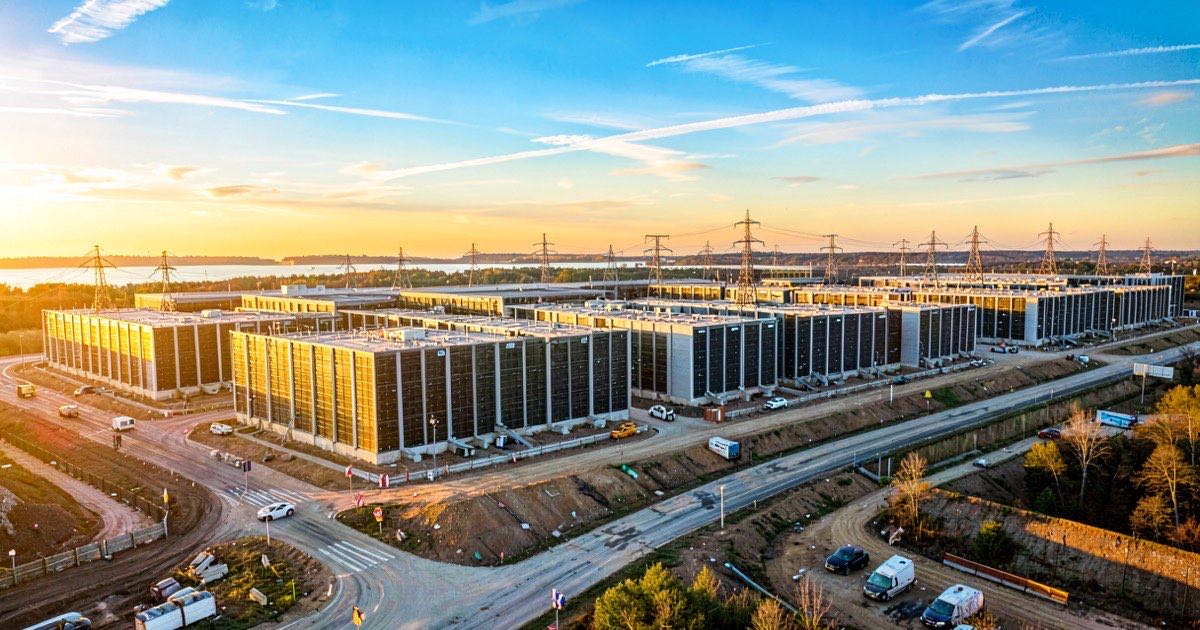
The confirmed deal is smaller on paper but bigger in scope. Nvidia will provide up to $105 billion in credit to support the PORTS-Pike Technology Campus near Portsmouth, Ohio, and invest $1.5 billion directly in SB Energy, the SoftBank-linked company that will own the site. OpenAI leases it. Nvidia supplies every chip inside it. The guarantee phases in between 2028 and 2030 as data centres come online.
What Changed From the July Talks
The July report described a $250 billion guarantee under negotiation. The confirmed version is $105 billion in credit support, plus the $1.5 billion SB Energy equity stake. Nvidia’s official blog post is careful about what the guarantee covers: “defined portions of lease and power payments, along with a specified residual-value commitment — not the full cost of the site or all of the tenant’s obligations.”
In other words, Nvidia is not writing a blank cheque. The $250 billion figure from the WSJ may have included the total project cost — which the New York Times reports could reach $500 billion — rather than just Nvidia’s guarantee portion. The $105 billion is the contingent liability Nvidia is actually taking on.
The scale is still staggering. The initial deployment provides 4.25 gigawatts of AI factory capacity, with the option to expand to 8 gigawatts using the remaining 3.75 GW at the site. Nvidia says each generation of GPUs deployed there — roughly 1.5 million units — represents $150 billion to $200 billion in revenue. Over the full 20-year lease, with multiple upgrade cycles, the company puts the total compute opportunity at approximately $600 billion through 2030.
The Chipmaker-as-Banker Era
What stands out here is not the dollar figure. It is the structural shift.
Nvidia is now doing three things at once: selling chips, financing the buildings that house them, and investing in the energy companies that power those buildings. The TechCrunch report notes the SB Energy investment “guarantees its chips power an OpenAI data center” — a vertical integration play that goes well beyond semiconductor design.
The blog post addresses the obvious question head-on: “Is this circular financing?” Nvidia says no, because OpenAI pays the lease and Nvidia’s guarantee is limited. But the structure still ties Nvidia’s balance sheet to OpenAI’s ability to pay, and OpenAI’s ability to pay depends partly on buying Nvidia’s chips. The circularity is not direct, but it is there.
This is the pattern Nikkei flagged earlier this year — chipmakers funding AI companies, AI companies buying chips, and the cycle repeating. Nvidia’s deal is more transparent than the off-balance-sheet structures Nikkei criticised. It is a disclosed credit commitment with clear limits. But it deepens the entanglement between supplier and customer in a way that would have been unthinkable for a semiconductor company even three years ago.
Why Nvidia Needs to Be a Lender Now
Nvidia’s blog gives the most candid explanation I have seen from the company on this point. Frontier AI labs, it says, “have extraordinary demand for training and inference compute, but many are growing faster than their balance sheets and long-term credit profiles can support.”
Translation: OpenAI burns cash faster than it can raise it. The OpenAI IPO filing was supposed to give the company independent access to public markets. But even with IPO money, a $500 billion data centre is beyond what traditional project finance will cover. Goldman Sachs’ global head of infrastructure finance told The Information he is “looking for capital in every nook and cranny” to support an expected $7.5 trillion in AI spending over five years.
Nvidia is stepping into that gap because it has to. If OpenAI cannot secure compute, it cannot train models. If it cannot train models, it does not buy Nvidia chips. The guarantee is not charity — it is a defensive investment in Nvidia’s own revenue pipeline.
The SoftBank Layer
The SoftBank connection is the third leg. SB Energy, a SoftBank Group company, owns the site. Nvidia invests in SB Energy. OpenAI leases from SB Energy. Nvidia guarantees OpenAI’s lease payments. Nvidia sells the chips that go inside.
Each party has a role. SoftBank provides the real estate and energy. Nvidia provides the hardware and the credit. OpenAI provides the demand. The Bloomberg report frames this as Nvidia “calling on Wall Street to finance the AI chip boom” — the chipmaker is now the matchmaker between AI labs, energy companies, and capital markets.
What Happens if OpenAI Stumbles
Nvidia’s blog addresses this with a line that reads like it was written by the legal team: “NVIDIA compute is versatile, fungible and broadly adopted. The capacity can be resold to another qualified tenant across NVIDIA’s global ecosystem.”
If OpenAI defaults, Nvidia takes the site and finds another tenant. The argument is that CUDA — Nvidia’s software platform — makes the hardware useful to anyone, not just OpenAI. That is probably true. But it also means Nvidia has decided that owning the infrastructure is safer than relying on any single customer, even one as large as OpenAI.
The Oracle credit downgrade to junk showed what happens when Wall Street starts questioning the debt profile of AI infrastructure investors. Nvidia’s balance sheet is stronger, but a $105 billion contingent obligation is not trivial. The guarantee phases down as OpenAI makes lease payments and capacity comes online, so the peak exposure is early. Still, between 2028 and 2030, Nvidia is carrying real risk on someone else’s data centre.
NZ Angle
New Zealand’s sovereign AI ambitions — including the NZ Super Fund’s infrastructure investments — operate at a scale orders of magnitude below this deal. But the consolidation of AI infrastructure financing around Nvidia and a handful of US firms has a direct implication for anyone outside that circle. If the largest AI projects require a chipmaker’s credit backing to get financed, the barrier to entry for new AI labs keeps climbing. A country or company that wants to run frontier models without Nvidia’s backing will need to find alternative financing paths, and those paths are getting narrower.
❓ FAQ
Is Nvidia giving OpenAI $105 billion in cash? No. It is credit support — a guarantee covering defined portions of lease and power payments. Nvidia invests $1.5 billion in SB Energy directly, but the $105 billion is contingent liability, not a cash transfer.
What happened to the $250 billion figure from July? The July WSJ report described talks. The confirmed deal is $105 billion in credit support. The $250 billion may have referred to total project scope rather than Nvidia’s guarantee alone. The NYT says the full facility could cost $500 billion.
Why is Nvidia investing in an energy company? SB Energy owns the Ohio site. By investing $1.5 billion, Nvidia secures influence over the infrastructure that houses its chips. It also ensures the site is built to Nvidia’s specifications.
Does this mean Nvidia is now a bank? Not quite. But it is doing something banks do: providing credit support to help a customer finance a major capital project. The line between chipmaker and financier is getting blurry.
📰 Sources
- Nvidia Blog — Securing the Infrastructure of Intelligence
- TechCrunch — Nvidia investing $1.5B in SoftBank data center developer
- Bloomberg — Nvidia Calls on Wall Street to Finance AI Chip Boom
- New York Times — Nvidia to Back Ohio Data Center With as Much as $105 Billion
- Financial Times — Nvidia pledges $100bn backing for OpenAI data centre in Ohio