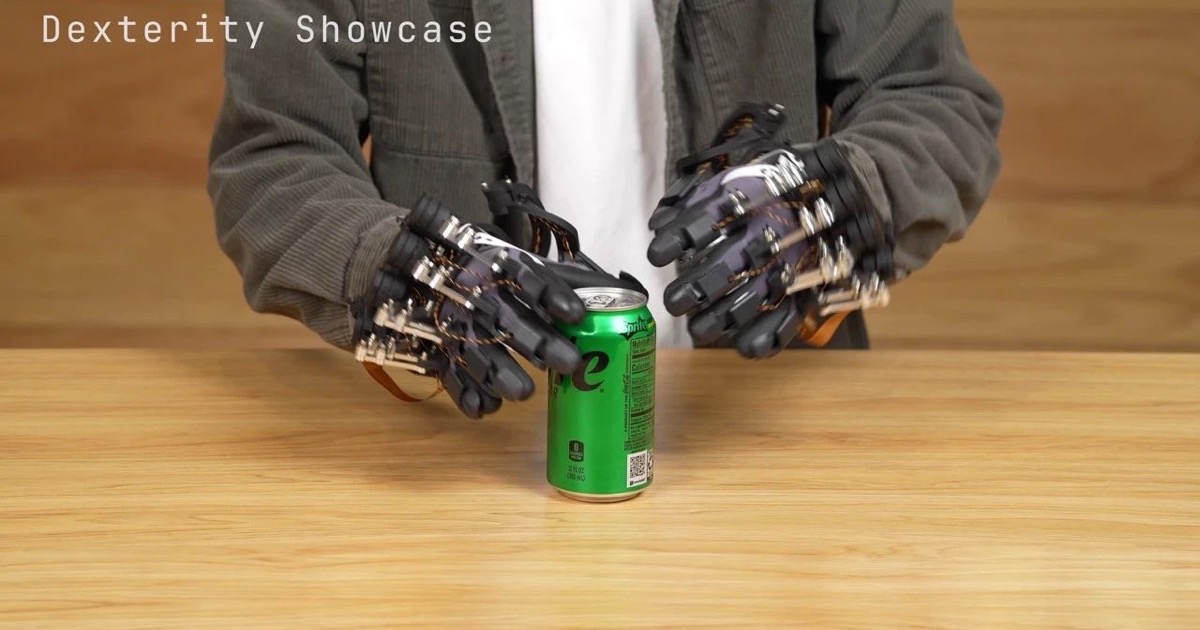
Origami Robotics has announced the S1, a soft skill-capture glove that records finger joint angles, touch and video simultaneously — and, more interestingly, feeds its measurements straight into the company’s own robot hand as joint position targets, skipping the geometric retargeting solver that most teleoperation data pipelines need. The unveiling was covered by Humanoids Daily on 21 October 2026, in what appears to be the first substantive write-up anywhere; as of publication, the S1 has not been independently reported by any other outlet.
The claimed numbers are the story’s spine. Origami says it benchmarked the glove against an OptiTrack motion-capture rig and got millimetre-level fingertip accuracy for the index, middle and ring fingers, relative to the wrist, in a single recording. The company also reports the glove held its measurements through 30 demanding tasks — card shuffling and fast Rubik’s Cube solves among them — and kept measuring even inside a container, after cameras lost sight of the fingers entirely. That last detail matters more than it sounds: optical capture is the industry’s default dexterity reference, and it goes blind the moment occlusion happens, which is roughly always in real work.
The design history shows a company iterating on what factories would actually tolerate. An earlier rigid-glove design, about seven months old and trialled in a couple of factories, only fit some workers. The S1’s soft shell is meant to fit a wider range of hands, and Origami says mass production has already started with a waitlist open — though there is no price and no shipping date yet. Humanoids Daily’s account pairs the glove with Origami’s robot hand, so that “measured finger angles become robot joint position targets directly.”
Two caveats deserve their own paragraphs. Every quantitative claim here is the company’s own: the OptiTrack comparison and the 30-task evaluation are Origami’s benchmarks, reported through Humanoids Daily’s coverage of company materials. Until an independent lab measures the S1 against the same rig, millimetre-level accuracy is a claim, not a finding — plausible for joint-angle sensing, but unverified. Second, the name is not free real estate: Sunday Robotics already markets a “Skill Capture Glove” — the device built alongside its Memo robot hand — so the generic-sounding category name carries, at minimum, a trademark collision Humanoids Daily flagged in its coverage.
Why does a glove warrant coverage on a beat dominated by whole humanoids? Because data, not robots, is the bottleneck. Teleoperation rigs — the classic exoskeletons and leader-follower arms — capture a human operator’s hand only as well as their mechanical linkages and cameras allow, and they lose exactly the fine-grained contact information that makes tasks like threading a cable or peeling a sticker possible. A glove that owns three sensing channels at once — joint angles, touch, video — and whose readings transfer to a robot hand without a retargeting solver is attempting to close the data-quality gap at the source. Nothing about the S1 proves that approach works at scale; it just makes the bet legible.
The broader pattern echoes what this site has tracked all year: the hands are the hard part. Stanford’s HomeBody work let a Unitree G1 explore and tidy an unfamiliar kitchen — locomotion and scene memory handled, manipulation still the frontier. KAIST’s V0.9 humanoid pushed a 35 kg load while walking but would struggle to lift it, full-body strength being easier to demonstrate than fingertip control. And LG’s 100,000-hour robot training data programme with NVIDIA in Seoul exists precisely because nobody has enough good manipulation demonstrations. A sensor glove is a small object in that landscape — mass-produced, wearable, aimed at the one skill set robots conspicuously lack.
For New Zealand, the relevance is indirect but real: if skill capture keeps getting cheaper and portable, the argument that high-value robot training work must concentrate around major industrial clusters weakens. Demonstrations gathered anywhere — including small workshops — can become training data everywhere. That is the optimistic version. The cautious read is a single-source announcement from a company we have not covered before, whose benchmarks we cannot yet check, in a category with at least one trademark dispute brewing.
Origami’s waitlist is open per Humanoids Daily’s report; we will treat the S1’s accuracy and transfer claims as verifiable only when someone other than Origami measures them.