The hardest thing to judge about a robotics company is whether anything real is being sold. Demos are free. Revenue isn’t. So SEER Robotics’ first interim results since listing on Hong Kong’s stock exchange on June 24 are worth a proper look, because they’re a rare case of a Chinese embodied-intelligence company showing its numbers while the hype cycle is still running hot.
The headline figures, from the company’s September 2 announcement: revenue of RMB264.4 million (roughly NZ$62 million) for the six months to June 30, up 67.5 per cent year on year. Gross margin of 46.6 per cent. New orders above RMB467 million. Unit shipments over 8,000, up more than 80 per cent.
Those are solid industrial numbers. But the interesting line is buried further down: overseas revenue up 197.5 per cent, and new overseas orders up more than 550 per cent — about RMB124 million worth. Overseas now makes up 25 per cent of revenue, against 14 per cent a year ago, spread across 43 countries.
What SEER actually sells
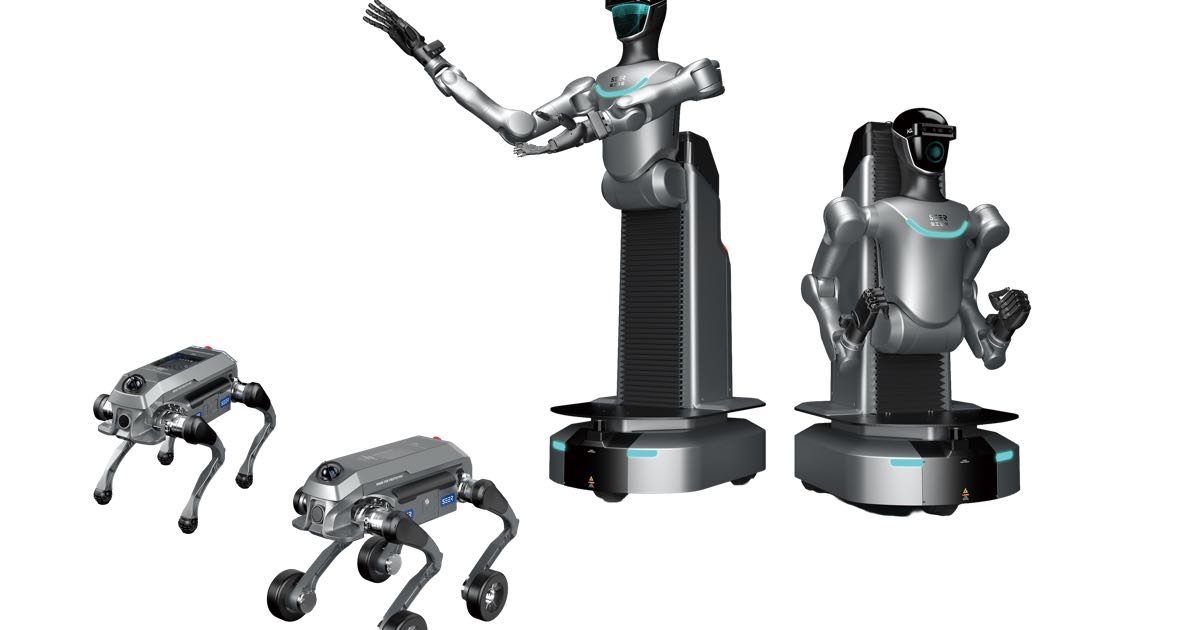
SEER’s core product is the “Robot Brain” — the controller and software stack that sits inside autonomous mobile robots and tells them where to go and what to do. The company claims the top spot in global intelligent robot controller shipments for three consecutive years, and its technology is now deployed with more than 2,500 customers across 20-plus industries.
That positioning matters. SEER isn’t trying to win the humanoid race; it’s selling the plumbing underneath every kind of robot — AMRs in warehouses, arms on production lines, quadrupeds on inspection rounds. Its earnings call language leans hard into embodied intelligence: products powered by end-to-end and vision-language-action models are, per the company, “in scaled commercial deployment” with customers in semiconductors, automotive and 3C electronics.
The claimed architecture is a closed loop — robots collect data in the field, that data flows back through cloud infrastructure for cleaning, labelling, model training and simulation, then ships out again as updated models. It’s the same flywheel Figure is building with crowdsourced teleoperation data, just pointed at industrial fleets instead of humanoids.
The read
Two things stand out. First, the overseas growth rate. Chinese robotics firms have historically sold mostly at home, where the market is the world’s largest — more than half the world’s industrial robots are now made in China. A 550 per cent jump in overseas orders suggests the export story that transformed China’s EV industry may be repeating in robotics. Buyers in 43 countries don’t order controller-equipped robots at that rate out of curiosity.
Second, the margin. Forty-six per cent gross on controllers and embodied-intelligence software is hardware-adjacent business with software economics layered on top. If that holds as volumes scale, SEER has a better cost structure than most of the humanoid startups burning capital to hit price targets.
Caveats apply. These are company-reported figures, unaudited at the interim level, and GlobeNewswire releases are — structurally — marketing documents. “Scaled commercial deployment” is the company’s phrasing, not an independent measurement. And first-interim results after a June listing always carry a bit of listing-momentum shine.
But the shape of the numbers is coherent: orders ahead of revenue, shipments ahead of orders in growth rate, and international expansion compounding off a small base. That’s what a company riding a real demand curve looks like, at least on paper.
For New Zealand, the interesting angle is infrastructure rather than robots. If Chinese robot-controller ecosystems keep expanding globally at this pace, the default stack inside warehouses and factories — including here — increasingly gets decided in Shenzhen and Shanghai. China’s industrial robotics buildout has been the story of the year; the quieter part is who owns the layer every robot runs on.
FAQ
What does SEER Robotics make? Controller hardware and software — the “Robot Brain” — that powers autonomous mobile robots, robotic arms and other platforms, plus embodied-intelligence models for industrial customers.
How big was SEER’s H1 2026 revenue? RMB264.4 million (about NZ$62 million), up 67.5 per cent year on year, per the company’s September 2, 2026 announcement.
When did SEER Robotics list? June 24, 2026, on the Hong Kong Stock Exchange.
— CJ Murden, editor of Singularity.Kiwi. Former digital technologies teacher, author of AI-focused books. Writing with a New Zealand focus.