At the SPS automation fair in Nuremberg this week, Siemens showed the kind of robot application that rarely gets a press release and quietly defines whether factory automation has hit its ceiling: an AI-powered arm that unpacks deliveries. The company is developing the system for its own Electronics Factory in Erlangen, where incoming boxes are still, in 2026, opened largely by hand. Siemens announced the work on Tuesday as part of a broader push it is branding as AI-powered autonomous production.
The reason unpacking survived every previous automation wave is not that nobody thought of it. It is that no two delivery days look the same. Cartons arrive in every shape, size and state of abuse, and a fixed robot program — the traditional tool — can only repeat a choreography, not improvise one. As The Next Web reports, that variability is exactly why the task “is still mostly done by hand” at plants like Erlangen, which receives between 80 and 200 packages a day according to the trade site All About Industries.
How the robot figures it out
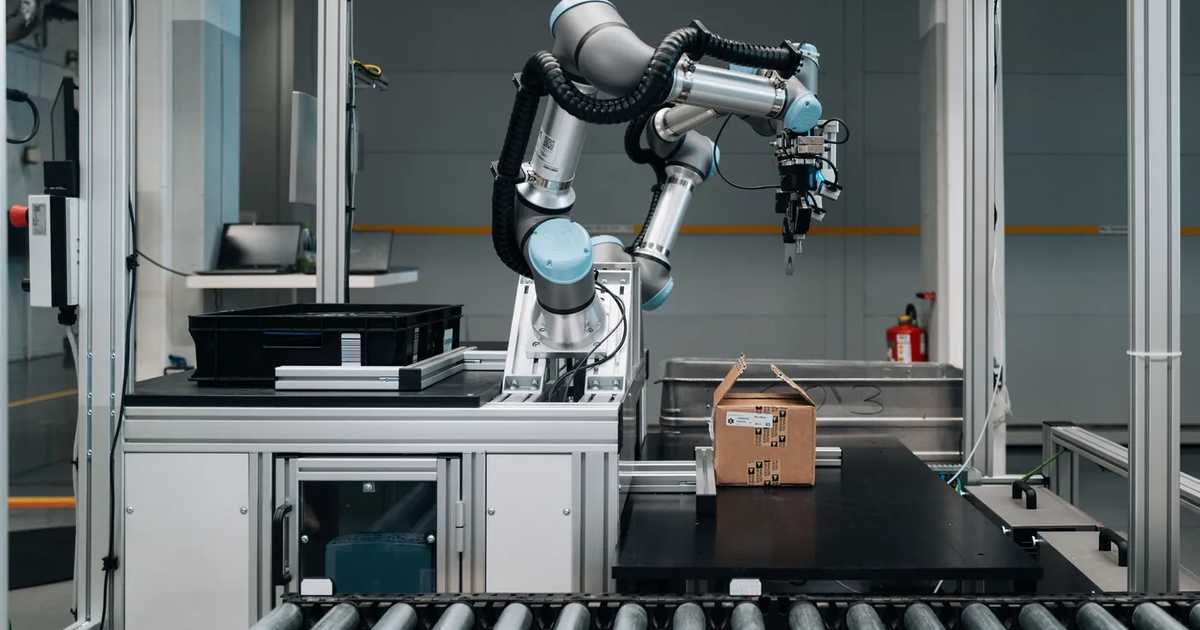
Siemens’ approach replaces the fixed program with a decision loop. Cameras watch the workspace in real time, and robot foundation models — large AI models trained for physical tasks rather than just language — interpret what they see and choose the next action. The robot opens cartons and lifts out reels of electronic components for further processing. Two details in the reporting are worth more attention than the demo itself: the AI learned from humans steering the robot remotely, and it runs on Siemens industrial PCs with NVIDIA chips inside.
That first detail is the quiet standard operating model of this wave of industrial AI. Rather than learning in pure simulation, the system banked human judgement through teleoperation — an operator pilot the arm, the model learned the intent. It is the same playbook that Warsaw-based Nomagic has run in paying warehouses, where it halved how often its robots needed a human to intervene. Teleop-as-training-data is becoming the bridge between the lab and the loading dock, and Siemens is applying it to its own inbound dock before selling the pattern to anyone else.
The planner that schedules the factory
The unpacking robot shared the booth with a software product that attacks the factory’s white-collar bottleneck. Siemens’ Autonomous Production Planner uses several AI agents to draft production schedules, then tests each schedule in a physics-based digital twin of the factory before anything is committed to the real line. Siemens claims the approach can cut manual planning effort by up to 70 percent and costs by up to 20 percent — Automation Fair’s show report notes these are Siemens’ own figures, and that most of the SPS announcement is a roadmap rather than a shipping product list, with the unpacking application explicitly still under development and no availability date given.
“The next productivity leap will come from automating tasks that were impossible to automate before,” said Rainer Brehm, president of automation at Siemens, in the company’s release.
Why Siemens is dogfooding, and why that matters
The most interesting strategic fact in this story is the address: Erlangen is not a customer’s plant. It is Siemens’ own Electronics Factory — the same facility that ran an eight-hour humanoid robot trial with NVIDIA’s HMND 01 back in April. That is a company stress-testing every route to flexible automation inside one building: a humanoid for mobility tasks, a foundation-model arm for manipulation, and agent software for the planning layer above both. Doing it in-house first is the classic pattern of an industrial giant de-risking a product category with its own production line before asking customers to bet theirs.
It also tells you where the industry thinks the remaining margin is. The past two years of industrial robotics coverage — UBTech aiming at 10,000 humanoids in a Chinese factory, SCHUNK spinning off a tactile sensing company to give robot hands a sense of touch, Honda building dexterous robot hands for factory work — has converged on the same diagnosis: the repeatable tasks are automated, and the residual value sits in high-variability, judgement-heavy work. Unpacking a random delivery box is almost a caricature of that category, which is presumably why the demo exists. Whether the competition agrees is clear enough: in June, Schneider Electric agreed to buy industrial-AI firm Cognite for $3.1 billion, as TNW notes, putting a similarly large bet on software that understands physical operations.
For factories outside the industrial core — and, closer to home, for New Zealand’s food and materials plants, which run on small batches and unpredictable inbound shipments far more than German electronics does — the relevance is not the specific robot but the direction of travel. The tools being proven at Erlangen are aimed at exactly the variability profile that has kept these plants manual. It is also a pointed contrast with the humanoid headlines: the arms most likely to pay for themselves first are not walking, but standing still at a conveyor, solving one unglamorous task after another. The caveats are real: nothing here is purchasable yet, the 70 and 20 percent figures are vendor projections, and Siemens has not said when, or in what form, the unpacking robot ships. But the sequence is worth watching. If foundation-model robots pass a season or two reliably emptying 200 packages a day at Erlangen, the same stack will be repackaged for plants that never ran a robotics trial in their lives.