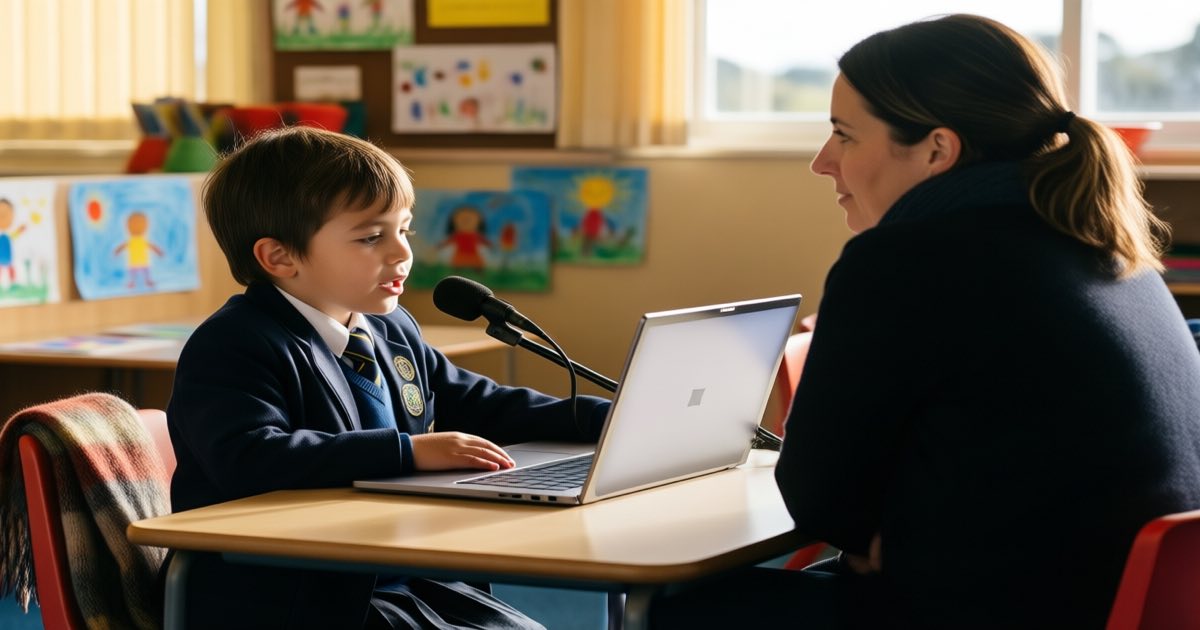
Hundreds of students in two New York school districts are now checked by an AI chatbot after class — and their parents are organising to stop it.
According to the Times Union’s report from Albany on 17 October 2026, students in the Albany and Bethlehem districts use a platform called Snorkl: after an in-class assignment, the AI asks each child questions about what they just learned, writes back and forth with them, and sends a summary to the teacher. Albany officials stress that the teacher, not the bot, assigns every grade. Snorkl claims its technology is used in 10,000 school districts worldwide, a figure the Times Union attributes to the company.
The pushback is no longer a single angry parent meeting. Both districts now have chapters of Schools Beyond Screens, a national coalition of parents and educators that campaigns for what it calls “evidence-based guidelines around technology in the classroom.”
“It is almost as distracting as the phone,” Caroline Corrigan, an Albany parent and former substitute teacher, told the Times Union about the classroom Chromebooks.
Her complaint is not the chatbot’s answers — it is the sequence. Albany held its community demonstration of Snorkl, complete with a show of how the bot flags inappropriate words, only after students had already started using it. “A lot of this was rolled out without community input,” Corrigan said. “And so we are asking to slow things down and let’s look at the technology.”
The district’s position, from spokesman Ron Lesko: technology never replaces teacher-student engagement, and instruction remains “very much human-centred.” He defended the Chromebooks as an essential preparation for the tech that will shape students’ working lives.
What parents are actually objecting to
The Snorkl story is easy to misread as another screen-time fight, but the objections stack in a specific order. First, consent: the rollout preceded the explanation. Second, evidence: nobody — vendor, district, or researcher — has shown that an AI-run recall check teaches fourth graders anything better than a group discussion. “No parent wants to feel their kids are being experimented on,” Corrigan said. Third, crowding-out: kindergartners coming home begging for YouTube after “brain break” videos by a dancing YouTuber called DannyGo — screen habits formed at school, not at home.
That is a different argument from the one about high-schoolers dodging Chromebook blocklists, which even the state’s phone-ban rollout did not anticipate. Governor Kathy Hochul told the Times Union in 2025 she was confident teachers could control the laptops — “it’s then put away and it’s not in the child’s hand.” Teachers in the piece describe the opposite at middle and high school level, where students treat the Chromebook much like the phone they just lost.
Why this looks like a test run for every district
Albany and Bethlehem are not the biggest districts to hit this conflict, and that is exactly why the story travels. New York City already banned most AI from elementary and middle schools earlier this year, and its schools introduced AI and screen-time limits that Chalkbeat reported many parents found relieving. What Albany adds is the granular version: a specific product, a specific grade level, and a demand that shifts from “ban it” to “ask us first.”
What Albany adds to the national picture is the granular version: a specific product, a specific grade level, and a demand that shifts from “ban it” to “ask us first.” New Zealand schools are running the same playbook in slow motion — Newsroom reported in June that NZ boards are writing AI policies independently, from outright bans to unrestricted access, with no Ministry of Education mandate and only the Privacy Commissioner’s guidance as guardrail. Consultation with parents is discretionary. An Albany-style chapter movement is not hard to imagine in Tauranga or Hamilton — the pattern is product-first, consultation-later, and parents are learning to name it.
South Korea’s legislature drew the sharpest line earlier this year: AI cannot grade students alone, full stop. That law was framed as a high-risk-use designation. The Albany conflict shows what happens in countries without one — the line gets drawn district by district, parent meeting by parent meeting, usually after the tool is already in the classroom.
The uncomfortable pattern across all of these: the vendor arrives with evidence of adoption (“10,000 districts worldwide”), the district arrives with enthusiasm, and the evidence of learning outcomes arrives last, if ever. Until that ordering flips, expect more Albany moments — and more chapters forming.
- America’s Two Biggest School Districts Just Hit Pause on AI — Again
- Schools Are Banning Screens While Being Told to Teach AI. Something’s Gotta Give.
- 60% of UK Teachers Use AI. 43% Rate Their Confidence at 3/10. The Global Pattern Is Clear.
- Microsoft Signs a Legally Enforceable AI Standard for Schools — Because Governments Wouldn’t
Sources: Times Union (17 Oct 2026); Schools Beyond Screens; Chalkbeat (10 Sep 2026); Snorkl company claims via Times Union.