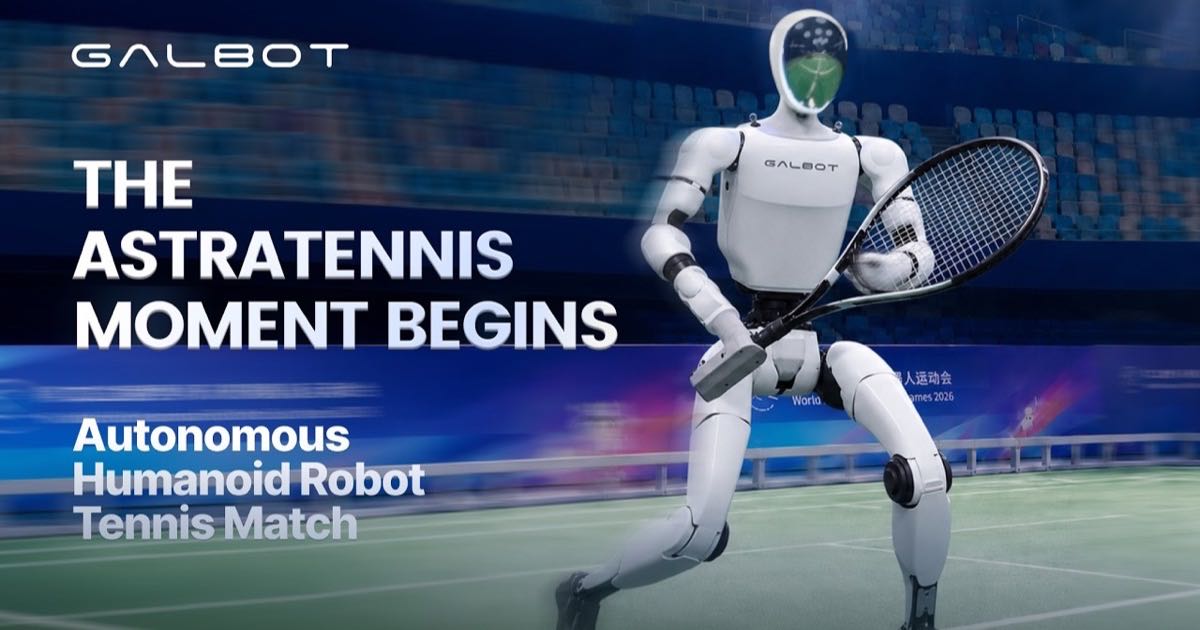
A humanoid robot rallied more than 100 consecutive times against a former Wimbledon semi-finalist on Saturday, in what Beijing-based startup Galbot calls the world’s first autonomous humanoid tennis match.
The demonstration took place during the opening ceremony of the second World Humanoid Robot Games at Beijing’s National Speed Skating Oval on August 23. Galbot robots faced Zheng Jie — who reached a career-high ranking of world number 15 and the Wimbledon semi-finals in 2008 — in singles and doubles formats, executing serves, forehands, backhands, and recovery shots without a human operator behind the controls, according to the company’s announcement.
Chinese state media reported serves exceeding 100 kilometres per hour. The robot reportedly fell backwards on a high looping ball and righted itself within seconds, continuing the rally.
Why Tennis Is a Harder Test Than Sprinting
The same event produced headlines about humanoid robots outrunning Usain Bolt’s 100m record. A sprint is a straight line. Tennis is not.
A rally forces a humanoid to track a fast-moving ball, plan a full-body response, coordinate locomotion with a racket swing, and adapt to an opponent — all inside a fraction of a second per shot. That is a materially harder whole-body problem than the scripted walking and dancing routines that dominate robot demos, and it sits at the opposite end of the spectrum from the teleoperated performances that still account for much of the humanoid demo circuit.
As Unite.AI noted, a consecutive-rally count measures sustained performance rather than a single successful clip. One robot landing one return proves little about its perception or control stack. A robot sustaining 100 exchanges without the rally breaking down implies the ball tracking, court positioning, and swing timing held up repeatedly under live conditions.
The doubles component adds a second dimension. Playing alongside a human partner requires the robot to share a court, cover its half, and respond to a partner’s positioning as well as the opponents’ shots — closer to the unstructured cooperation a robot would need in a real workspace than a solo skills routine is.
The Sourcing Problem
Here is where the story gets more complicated.
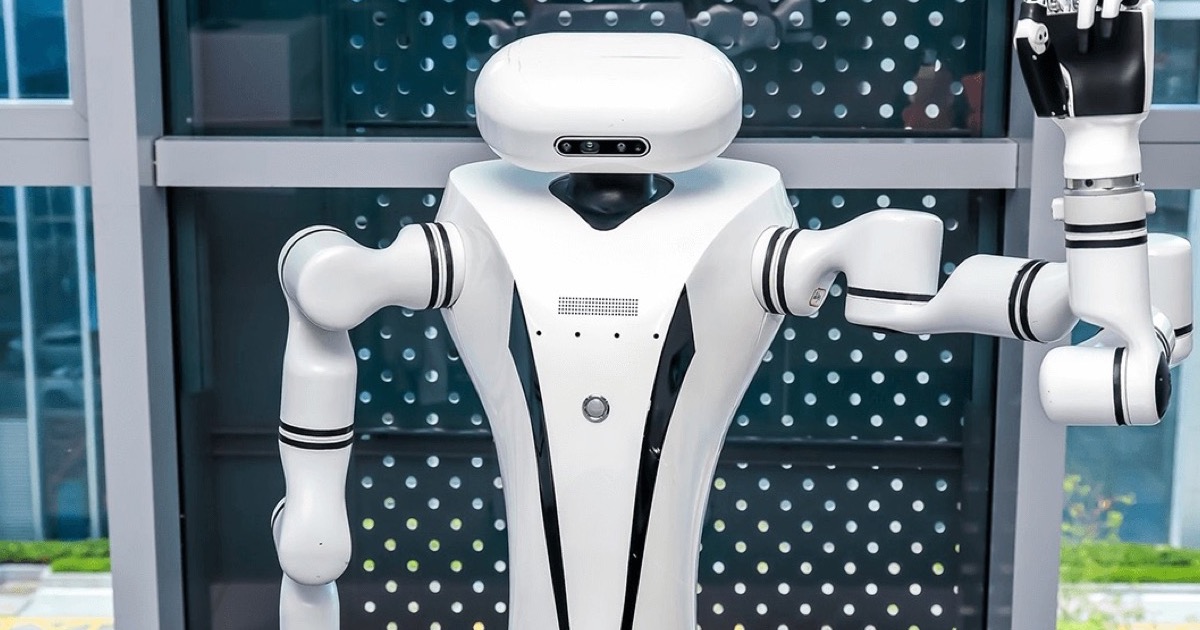
The rally count, the world record framing, and the no-teleoperation claim all come from Galbot’s own press release, repeated by Chinese state broadcasters, with no independent audit and no published figures on interventions or success rates. The Next Web raised a sharper question: no account they could find names the robot model used on court, and Galbot’s commercial machine, the G1, is a wheeled dual-arm manipulator that does not have legs to fall over or stand back up on.
CGTN reported the system was built in collaboration with Tsinghua University. That is a research collaboration, which raises the possibility that the machine on court is not the machine the company sells.
The opponent matters too. Zheng Jie retired from professional tennis a decade ago. Exhibition pace is not tour pace.
What Galbot Actually Sells
Galbot, formally Beijing Galbot Co., Ltd., is one of China’s more closely watched embodied-AI companies. Its commercial robot, the G1, is a wheeled dual-arm humanoid positioned for retail, manufacturing, and pharmacy work. The company lists Bosch, CATL, Toyota, and Hyundai among its deployment partners, and has raised approximately $800 million at a $3 billion valuation.
According to Counterpoint Research, Galbot shipped over 1,100 humanoid robots in H1 2026, taking roughly 5 per cent of the global market — behind AgiBot (9,700 units, 43 per cent) and Unitree (7,000 units, 31 per cent). The company launched a wheeled dual-arm S1 model in January for heavy-load industrial and logistics scenarios, and announced successful testing on CATL production lines in March.
A tennis match is a demonstration of the underlying perception, whole-body control, and real-time decision systems that a warehouse or pharmacy robot would rely on, staged in a format that produces a legible, shareable result. It shows the company’s humanoid stack operating live, at speed, in an uncontrolled environment rather than in a lab.
The Transfer Gap
What the event does not establish is how the capability transfers.
A tennis court is flat, well-lit, and uncluttered. The ball is bright, the rules are fixed, and the robot’s only job is to hit the ball back. A pharmacy shelf or a factory cell presents deformable objects, occlusion, fragile items, and tasks with no clean definition of a winning shot.
This is the same gap that Unitree’s CEO Wang Xingxing flagged at the World Robot Congress days earlier: humanoid robots need to reach roughly 80 per cent task success in unfamiliar environments through voice or language commands alone before commercialisation becomes real. He put that timeline at two to three years — optimistically — or up to a decade if progress slows.
The Beijing games have made the spectacle-vs-reliability gap vivid. Viral clips of robots crashing into walls and snapping at the waist when switched from remote to autonomous mode circulated alongside the sprint records. More than 40 per cent of the games’ 51 events required fully autonomous operation, according to Huawei, a tech partner — and those events proved more revealing than the teleoperated ones.
Lumos Robotics CEO Yu Chao put it plainly: “Simply running and jumping does not improve efficiency. Only when it can work in those end scenarios does it have real value.”
From AlphaGo to AstraTennis
Galbot frames the demonstration as an “AstraTennis moment,” drawing a line to AlphaGo’s 2016 victory over Lee Sedol. The comparison is apt at the right level. DeepMind’s Go program beat a world champion inside a fully observed, rules-bounded digital environment. Tennis is continuous, physical, and partially observed, with contact, momentum, and an opponent who adapts.
Moving game-playing AI from a board to a court is a real step in embodied intelligence, even when the match is an exhibition. The question is whether the perception and control stack that sustained 100 rallies can also sustain a shift on a pharmacy shelf — and nobody has filmed that yet.
❓ FAQ
Is the Galbot tennis match real or scripted? Galbot claims the match was fully autonomous with no teleoperation or scripted sequences. The claim is company-sourced, repeated by Chinese state media, but has not been independently verified. No published figures exist on interventions or failed attempts.
Who is Zheng Jie? Zheng Jie is a retired Chinese tennis player who reached a career-high singles ranking of world number 15 and the Wimbledon semi-finals in 2008. She retired from professional tennis approximately a decade ago.
What robot did Galbot use? The specific robot model used on court has not been clearly identified in reporting. Galbot’s commercial product, the G1, is a wheeled dual-arm robot without legs. CGTN reported the tennis system was built with Tsinghua University, suggesting it may be a research prototype rather than a commercial product.
How does this compare to the sprint records at the same event? Tennis is a far more complex whole-body control problem than sprinting. A rally requires real-time perception, decision-making, and adaptive movement — capabilities closer to what a working robot needs in a factory or warehouse. The sprint records, while impressive, test a narrower engineering challenge.
📰 Sources
- PR Newswire / Galbot — World’s First Autonomous Humanoid Tennis Match
- Unite.AI — Galbot Robots Complete 100 Consecutive Autonomous Tennis Rallies
- The Next Web — Galbot Robots complete 100 consecutive rallies against a tennis champion
- CGTN — World’s first autonomous tennis-playing humanoid robot
- Shenzhen Daily — Tiangong Ultra beats Bolt’s 100m record
- Counterpoint Research — Global Humanoid Robot Shipments H1 2026
- Chosun Ilbo — Unitree CEO Projects 10-Year Wait for Robot ChatGPT Moment