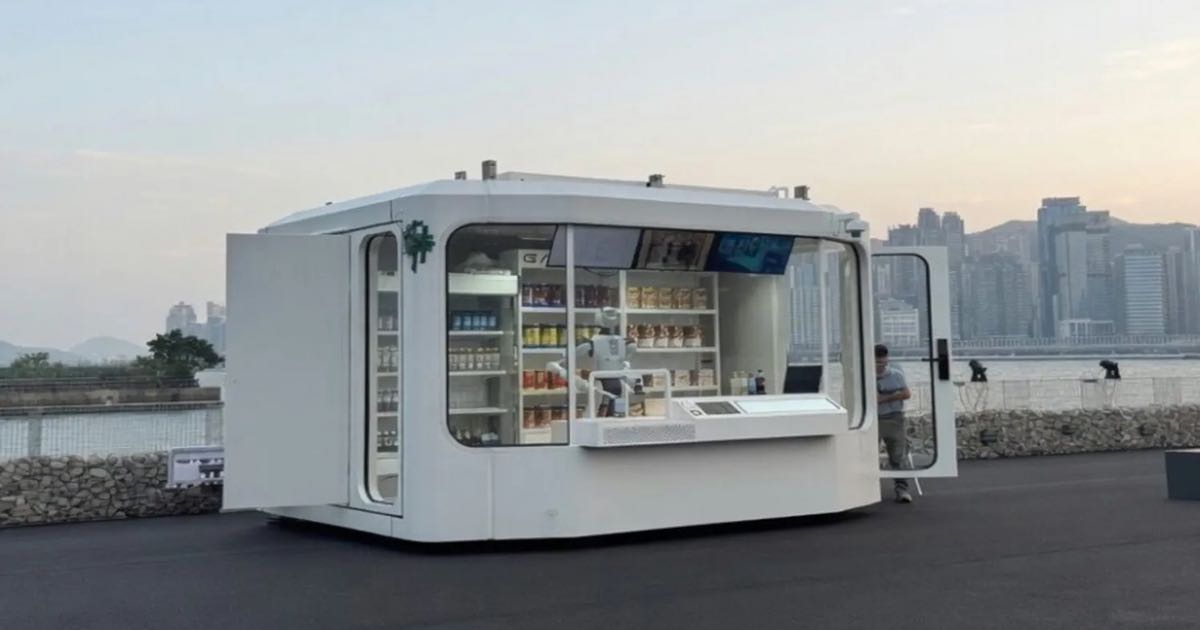
The convenience store is 9 square metres — about the size of two car parks — and it has exactly one employee. It stands 173 centimetres tall, has a 190-centimetre arm span, and per its manufacturer Galbot, it can stock shelves, handle checkouts, and take voice commands in multiple languages. The store opened on the Hung Hom waterfront in Hong Kong, and according to coverage of the launch, a human won’t be rostered at any hour of the day or night.
The robot is called Xiao Gai. It is a Galbot G1, built by a Beijing startup that has been experimenting with unmanned retail for a while — it already runs a robot-staffed store in Beijing. This Hong Kong location is, per Galbot, the company’s first deployment outside mainland China, and it is backed by the Hong Kong Investment Corporation. Reports on the pilot suggest it could expand to as many as 100 stores if the Hung Hom site proves out. That expansion figure comes from coverage of the project, not a confirmed plan, but even the existence of a scaling target tells you what kind of project this is.
What is actually new here
China has run robot-staffed retail demonstrators before, including within Galbot’s own Beijing footprint. The genuinely new part is the geography and the economics. Hong Kong has some of the highest retail rents on earth, and the store is a 9-square-metre capsule rather than a 100-square-metre shop. A fully automated micro-store is a bet that the winning retail format for humanoid operators isn’t “a robot in a big shop” — it’s “a shop shrunk until one robot is enough.”
That reframing matters. The usual benchmark for humanoid retail is general-purpose dexterity: can the machine handle a slippery bottle, a crumpled bag, a customer paying cash? Those problems remain hard, and China’s own humanoid showcase events have shown how uneven robot performance still is outside rehearsed tasks — we looked at exactly that question after the World Humanoid Robot Games in China’s robot games were a flex. The failures were the point. The capsule-store sidesteps some of it by design: fewer SKUs, fixed shelf positions, a checkout the hardware was built around. Constraints are doing the work that general intelligence hasn’t yet.
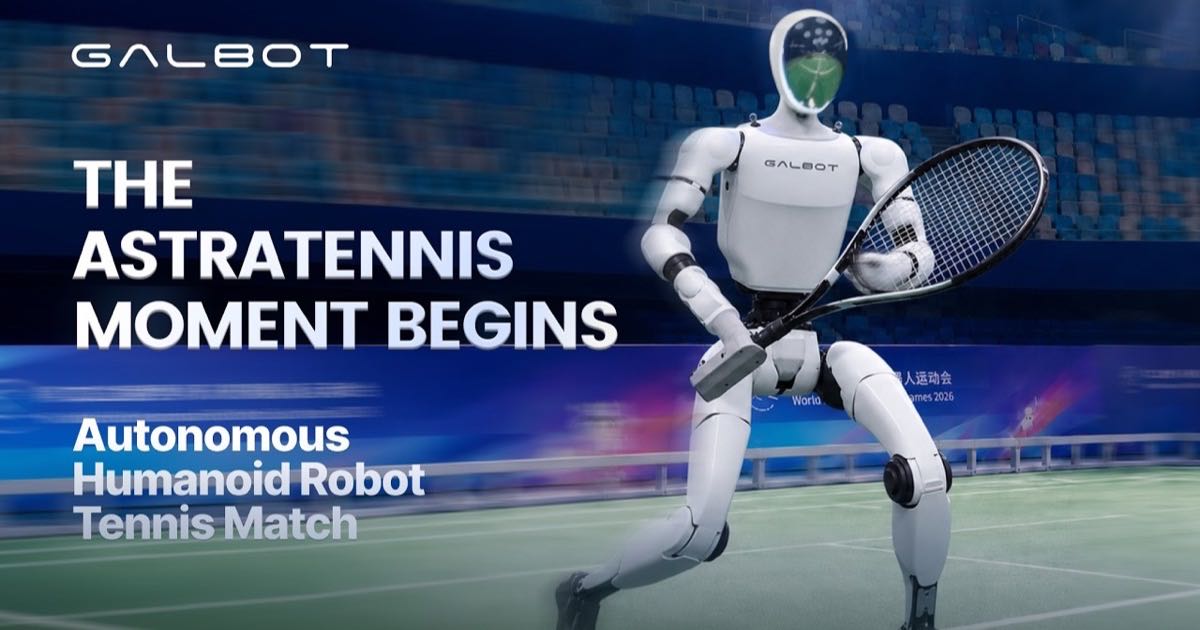
The G1 itself is a wheeled-base humanoid with a humanoid upper body — Galbot has previously drawn attention with demonstrations like a 100-rally autonomous tennis session with a former pro, claims that were company-sourced but pointed at real whole-body control progress. Shelf-stocking in a fixed micro-store is a far easier problem than a tennis rally or a dishwasher, which is precisely why it is a sensible first commercial deployment.
The 24-hour shift nobody wants
There’s a blunter reason the capsule format works, and Hong Kong is a fitting stage for it. Overnight shifts in convenience retail are the jobs humans price at a premium and quit at the highest rates. A robot that can cover 2am to 6am — restocking, cleaning, payment terminals, nothing exotic — captures value immediately, without needing to outperform a daytime worker in any single task. The pitch isn’t “better than a person.” It’s “covers the hours nobody wants, in a footprint too small to matter to a human payroll.”
That’s also why 100 stores is the number to watch rather than the robot’s arm span. One store is a demo. A hundred stores is a supply chain, a maintenance fleet, a restocking logistics operation, and an insurance question. Most robotics pilots die in the gap between those two.
What it doesn’t prove
The store’s manufacturer supplied the claim that the robot handles checkouts and multilingual voice interaction — those haven’t been independently audited, and no one outside the project has published failure rates for the site. Hong Kong’s retail customers will do that audit for free, every day, in one of the most demanding consumer markets in the world.
For New Zealand, there’s no direct equivalent — our convenience retail runs thin margins on large floor areas with cheap night staff, so a 9-square-metre robot capsule doesn’t obviously compute. But the underlying move travels: shrink the task environment until today’s robots are good enough, then scale. New Zealand’s first robot-staffed retail will almost certainly look like this — a kiosk, not a robot loose in a Countdown.
If the Hung Hom store survives its first quarter, expect the capsule format to spread through Asia before it ever reaches a Western high street.