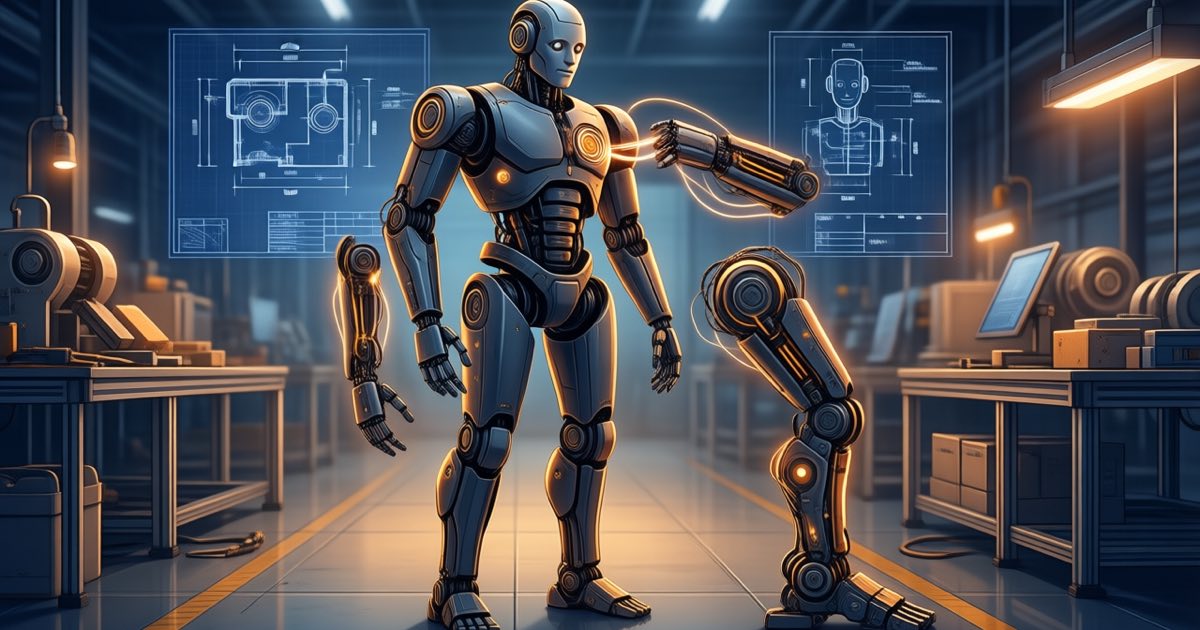
NVIDIA used its GTC event in Berlin on Wednesday to announce a major expansion of the Isaac open robotics development platform, and the headline item is a complete reference humanoid. As detailed in NVIDIA’s newsroom release, Munich-based Agile Robots unveiled Agile ONE SN: a full-stack humanoid preconfigured with NVIDIA’s Isaac GR00T foundation model stack and running on Jetson Thor edge compute, planned for availability in early 2027 with interest from Stanford and ETH Zurich.
The machine itself is competitive but not exceptional — 1.40 metres tall, 40 kilograms, 31 degrees of freedom, dual five-finger hands with 1kHz force control and tactile sensing. What makes the announcement significant is what wraps around it. The package unifies the simulation, training and deployment tools that robotics teams usually stitch together themselves, and NVIDIA claims it cuts setup time “from weeks to days.” Jensen Huang’s keynote framing was expansive even by his standards: “General-purpose robotics is advancing at extraordinary speed — the ChatGPT moment for robotics is fast approaching.”
The rest of the stack expansion is aimed at the layers below the robot. NVIDIA shipped Isaac Lab 3.0, its open-source robot-learning framework, as generally available with multi-GPU training workflows. A new Isaac OS — an open-source runtime built on Holoscan — connects AI models, sensors, control loops and hardware for deterministic real-time performance from simulation to physical machines. There’s a data play too: a SimReady library of more than 2,000 simulation-ready factory assets and a “Human 1M” dataset of human activities with synchronized video and 3D hand tracking, both landing on Hugging Face. Three open-source reference workflows show developers how to refine GR00T 1.7 models with reinforcement learning and post-train Cosmos world models for synthetic data generation.
NVIDIA isn’t shipping this stack into a vacuum. The release names ABB Robotics, KUKA, Universal Robots, Hexagon Robotics and NEURA Robotics among the European ecosystem building on Isaac — and the company has been assembling exactly this position for most of the year. We’ve tracked the platform war from Isaac ROS 5.0 putting AI agents into robotics’ plumbing, through the first open humanoid foundation model, to Direct comparisons of Google’s Intrinsic stack against Isaac, plus Thor silicon reaching humanoid-scale power budgets. TechRadar’s coverage of the GR00T line called the age of generalist robotics “here” in its analysis; Yahoo Finance’s GTC report pairs the robotics news with NVIDIA’s parallel agent-security push in its GTC wrap.
The strategic read is that NVIDIA is doing to robotics what it did to AI training: don’t sell robots, sell the layer every robot builder depends on. A reference humanoid matters less as a product than as a calibration target — it gives every startup and university lab a known-good baseline so the marginal cost of starting serious humanoid work drops again. The risk to watch is concentration: if GR00T, Isaac OS, Cosmos and Jetson become the default path, the robotics stack inherits the same single-vendor gravity that the AI training stack already has. Alibaba, Unitree and BYD are all building humanoid stacks outside NVIDIA’s orbit, so the counterweights exist — but a developer choosing a default in 2027 will mostly be choosing Isaac.
For New Zealand the practical angle is access economics. A research group that could never justify building a humanoid data pipeline can rent the workflow on a DGX Station or a cloud instance, and reference workflows being open-source means the entry ticket is engineering time, not licensing. The bottleneck this announcement actually targets isn’t hardware or even models — it’s integration, which is where most robotics projects historically die.
Sources: NVIDIA Newsroom · Yahoo Finance · TechRadar