Most humanoid robot companies are chasing the same jobs: warehouse box-moving, factory line work, maybe someday the home. Persona AI is looking somewhere different — shipyards.
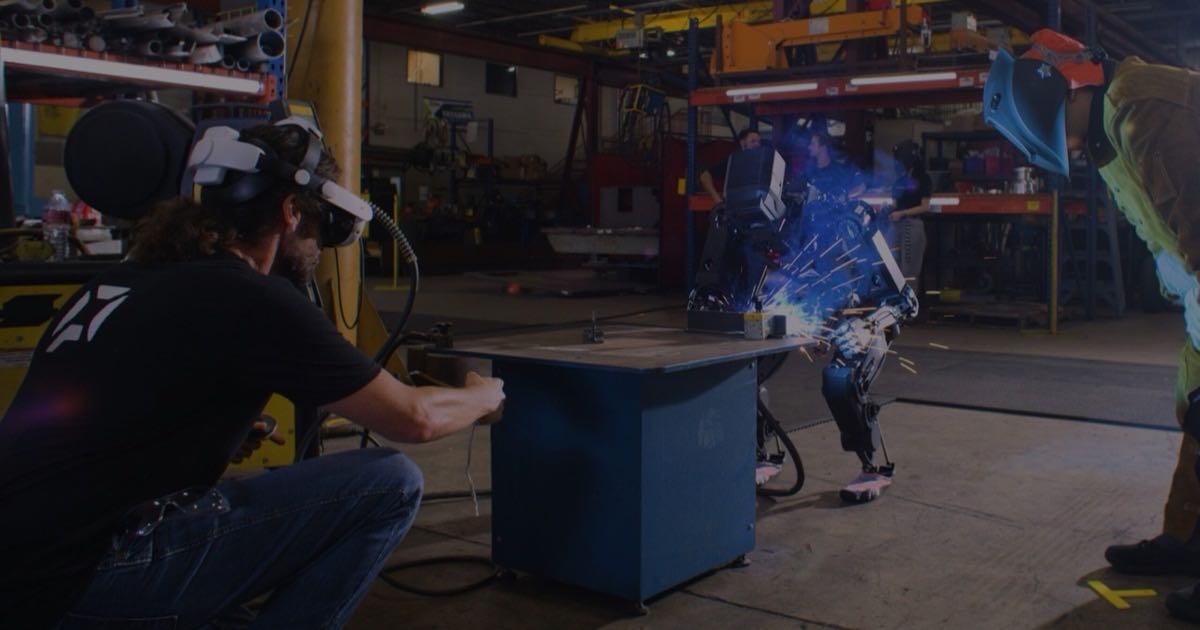
The Texas-based company, founded by former NASA and IHMC robotics leaders, has positioned its humanoid robot around a very specific task: welding long, linear seams on ships. It has public partnerships with HD Hyundai, the world’s largest shipbuilder, and POSCO, the third-largest steel producer globally. Both are in South Korea.
What is Persona AI? Founded in 2024 by Nic Radford and Jerry Pratt, Persona AI builds bipedal humanoid robots for heavy industry. Radford led NASA JSC’s Valkyrie robot program and founded Nauticus Robotics. Pratt led IHMC’s DARPA Robotics Challenge team and later served as CTO of Figure AI. The company’s modular platform uses interchangeable “Personas” — software and tool packages that let the robot adapt across industrial tasks.
Why Welding, Not Warehouses
The logic is economic. Most humanoid companies target unskilled labour — picking, sorting, carrying. Persona did not see viability there. “We started forming this thesis around skilled trades and tool usage,” Radford told IEEE Spectrum.
The welding process turns out to be robot-friendly in a way that box-moving is not. You can only weld as fast as metal melts, so the top speed is a manageable centimetre per second. Quality welding requires millimetre-scale repeated motions over long periods — exactly the kind of task where robots outperform humans, who get tired or bored. A single ship requires hundreds of kilometres of linear welds.
There is also a labour gap. Shipyard welding is highly paid, physically taxing skilled work with persistent shortages. Workforce attrition in key shipyard trades can exceed 30 per cent, according to industry data cited by Interesting Engineering.
Why Legs, Not Wheels
Shipyards are messy, open-air environments spanning hundreds of metres. Workers step over horizontal and vertical spars, duck through portholes, and weld at ground level, overhead, and in confined spaces. A wheeled robot would struggle. A bipedal one fits the existing workflow.
Persona considered other form factors — four legs, even more — but settled on two as the least disruptive to how shipyards already operate. The safety concern of a bipedal robot falling on a human worker is lessened in an environment where staff are already trained to work around heavy industrial equipment.
The Business Case: More Ships, Not Fewer Humans
Here is where Persona’s pitch diverges from the typical “robots replace workers” narrative. Radford says their partners are running at significant backlog and are labour-constrained. The argument is not that robots will reduce costs by replacing humans — it is that robots will allow more ships to be built.
“Even if our robot was more expensive than a human, that would still be valuable to these companies, because it could unlock additional revenue,” Radford said. The robot is additive capacity, not a cost-cutting measure.
Persona is interested in customers who can support hundreds of robots per location. A shipyard with 300 humanoid welders does not eliminate its human workforce — it adds output that the existing workforce cannot deliver alone.
”Not Thinking Big Enough”
Persona’s narrow focus has drawn criticism within the humanoid industry. “We’ve been told that we’re not thinking big enough,” Radford said. The prevailing model in humanoid robotics is general-purpose — a robot that can do anything, justified by undefined scale at an undefined future date.
Persona rejects that. Its approach is closer to how industrial robotics historically worked: pick one task, do it well, prove economic viability, then expand. Shipbuilding is what co-founder Pratt calls a “beachhead.” Adjacent skills — grinding, painting, other fabrication — can follow within the same environment.
This mirrors the trajectory of Unimation, the company that sold the first industrial robot in 1961. That robot also welded. The parallel is not lost on Persona’s founders.
The Competition Question
Persona is not the only company targeting industrial humanoids. Hyundai has set a 20,000-robot target across its operations. Walden Robotics partnered with Toyota on practical humanoids. Tesla has deployed over 1,000 Optimus units in its own factories.
What sets Persona apart is the refusal to chase the general-purpose dream. While others build demos for YouTube, Persona is collecting the tens of thousands of hours of expert demonstration data needed to make a welding robot reliable enough to bill for. The company is still in the proving phase — a prototype is targeted for late 2026, with field testing and commercial deployment in 2027.
Whether the narrow-first strategy works is the open question. But in an industry where most humanoids have demonstrated everything and sold nothing, a company with a concrete business case and signed partnerships with the world’s largest shipbuilder is worth watching.