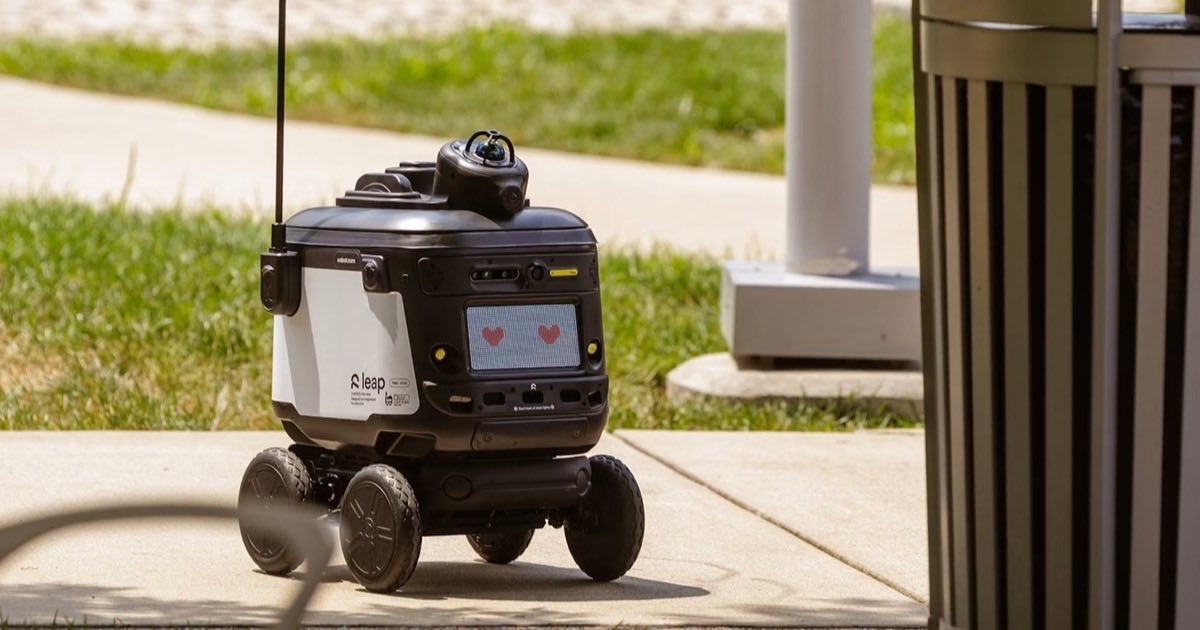
Zeus Robotics, a year-old Chattanooga startup, has announced a three-month pilot with Erlanger Hospital to deploy its ZERA autonomous logistics robot — the unit’s first deployment anywhere. ZERA’s job is unglamorous and exactly right for a machine: carrying lab samples like blood, swabs and biopsies between hospital departments, navigating hallways on its own and using a robotic arm to open doors and press elevator buttons. Site assessment work is already done, and CEO Vivek Thankachan says the robot goes live in mid-October.
🔍 THE BOTTOM LINE
The interesting part of this story isn’t the robot — it’s the threat model. ZERA requires a biometric scan tied to a specific employee every time someone loads or unloads it, never connects to hospital Wi-Fi or any telecom system, and never electronically stores patient information. That is a hardware-level answer to the question every hospital asks about robots touching regulated materials: what if someone gets into it?
What ZERA actually does
Hospital lab samples are exactly the kind of freight nobody wants a tired human carrying at 2am — and exactly the kind that can’t just be tossed on any old cart. According to the Chattanooga Times Free Press, ZERA will move blood, swab and biopsy samples from one area of the hospital to another autonomously, with the robotic arm handling doors and elevators along the way.
The three-month pilot’s goal, Thankachan said, is to assess how staff workflows improve with the unit in service. If it works, the expansion path is broader freight: documents, linens, other supplies, and eventually medication — the cargo where the security design really starts to matter. Zeus Robotics pitches itself as building “operational intelligence for healthcare logistics,” and this pilot is the company’s proof point.
The security design is the actual story
Hospital robots that haul stuff around corridors are not new — Aethon’s TUG robots have been trundling through US hospitals since the early 2000s. What’s notable about ZERA is how it handles the cargo problem. The unit requires biometric scans tied to individual employees both to open it and place something inside, and to open it again at the destination. And rather than plugging into the hospital’s network, it connects to nothing — no hospital Wi-Fi, no other telecommunications systems, and no electronic storage of patient information at all.
That’s a deliberate trade. An offline robot can’t be reached from the outside, but it also can’t be monitored or rerouted remotely the way fleet software usually works. Whether “dumber and sealed” beats “connected and monitored” is a design question the pilot will quietly answer — and hospitals watching from outside will read that answer closely, because the alternative designs all involve trusting the network they’re trying to keep locked down.
Not replacing workers, says the CEO
Thankachan was direct about the intent. “Clinicians shouldn’t be moving things around the hospital,” he said. “They are clinicians. They should be attending to patients.” He reiterated that the pilot isn’t aimed at replacing human workers — the pitch is that a robot doing hallway freight is one less interruption between a nurse and a patient.
Erlanger’s leadership framed the partnership the way hospitals usually do, in a written statement: “These partnerships help us bring new ideas, resources and energy to the care we provide, and we’re proud to be part of an environment in Chattanooga where innovation can thrive.”
It’s worth reading that alongside where else automation is landing. UPS is cutting 30,000 jobs while automation moves beyond tech, Agility’s humanoids are expanding across manufacturing deployments, and the scale questions are getting bigger — five million robots rebuilding a city in six months is no longer a purely hypothetical frame. Hospitals are a quieter corner of that wave, but a real one.
❓ FAQ
What is the ZERA robot? ZERA is an autonomous logistics robot built by Zeus Robotics, a Chattanooga startup. Per the Chattanooga Times Free Press, it transports lab samples around hospitals, navigates hallways on its own, and uses a robotic arm to open doors and use elevators.
When does the Erlanger pilot start? The company says site assessment work is already done and the robot will be deployed in mid-October 2026, starting a three-month pilot to assess how staff workflows can be improved.
Does ZERA replace hospital staff? The company says no. CEO Vivek Thankachan’s framing is that clinicians shouldn’t be spending their time moving things around the hospital — the robot takes the hallway freight so staff can attend to patients.
Are hospital robots new? Hospital courier robots have existed for years — Aethon’s TUG robots have hauled supplies through hospitals for two decades. ZERA’s distinguishing feature is its security model: biometric locks at both ends and zero connection to hospital networks.
🔍 THE BOTTOM LINE
If ZERA’s pilot works, the expansion path runs straight toward the sensitive cargo — documents, linens, medication. The bet underneath the hardware is that sealed, offline machines are how robots earn access to regulated hospital freight. Watch what “works” means after three months: workflow data, not press-release enthusiasm, is the number that decides whether more hospitals follow Erlanger.
📰 Sources
- Chattanooga Times Free Press
- Zeus Robotics
- Wikipedia