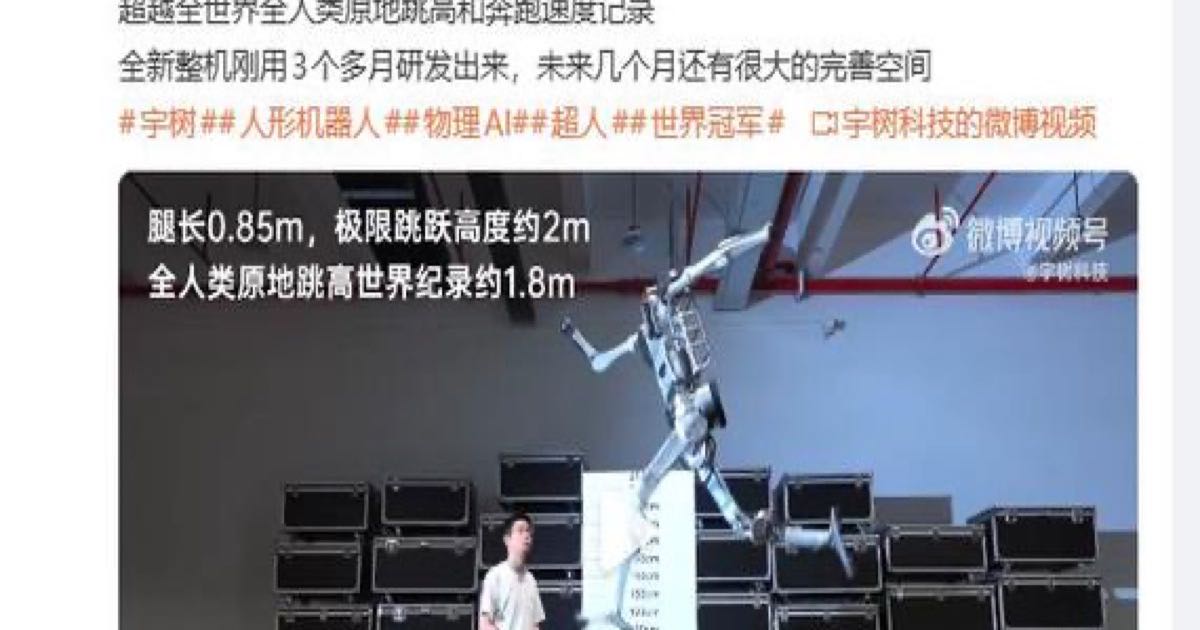
Unitree Robotics unveiled a humanoid robot on Monday that the company says can run at 12.66 metres per second and perform a two-metre standing high jump — claims that, if accurate, put the machine ahead of Usain Bolt’s peak sprint speed of 12.2 m/s during his 2009 world record.
The robot, called Superman, was developed in just over three months, according to Xinhua. Unitree says it remains a prototype with substantial room for optimisation, implying the numbers could get even more aggressive in the coming months.
A video posted to social media shows the robot performing both feats. The standing jump is the more visually arresting — a metal frame launching itself upward with a mechanical pop that looks nothing like a human jump but achieves the height. The sprint is recorded on what appears to be a test track.
What the Numbers Actually Mean
Usain Bolt’s peak speed was recorded during his 100-metre world record run in Berlin, 2009 — 12.27 m/s, or roughly 44.17 km/h. Superman’s claimed top speed of 12.66 m/s translates to 45.6 km/h with a leg length of 0.85 metres. The standing high jump of 2 metres exceeds the human world record of 1.65 metres set by Rwandan athlete Onesphore Ndayisenga in 2020.
These are lab conditions, not field deployments. A robot hitting 45 km/h on a test track is not the same as a robot navigating a warehouse floor or a construction site at that speed. But the rate of improvement is the story. At last year’s inaugural World Humanoid Robot Games, Unitree’s robots topped out at 4.78 m/s. In less than a year, the company has nearly tripled that figure.
The Timing Is Not Subtle
Superman’s unveiling comes three days before Unitree is set to begin trading on Shanghai’s STAR Market on Wednesday, August 20. The IPO raised 6.1 billion yuan ($904 million) at a valuation near 61 billion yuan — roughly $9 billion — with retail demand reportedly 5,526 times oversubscribed, a record for the board.
It also lands days before two major Beijing events: the World Robot Conference from August 19 to 23, and the second World Humanoid Robot Games from August 22 to 26. Unitree dominated last year’s games, winning four gold medals. The company is clearly aiming to set the narrative before the competition even starts.
Reuters reported that the Superman reveal was designed in part to generate buzz for the IPO. The company’s prospectus guides first-half 2026 revenue growth of 36 to 45 per cent — down from 333 per cent a year earlier — with adjusted net profit 6 to 22 per cent lower. The valuation, at roughly 219 times 2025 earnings, is built on the story more than the current trajectory.
The Geopolitical Backdrop
The FCC banned imports of new foreign-made humanoid robots last month, a move that directly targets Unitree. The Hangzhou-based company holds just under a fifth of global humanoid market share, according to Counterpoint Research, and was recently added to the Pentagon’s list of alleged Chinese military-backed companies.
Unitree has a partnership with Nvidia to use Blackwell chips in its robots’ AI brains. Nvidia says the data stays in the US and that Unitree’s biggest American customers are academic and research institutions. None of that will matter under the new FCC rules, which bar new robot models from the US market entirely.
So Unitree is doubling down on the market it can actually sell into. China has announced a state-backed venture capital fund targeting 1 trillion yuan ($148 billion) in public and private robotics investment over the next two decades. The US, by contrast, still lacks a national robotics strategy, as the Information Technology and Innovation Foundation noted in June.
A Second Robot You Probably Missed
Alongside Superman, Unitree also unveiled the As2W — a wheeled-leg quadruped designed for heavy loads. It carries up to 16 kilograms continuously, travels more than 30 kilometres unloaded, and reaches 6 m/s. The 25-kilogram machine has a maximum payload of 180 kilograms and is rated IP54 for dust and water resistance. Demonstrations showed it diving from platforms and walking through shallow water.
This is the kind of robot that could actually sell to industrial customers. Superman is a headline generator. The As2W is a workhorse. Both were announced the same day, but the Superman story dominated coverage — which was almost certainly the point.
What Stands Out
Three months from concept to a robot that outperforms human athletic records. That’s not a manufacturing milestone — Superman isn’t rolling off an assembly line. But it’s a signal about how fast the development cycle is compressing. The AGIBOT production milestone of 15,000 units was a scale story. This is a speed story.
The question for the sector is whether raw athletic performance translates into commercial utility. A robot that can run at 45 km/h but can’t reliably pick up objects in a warehouse is a marketing asset, not a product. Unitree’s existing H2 and G1 models are the ones generating revenue. Superman is the proof-of-concept that says the next generation won’t be constrained by the same physical limits.
For New Zealand, the implications are indirect but real. Unitree products are available to NZ buyers through AliExpress and direct channels. The FCC ban does not apply here. If humanoid robots drop in price and improve in capability at this rate, the question of whether NZ businesses adopt them becomes when, not whether.